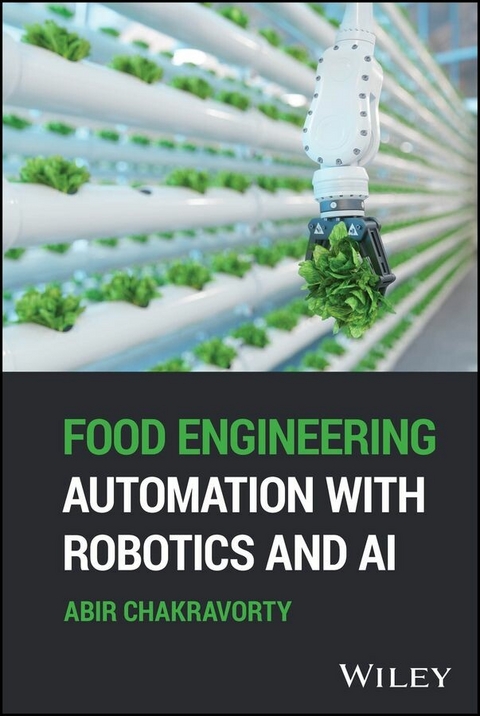
Food Engineering Automation with Robotics and AI (eBook)
782 Seiten
Wiley (Verlag)
978-1-394-31657-1 (ISBN)
Revolutionize food manufacturing with the latest in automating technology
Virtually every area of industry has been transformed by robotics and AI, which have automated production and increased efficiency in myriad ways. Until recently, food manufacturing was an exception to the trend. At present, however, the food manufacturing industry is in the process of a transformation which will see automation deliver the same levels of productivity and uniformity that have revolutionized other sectors of the economy.
Food Engineering Automation with Robotics and AI is a comprehensive introduction to the areas of intersection between cutting-edge technologies and food manufacturing. Beginning with an overview of the basic principles of food engineering, the book then details applications of robotics and AI in this field, along with the way automation is integrated at every stage of food production. The structure of the book seamlessly blends theory and practice to maximize reader capacity to put its lessons into motion.
Food Engineering Automation with Robotics and AI readers will also find:
- Content aligning with several UN Sustainable Development Goals, including Zero Hunger; Industry, Innovation, and Infrastructure; and Responsible Consumption and Production
- Real-world case studies throughout to show automating technologies revolutionizing food production
- A consistent focus on sustainable food engineering, with attention to resource conservation, waste reduction, environmental impact mitigation, and more
Food Engineering Automation with Robotics and AI is ideal for the growing, global market for food automation technologies in the coming years.
Abir Chakravorty, PhD, M.Tech, works in the field of automation, robotics, and food equipment machinery design in the Agricultural and Food Engineering Department, Indian Institute of Technology Kharagpur. He received his PhD from the Department of Mechanical Engineering, IIT Kharagpur. He has three patents filed, one granted, fifteen and more journals, and a book published in his name.
Revolutionize food manufacturing with the latest in automating technology Virtually every area of industry has been transformed by robotics and AI, which have automated production and increased efficiency in myriad ways. Until recently, food manufacturing was an exception to the trend. At present, however, the food manufacturing industry is in the process of a transformation which will see automation deliver the same levels of productivity and uniformity that have revolutionized other sectors of the economy. Food Engineering Automation with Robotics and AI is a comprehensive introduction to the areas of intersection between cutting-edge technologies and food manufacturing. Beginning with an overview of the basic principles of food engineering, the book then details applications of robotics and AI in this field, along with the way automation is integrated at every stage of food production. The structure of the book seamlessly blends theory and practice to maximize reader capacity to put its lessons into motion. Food Engineering Automation with Robotics and AI readers will also find: Content aligning with several UN Sustainable Development Goals, including Zero Hunger; Industry, Innovation, and Infrastructure; and Responsible Consumption and ProductionReal-world case studies throughout to show automating technologies revolutionizing food productionA consistent focus on sustainable food engineering, with attention to resource conservation, waste reduction, environmental impact mitigation, and more Food Engineering Automation with Robotics and AI is ideal for the growing, global market for food automation technologies in the coming years.
Chapter 1
Robotics and Automation in Food Processing, Developments Prompted by the Present Era Industrial Revolution
Abir Chakravorty
The first three industrial revolutions have indeed drastically changed the landscape of agriculture—from purely traditional farming to mechanized farming, and now, with the latest technological advances, to precision agriculture. Moving toward an industrial farming model has greatly increased productivity, but also brought on a wide range of problems that have gained strength over time. Industry 4.0 is on the threshold of revolutionizing agriculture once again, thus heralding the fourth agricultural revolution. It starts by discussing the current state of industrial agriculture and dwelling on the lessons learned from the patterns, processes, and supply chain of industrialized agricultural production. Next, we touch on five highly relevant emerging technologies that can help propel Agriculture 4.0 and beyond: IoT, robotics, AI, and big data analytics. We will focus on how these technologies are being used in the agricultural domain, and on various challenges in the research community. With this article, we hope to discover new research opportunities for the reader, especially from the academia as well as the industry side.
1.1 Abridgement of the Existing Obstacles and Opportunities Presented by the Present Era Industrial Revolution in the Food Processing Sector
The present-era of industrial technologies challenges and offers much in food processing. Below is a brief overview based on the insights from the section.
1.1.1 Current Challenges in Food Processing
- Lack of Digitization: There is a lack of digitization in the food processing sector, which effectively hinders the collection and analysis of data. The lack of digital infrastructure constrains automation and highly intelligent decision-making capabilities.
- Inefficient Agri-food Supply Chains: Agri-food supply chains are not even smartly managing their chains in terms of efficiency, which delays the delivery charges and all such waste-generating situations. This is one serious concern in food processing.
- Ecological and Health Issues: Industrial farming, based on monoculture and intensive livestock production, can give rise to ecological health issues, public health risks, and animal welfare problems. Unsustainable food production systems are behind such practice.
- Integration Problems: Data, element tracking, and poor problems of agricultural information systems. Such shallow integration limits the exploration of biological knowledge and makes multiscale analysis impossible.
1.1.2 Technologies in Agricultural Automation
- IoT: IoT technologies can help offer real-time tracking and management for food processing operations, as well as efficiency and productivity gains in the supply chain. It can track resources and processes inside the chain much better.
- Big Data Analytics: It simply involves examining large amounts of data collected from different sources that are helpful in making decisions. It enhances forecasting, quality control, and even operant performance in food processing.
- AI: This will be used in process improvement to make predictive outputs with auto-decision-making, thereby increasing the percentage value in food processing, meaning it will yield products of higher quality and less waste generation.
- Robotics: As long as robotics can help improve food automation on the processing fronts, it indeed makes speed and efficiency shorter for production lines. This also allows one to manage tasks that would otherwise be risky, or perhaps hazardous to people.
- Blockchain Technology: Blockchain can create transparency and traceability of the food supply chain through a guarantee that all foods sold are safe and quality products. It provides controlled data sharing between stakeholders, very vital for any food processing standards in proper implementation (Liu et al., 2020).
Figure 1.1 depicts the timeline for the agricultural and industrial revolutions. While this might be difficult, the food-processing industry may seem severely hindered by digitization and perceptions of inefficiencies in supply chains and ecologies, but Industry 4.0 would create a commonplace where these bottlenecks are removed, and the processes are productive and sustainable.
Figure 1.1 The application of robotics and autonomous systems in agriculture.
1.2 Adoption of Technology in Food Processing and Key Industry Technologies
1.2.1 Technologies in the Present Era Food Processing
Technologies of Industry 4.0 and 5.0 transform the food industry with better efficiency, sustainability, and product quality. Some key technologies and implications are listed below:
The role of AI and machine learning
AI and ML are used in predictive analytics, optimizing the production process, and enhancing decision-making.
These technologies aid in predicting demand, thereby reducing waste and improving product quality based on data-driven insights.
The devices in IoT enable real-time monitoring and controlling of equipment and processes for better control in the production process.
This technology enhances food safety because conditions are monitored across the supply chain. Immediate responses to any issues are made possible. Big data analytics processes large volumes of data created in the food industry through different origins.
It helps identify trends and enhances operational efficiency, thereby ensuring that products are tailored according to consumers’ wishes and therefore increase customer satisfaction. Blockchain technology ensures safety and transparency in tracking food products from the farm to the table.
This technology increases traceability, hence allowing safe food and confidence for consumers with this choice of credible information regarding origins. These smart sensors measure a number of parameters at the food processing stage, such as temperature, humidity, and quality. They ensure optimum conditions prevail, spoilage decreases, and, finally, product quality is assured at every step of the production cycle.
1.3 Definition of Robot and Its Various Classification
A robot is a programmable, electromechanical machine designed to perform tasks autonomously or semi-autonomously, often mimicking human or animal actions. Robots are equipped with sensors, actuators, and control systems, enabling them to interact with and adapt to their environment. Figure 1.2a represents the classification of robots; Figure 1.2b represents various types of joints between robotic links; Figure 1.2c represents various types of industrial robotic manipulator and the work volume; Figure 1.2d represents robot’s reach and degree of freedom for each category of joint.
Figure 1.2 Robots classification.
The various types of industrial robot classification are presented in Figures 1.2 and 1.3.
Figure 1.3 Industrial robot classification based on type of axes of motion and joints.
1.3.1 Automation and Its Various Types
Automation is the use of technology, machines, or systems to perform tasks or processes without direct human intervention. It involves a process in which functions are predetermined by guidelines or algorithms to follow, allowing for higher efficiency, accuracy, and consistency. Automation can be applied in any field—in manufacturing, data processing, transportation, and even everyday activities such as smart home management. The general objective is to minimize the need for manual labor, decrease human error, and maximize productivity. Figure 1.4 describes the types of automation.
Figure 1.4 Types of automation.
Robotics and Automation Role: There is an application of robotics to facilitate the automation of repetitive food processing, packaging, and logistics tasks. This, in turn, enhances productivity, decreases labor costs, and increases safety as human interference is limited in hazardous environments.
The industry robot classification is presented in Figure 1.3. Cyber-Physical Systems (CPS) and Digital Twins Role: CPS refers to the integration of the physical process with digital systems. This is further elaborated as digital twins that mimic real-world processes for analysis.
Impact: These technologies have upgraded the capability of food production systems for planning, monitoring, and optimization, which, in turn, leads to improved efficiency and reduced losses.
Challenge in Adopting TechnologySilo Mentality: Information is not shared among the members of this industry, which leads to a lack of collaboration and innovation.
Higher Installation Costs: The cost of installing these technologies is a limitation for small businesses.
Lack of Skills: The general lack of technical skills needed to implement and maintain these advanced technologies.
The challenges in the food domain and the solutions provided using data and AI are as shown in Figure 1.5. Industry 4.0 technologies in food processing, therefore, have the potential to significantly enhance sustainability and efficiency in the food industry. However, an effective response to the challenges associated with adoption is needed to bring about the intended change in the food industry. Continuous efforts at collaboration and investment in developing skills will be important in the implementation of successful Industry 4.0...
| Erscheint lt. Verlag | 16.9.2025 |
|---|---|
| Sprache | englisch |
| Themenwelt | Technik ► Elektrotechnik / Energietechnik |
| Technik ► Maschinenbau | |
| Schlagworte | 3D Printing • AI • Artificial Intelligence • automatic control of food storage temperature • food engineering • Food Packaging • Food Processing • Gripper • machine learning • odometry • PID Controller • robot • Robotics • robot kinematic • Scada |
| ISBN-10 | 1-394-31657-7 / 1394316577 |
| ISBN-13 | 978-1-394-31657-1 / 9781394316571 |
| Informationen gemäß Produktsicherheitsverordnung (GPSR) | |
| Haben Sie eine Frage zum Produkt? |
 EPUB (Adobe DRM)
Kopierschutz: Adobe-DRM
Adobe-DRM ist ein Kopierschutz, der das eBook vor Mißbrauch schützen soll. Dabei wird das eBook bereits beim Download auf Ihre persönliche Adobe-ID autorisiert. Lesen können Sie das eBook dann nur auf den Geräten, welche ebenfalls auf Ihre Adobe-ID registriert sind.
Details zum Adobe-DRM
Dateiformat: EPUB (Electronic Publication)
EPUB ist ein offener Standard für eBooks und eignet sich besonders zur Darstellung von Belletristik und Sachbüchern. Der Fließtext wird dynamisch an die Display- und Schriftgröße angepasst. Auch für mobile Lesegeräte ist EPUB daher gut geeignet.
Systemvoraussetzungen:
PC/Mac: Mit einem PC oder Mac können Sie dieses eBook lesen. Sie benötigen eine
eReader: Dieses eBook kann mit (fast) allen eBook-Readern gelesen werden. Mit dem amazon-Kindle ist es aber nicht kompatibel.
Smartphone/Tablet: Egal ob Apple oder Android, dieses eBook können Sie lesen. Sie benötigen eine
Geräteliste und zusätzliche Hinweise
Buying eBooks from abroad
For tax law reasons we can sell eBooks just within Germany and Switzerland. Regrettably we cannot fulfill eBook-orders from other countries.
aus dem Bereich