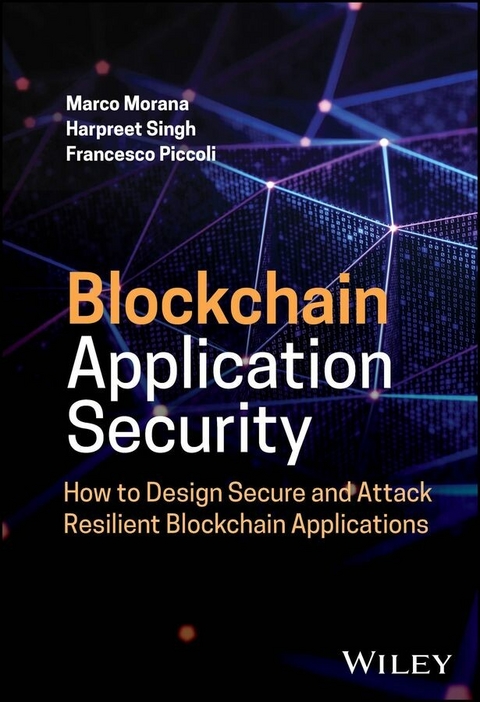
Blockchain Application Security (eBook)
1027 Seiten
Wiley (Verlag)
978-1-119-55107-2 (ISBN)
Learn to secure, design, implement, and test tomorrow's blockchain applications.
Blockchain Application Security guides readers through the architecture and components of blockchain, including protocols such as Bitcoin and beyond, by offering a technical yet accessible introduction. This resource is ideal for application architects, software developers, security auditors, and vulnerability testers working on enterprise blockchain solutions. It bridges the gap between theory and implementation, providing actionable guidance on protecting decentralized systems while capitalizing on their innovative benefits.
Blockchain Application Security covers the essentials, from the fundamentals of distributed ledgers, consensus algorithms, digital wallets, smart contracts, privacy controls, and DIDs, to designing secure dApp architectures with component-level threat analysis and resilient APIs, token transactions, digital exchanges, and identity models. It features a complete lifecycle example for securing a DeFi lending and borrowing platform, along with practical walkthroughs for smart contract development, AWS-integrated blockchain systems, frontend/API integration, and code auditing.
'An accessible, comprehensive blockchain overview that emphasizes its value across industrial and government sectors with a holistic security focus.'
-David W. Kravitz, Technical Advisor, Spring Labs
'A cutting-edge method for securing blockchain applications, pushing the boundaries of current practice.'
-David Cervigni, Senior Security Research Engineer at R3
'Bridging theory and practice with realistic examples, this guide empowers architects and developers to build attack-resistant applications.'
-Steven Wierckx, Product Security Team Lead & Threatmodel Trainer at Toreon
'A valuable resource for blockchain specialists, featuring hands-on examples of deploying dApps on AWS and securing infrastructure.'
-Ihor Sasovets, Lead Security Engineer, Penetration Tester at TechMagic
'A practical roadmap for navigating blockchain security that we recommend to clients and incorporate into our training.'
-Vijay Dhanasekaran, Founder & Chief Blockchain Officer, Consultant at Blocknetics
'An indispensable resource for dApp developers, guiding readers from fundamentals to advanced implementation with in-depth vulnerability analysis.'
-Mohd Mehdi, Head of DevOps, DevSecOps and Infrastructure at InfStones
Marco Morana, PhD, works as SVP at a large financial institution in London, where he's responsible for the architecture risk analysis program. In his distinguished 15+ year career in application security, Morana held roles in different companies as security consultant, application security architect, professional trainer and program manager. As cybersecurity technologist, Morana's most important contribution to cybersecurity is the invention of the first secure email plug-in using the S/MIME protocol that was patented for NASA in 1996.
Learn to secure, design, implement, and test tomorrow s blockchain applications. Blockchain Application Security guides readers through the architecture and components of blockchain, including protocols such as Bitcoin and beyond, by offering a technical yet accessible introduction. This resource is ideal for application architects, software developers, security auditors, and vulnerability testers working on enterprise blockchain solutions. It bridges the gap between theory and implementation, providing actionable guidance on protecting decentralized systems while capitalizing on their innovative benefits. Blockchain Application Security covers the essentials, from the fundamentals of distributed ledgers, consensus algorithms, digital wallets, smart contracts, privacy controls, and DIDs, to designing secure dApp architectures with component-level threat analysis and resilient APIs, token transactions, digital exchanges, and identity models. It features a complete lifecycle example for securing a DeFi lending and borrowing platform, along with practical walkthroughs for smart contract development, AWS-integrated blockchain systems, frontend/API integration, and code auditing. An accessible, comprehensive blockchain overview that emphasizes its value across industrial and government sectors with a holistic security focus. David W. Kravitz, Technical Advisor, Spring Labs A cutting-edge method for securing blockchain applications, pushing the boundaries of current practice. David Cervigni, Senior Security Research Engineer at R3 Bridging theory and practice with realistic examples, this guide empowers architects and developers to build attack-resistant applications. Steven Wierckx, Product Security Team Lead & Threatmodel Trainer at Toreon A valuable resource for blockchain specialists, featuring hands-on examples of deploying dApps on AWS and securing infrastructure. Ihor Sasovets, Lead Security Engineer, Penetration Tester at TechMagic A practical roadmap for navigating blockchain security that we recommend to clients and incorporate into our training. Vijay Dhanasekaran, Founder & Chief Blockchain Officer, Consultant at Blocknetics An indispensable resource for dApp developers, guiding readers from fundamentals to advanced implementation with in-depth vulnerability analysis. Mohd Mehdi, Head of DevOps, DevSecOps and Infrastructure at InfStones
Preface
Blockchain technology has evolved significantly over the past decade, reshaping the way we think about trust, security, and decentralization. I wrote this book to share the lessons I have learned from my early experiments with blockchain security, dating back to 2015. At the time, I was a Senior Application Security Architect at one of the largest financial institutions in the United States, where I was responsible for conducting security reviews of blockchain-based projects. These initiatives were undertaken in collaboration with start-ups developing blockchain technology and banking consortia exploring its potential applications.
With any emerging technology comes both innovation and risk. While blockchain has introduced new capabilities that disrupt traditional business processes, it also presents novel security challenges that organizations must navigate to ensure safe and effective adoption. One of the primary concerns remains the integration of blockchain with legacy systems, a complex but necessary requirement for broader enterprise adoption. Despite the growing enthusiasm around blockchain, real-world implementations must undergo rigorous security assessments to address vulnerabilities and operational risks.
Like all digital innovations, blockchain is not immune to security threats. A well-known example from its early days was the 2016 DAO attack, where a decentralized autonomous organization built on Ethereum was exploited due to multiple security flaws, resulting in a loss of approximately $50 million. This incident highlighted the critical need for proactive security measures in blockchain development, particularly for decentralized applications (dApps) and smart contracts.
In the early stages of private and permissioned blockchains, security assessments were often limited to checklist-based reviews, lacking the depth required to address blockchain-specific risks. The absence of standardized methodologies made it difficult to conduct architecture risk analysis and threat modeling, leaving significant gaps in security assurance. Over time, I observed the growing need for structured security frameworks to guide the secure design, development, and deployment of blockchain applications.
Fast forward to today, blockchain technology has transitioned from being an experimental innovation in financial services to becoming a mainstream platform for Web3.0 applications, including decentralized finance (DeFi), supply chain solutions, and digital identity management. The ecosystem has matured, equipping developers with advanced tools and frameworks to build dApps that integrate with blockchain platforms efficiently. However, this progress has also expanded the attack surface, making security a paramount concern.
This book began as a project in 2018 with the goal of educating readers about the fundamentals of blockchain technology, its use cases, and security considerations for private and permissioned enterprise-grade blockchain platforms. Over time, the scope broadened to address the security challenges of dApps, offering insights into how developers, security professionals, and business leaders can design, build, and secure blockchain-based solutions.
Who Should Read This Book?
This book is designed for stakeholders managing the security risks of dApps and blockchain-based products. Whether you are an architect, engineer, security leader, or business executive, this book provides insights tailored to your role:
- Security architects will gain a comprehensive understanding of designing secure dApps from the ground up. They will learn how to embed security into architecture, design patterns, and APIs, ensuring blockchain applications are resilient against attacks.
- Software security engineers will find practical guidance on securing dApp implementations, identifying vulnerabilities, and testing blockchain applications for security flaws. This book also covers threat modeling, DevSecOps integration, and secure coding practices for smart contracts.
- CISOs and product security business owners will benefit from governance, compliance, and risk management perspectives. This book provides strategies for security oversight, ensuring compliance with regulatory standards and best practices for blockchain security assurance.
How to Navigate This Book?
Should this book be read from beginning to end? That depends on the reader. While the chapters build upon one another, making sequential reading beneficial especially for those new to blockchain security, the content is structured to allow readers to focus on topics most relevant to their roles.
For security architects, Chapter 2 is the core section, covering dApp architectures, security requirements, and security by design principles. This chapter provides a detailed breakdown of securing APIs, protecting secrets, and implementing secure smart contracts. Chapter 3 is also essential, as it provides a comprehensive approach to securing blockchain applications by focusing on vulnerability prevention, threat modeling, and security testing. It introduces structured methodologies to identify, analyze, and mitigate risks in dApps, particularly within DeFi ecosystems. One of the key highlights of this chapter is the dApp DeFi threat modeling use case, providing a practical, step-by-step guide for security architects and engineers. It outlines how to identify attack vectors, assess design flaws, and implement risk mitigation strategies early in development. This structured approach ensures dApps are secure by design, implementation, and testing, rather than addressing security issues postdeployment. Chapter 4 offers practical insights on dApp creation, auditing methodologies, and security implementation strategies.
For software security engineers, the primary focus should be on Chapter 2, which covers API security, key management, and smart contract security best practices. This chapter provides essential insights into securing dApp components, ensuring that authentication, data protection, and cryptographic key handling are implemented securely. Chapter 3 offers an in-depth exploration of smart contract vulnerabilities, detailing common attack vectors such as reentrancy, integer overflows, and logic flaws. It also introduces threat modeling methodologies, helping engineers systematically identify and mitigate risks before deployment. Additionally, this chapter discusses DevSecOps security tooling, highlighting automated vulnerability scanning, continuous security integration, and security validation techniques that can be embedded into the development pipeline.
Chapter 4 is particularly valuable, offering hands-on guidance on smart contract audits, security testing methodologies, and practical implementation strategies. It provides real-world examples of securing dApps, focusing on code auditing, penetration testing, and best practices for secure deployment. This chapter also covers attack simulation exercises, allowing engineers to test security assumptions and refine their defenses against emerging threats in blockchain applications.
For CISOs and heads of product security, Chapter 1 is critical as it establishes the legal, regulatory, and risk considerations associated with blockchain applications. This chapter explores the compliance landscape, including data privacy laws, financial regulations, and jurisdictional challenges, helping organizations align blockchain adoption with corporate risk management strategies.
Chapter 3 is indispensable, providing a deep dive into security incidents, compliance audits, and risk management methodologies for dApps and blockchain platforms. It covers real-world case studies of blockchain security breaches, analyzing attack techniques, lessons learned, and strategic mitigation measures. Additionally, this chapter outlines frameworks for security audits, industry compliance standards, and enterprise-wide blockchain security governance. The risk assessment methodologies presented here help prioritize threats, implement proactive defenses, and establish incident response strategies tailored to blockchain ecosystems.
While Chapter 4 is primarily technical, it is still relevant for CISOs and heads of product security who need a high-level understanding of secure code audits. This chapter provides insights into what security code reviews should focus on, key risk areas in blockchain applications, and the types of vulnerabilities auditors typically uncover. It helps security leaders evaluate and oversee secure coding practices, ensuring that blockchain development teams implement proper security controls.
The appendices, including the Risk Analysis Report, the Risk Mitigation Plan, and the Threat Risk Register, provide examples to support informed, risk-based decisions for managing dApp DeFI technical and business risks. These resources help document security measures, establish risk mitigation strategies, and ensure compliance with regulatory requirements.
By leveraging these chapters, CISOs and heads of product security can build a structured approach to blockchain security governance, compliance oversight, and risk management, while gaining a better understanding of secure code auditing processes.
Final Thoughts
Blockchain technology continues to evolve and disrupt multiple industries, but its success depends on how well we secure and manage its risks. The intent of this book is to provide actionable guidance, real-world examples, and best practices for securing blockchain applications – whether they are enterprise-grade permissioned platforms or dApps in Web3 and DeFi.
As security professionals, engineers,...
| Erscheint lt. Verlag | 15.9.2025 |
|---|---|
| Sprache | englisch |
| Themenwelt | Technik ► Elektrotechnik / Energietechnik |
| Technik ► Nachrichtentechnik | |
| Schlagworte | blockchain APIs • Blockchain security and compliance • Blockchain vulnerability assessments • cryptocurrencies • cryptography • Decentralized Applications (dApps) • Distributed Ledger Technology (DLT) • Enterprise blockchain applications • Public key cryptography in blockchain • Smart Contracts • tokenized digital assets • Vulnerabilities |
| ISBN-10 | 1-119-55107-2 / 1119551072 |
| ISBN-13 | 978-1-119-55107-2 / 9781119551072 |
| Informationen gemäß Produktsicherheitsverordnung (GPSR) | |
| Haben Sie eine Frage zum Produkt? |
 EPUB (Adobe DRM)
Kopierschutz: Adobe-DRM
Adobe-DRM ist ein Kopierschutz, der das eBook vor Mißbrauch schützen soll. Dabei wird das eBook bereits beim Download auf Ihre persönliche Adobe-ID autorisiert. Lesen können Sie das eBook dann nur auf den Geräten, welche ebenfalls auf Ihre Adobe-ID registriert sind.
Details zum Adobe-DRM
Dateiformat: EPUB (Electronic Publication)
EPUB ist ein offener Standard für eBooks und eignet sich besonders zur Darstellung von Belletristik und Sachbüchern. Der Fließtext wird dynamisch an die Display- und Schriftgröße angepasst. Auch für mobile Lesegeräte ist EPUB daher gut geeignet.
Systemvoraussetzungen:
PC/Mac: Mit einem PC oder Mac können Sie dieses eBook lesen. Sie benötigen eine
eReader: Dieses eBook kann mit (fast) allen eBook-Readern gelesen werden. Mit dem amazon-Kindle ist es aber nicht kompatibel.
Smartphone/Tablet: Egal ob Apple oder Android, dieses eBook können Sie lesen. Sie benötigen eine
Geräteliste und zusätzliche Hinweise
Buying eBooks from abroad
For tax law reasons we can sell eBooks just within Germany and Switzerland. Regrettably we cannot fulfill eBook-orders from other countries.
aus dem Bereich