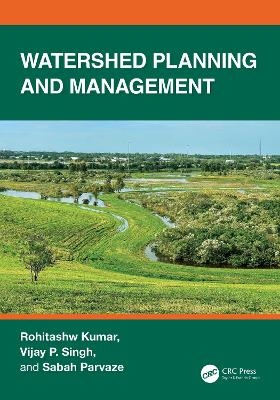
Watershed Planning and Management
CRC Press (Verlag)
978-1-041-22880-6 (ISBN)
- Noch nicht erschienen (ca. Mai 2026)
- Versandkostenfrei
- Auch auf Rechnung
- Artikel merken
Explains watershed concepts from basic hydrology to advanced applications in planning, management, and policy concept designed for optimizing crop yields, and reaping economic and environmental benefits.
Focuses on sustainable development and aligns watershed management with environmental conservation, climate resilience, and sustainable agriculture.
Explains methods of watershed prioritization, erosion modeling, hydrological budget analysis, and water yield assessment.
Includes practical real-world examples to present insights of watershed planning and management for climate change mitigation.
Dr. Rohitashw Kumar (B.E., M.E., Ph. D.) is Associate Dean and Professor in College of Agricultural Engineering and Technology, Sher-e-Kashmir University of Agricultural Sciences and Technology of Kashmir, Srinagar, India. He worked as Professor Water Chair (Sheikkul Alam ShiekhNuruddin Water Chair), Ministry of Jal Shakti, Government of India, at the National Institute of Technology, Srinagar (J&K). He is also Professor and Head, Division of Irrigation and Drainage Engineering. He obtained his Ph.D. degree in Water Resources Engineering from NIT, Hamirpur, and Master of Engineering Degree in Irrigation Water Management Engineering from MPUAT, Udaipur. He got, Gold medal award-2022, leadership award in 2020, Special Research award in 2017 and Student Incentive Award-2015 (Ph.D. Research) from the Soil Conservation Society of India, New Delhi. He also got the first prize in India for best M. Tech thesis in Agricultural Engineering in 2001. He has published over 160 papers in peer-reviewed journals, more than 30 popular articles, 11 books, 6 practical manuals, and 40 book chapters. He has guided four Ph. D students and 19 M. Tech in soil and water engineering. He has handled more than 18 research projects as a principal or co-principal investigator. Since 2011, he has been Principal Investigator of ICAR- All India Coordinated Research Project on Plastic Engineering in Agriculture Structural and Environment Management. Prof. Vijay P. Singhis a Distinguished Professor, a Regents Professor, and the inaugural holder of the Caroline and William N. Lehrer Distinguished Chair in Water Engineering at the Texas A&M University. His research interests include surface-water hydrology, groundwater hydrology, hydraulics, irrigation engineering, environmental quality, water resources, water-food-energy nexus, climate change impacts, entropy theory, copula theory, and mathematical modeling. He graduated with a B.Sc. in Engineering and Technology with emphasis on Soil and Water Conservation Engineering in 1967 from the U.P. Agricultural University, India. He earned an MS in Engineering with specialization in Hydrology in 1970 from the University of Guelph, Canada; a Ph.D. in Civil Engineering with specialization in Hydrology and Water Resources in 1974fromthe Colorado State University, Fort Collins, USA, and a D.Sc. in Environmental and Water Resources Engineering in 1998 from the University of the Witwatersrand, Johannesburg, South Africa. He has published extensively on a wide range of topics. His publications include more than 1365 journal articles, 32 books, 80 edited books, 305 book chapters, and 315 conference proceedings papers. For his seminar contributions he has received more than 100 national and international awards, including three honorary doctorates. Currently he serves as Past President of the American Academy of Water Resources Engineers, the American Society of Civil Engineers (ASCE), and previously he served as President of the American Institute of Hydrology and Cahir, Watershed Council, ASCE. He is Editor-in-Chief of two book series, three journals, and serves on the editorial boards of more than 25 journals. He has served as Editor-in-Chief of three other journals. He is a Distinguished Member of the American Society of Civil Engineers, an Honorary Member of the American Water Resources Association, an Honorary Member of International Water Resource Association, and a Distinguished Fellow of the Association of Global Groundwater Scientists. He is a fellow of five professional societies. He is also a fellow or member of 11 national or international engineering or science academies. Dr. Sabah Parvaze is serving as Assistant Professor-cum-Junior Scientist in the Division of Irrigation and Drainage Engineering, College of Agricultural Engineering and Technology, SKUAST-Kashmir. She holds a B.Tech. in Agricultural Engineering (SKUAST-Kashmir, 2014, Gold Medalist), an M.Tech. in Hydrology (IIT Roorkee, 2016, Gold Medalist and Kathpalia Awardee), and a Ph.D. in Soil and Water Engineering (SKUAST-Kashmir, 2021, Gold Medalist). She is specializes in flood forecasting, hydrological and hydraulic modeling, drought assessment, water quality management, and AI-based applications in agriculture and water resources. Her doctoral research focused on developing a real-time flood forecasting system for the Jhelum Basin using advanced hydrological models. She has professional experience as a Senior Water Resources Engineer at RMSI Pvt. Ltd., where she integrated AI, GIS, and hydrological models for flood risk, drought resilience, and water distribution. Currently, Dr. Parvaze has made significant contributions to sustainable mountain development, particularly in the Himalayan region, by modeling glacial-fed river systems, assessing climate change impacts, and developing decision support systems for climate-resilient water resource planning. She has been actively engaged in capacity-building programs, workshops, and field-level interventions to promote climate-smart agriculture and water management in fragile mountain ecosystems Her academic contributions include 25+ research publications, technical reports, and project proposals. She has received numerous awards, including: Gold Medals for securing the highest OGPA in B.Tech., M.Tech., and Ph.D. programs, Kathpalia Award for the best M.Tech dissertation in Environmental Engineering.
Acknowledgements
Summary
Preface
About the Authors
Chapter 1 Introduction
Chapter 2. Watershed-Concepts and Definitions
Chapter 3. Watershed Delineation and Prioritization
Chapter 4. Classification and Codification of Watersheds
Chapter 5. Watershed Characteristics
Chapter 6. Data Acquisition, Archiving, Storage and Retrieval
Chapter 7. Watershed Analysis
Chapter 8. Watershed Management
Chapter 9. Problems and Prospects in Watershed Management
Chapter 10. Integrated Watershed Management
Chapter 11. Water Budgeting in Watersheds
Chapter 12. Soil Erosion and Control
Chapter 13 Watershed Planning
Chapter 14. Land Capability Classification
Chapter 15 Land Use Planning
Chapter 16. Watershed Development Projects
Chapter 17. People’s Participation in Watershed Management
Chapter 18. Dryland Farming and Watershed Management
Chapter 19. Monitoring and Evaluation of Watershed Projects
Chapter 20. Water Yield Assessment and Measurement
Chapter 21. Remote Sensing and GHIS Uses in Watershed Modelling
Chapter 22 Current Watershed Management Practice and Programs
| Erscheint lt. Verlag | 20.5.2026 |
|---|---|
| Zusatzinfo | 39 Tables, black and white; 115 Line drawings, black and white; 16 Halftones, black and white; 131 Illustrations, black and white |
| Verlagsort | London |
| Sprache | englisch |
| Maße | 178 x 254 mm |
| Themenwelt | Naturwissenschaften ► Geowissenschaften ► Hydrologie / Ozeanografie |
| Technik ► Bauwesen | |
| Technik ► Umwelttechnik / Biotechnologie | |
| ISBN-10 | 1-041-22880-5 / 1041228805 |
| ISBN-13 | 978-1-041-22880-6 / 9781041228806 |
| Zustand | Neuware |
| Informationen gemäß Produktsicherheitsverordnung (GPSR) | |
| Haben Sie eine Frage zum Produkt? |
aus dem Bereich