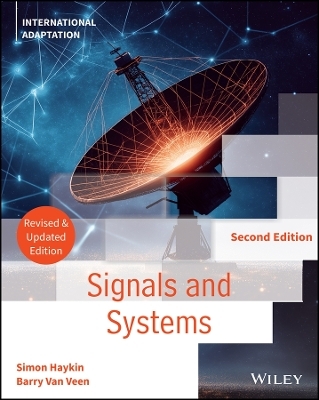
Signals and Systems, International Adaptation, Revised and Updated
John Wiley & Sons Inc (Verlag)
978-1-394-41575-5 (ISBN)
- Noch nicht erschienen (ca. Februar 2026)
- Versandkostenfrei
- Auch auf Rechnung
- Artikel merken
This International Adaptation offers expanded content with additional examples and exercises, and features a reorganized structure in selected chapters to better support diverse learning needs and improve course alignment.
Simon Haykin, PhD, is University Professor and Director of the Adaptive Systems Laboratory at McMaster University. Barry Van Veen, University of Wisconsin.
Preface vii
Notation xvii
Chapter 1 Introduction 1
1.1 What Is a Signal? 1
1.2 Classification of Signals 2
1.3 Basic Operations on Signals 11
1.4 Elementary Signals 19
1.5 What Is a System? 38
1.6 Overview of Specific Systems 39
1.7 Systems Viewed as Interconnections of Operations 52
1.8 Properties of Systems 54
1.9 Noise 68
1.10 Theme Examples 71
1.11 Exploring Concepts with MATLAB 80
1.12 Summary 86
Further Reading 87
Additional Problems 88
Advanced Problems 94
Computer Experiments 97
Chapter 2 Time-Domain Representations of Linear Time-Invariant Systems 99
2.1 Introduction 99
2.2 The Convolution Sum 100
2.3 Convolution Sum Evaluation Procedure 104
2.4 The Convolution Integral 118
2.5 Convolution Integral Evaluation Procedure 120
2.6 Interconnections of LTI Systems 132
2.7 Relations Between LTI System Properties and the Impulse Response 138
2.8 Step Response 144
2.9 Differential and Difference Equation Representations of LTI Systems 146
2.10 Solving Differential and Difference Equations 153
2.11 Characteristics of Systems Described by Differential and Difference Equations 163
2.12 Block Diagram Representations 169
2.13 State-Variable Descriptions of LTI Systems 174
2.14 Exploring Concepts with MATLAB 184
2.15 Summary 190
Further Reading 191
Additional Problems 192
Advanced Problems 201
Computer Experiments 203
Chapter 3 Fourier Representations of Signals and Linear Time-Invariant Systems 205
3.1 Introduction 205
3.2 Complex Sinusoids and Frequency Response of LTI Systems 206
3.3 Fourier Representations for Four Classes of Signals 209
3.4 Discrete-Time Periodic Signals: The Discrete-Time Fourier Series 212
3.5 Continuous-Time Periodic Signals: The Fourier Series 225
3.6 Discrete-Time Nonperiodic Signals: The Discrete-Time Fourier Transform 241
3.7 Continuous-Time Nonperiodic Signals: The Fourier Transform 252
3.8 Properties of Fourier Representations 265
3.9 Finding Inverse Fourier Transforms by Using Partial-Fraction Expansions 311
3.10 Parseval Relationships 317
3.11 Time−Bandwidth Product 319
3.12 Duality 321
3.13 Exploring Concepts with MATLAB 327
3.14 Summary 335
Further Reading 336
Additional Problems 337
Advanced Problems 348
Computer Experiments 353
Chapter 4 Applications of Fourier Representations to Mixed Signal Classes 357
4.1 Introduction 357
4.2 Fourier Transform Representations of Periodic Signals 358
4.3 Convolution and Multiplication with Mixtures of Periodic and Nonperiodic Signals 364
4.4 Fourier Transform Representation of Discrete-Time Signals 375
4.5 Sampling 379
4.6 Reconstruction of Continuous-Time Signals from Samples 388
4.7 Discrete-Time Processing of Continuous-Time Signals 400
4.8 Fourier Series Representations of Finite-Duration Nonperiodic Signals 407
4.9 The Discrete-Time Fourier Series Approximation to the Fourier Transform 414
4.10 Efficient Algorithms for Evaluating the DTFS 422
4.11 Exploring Concepts with MATLAB 426
4.12 Summary 429
Further Reading 430
Additional Problems 431
Advanced Problems 436
Computer Experiments 440
Chapter 5 The Laplace Transform 443
5.1 Introduction 443
5.2 The Laplace Transform 443
5.3 The Unilateral Laplace Transform 451
5.4 Properties of the Unilateral Laplace Transform 452
5.5 Inversion of the Unilateral Laplace Transform 457
5.6 Solving Differential Equations with Initial Conditions 462
5.7 Laplace Transform Methods in Circuit Analysis 467
5.8 Properties of the Bilateral Laplace Transform 470
5.9 Properties of the Region of Convergence 473
5.10 Inversion of the Bilateral Laplace Transform 477
5.11 The Transfer Function 481
5.12 Causality and Stability 484
5.13 Determining the Frequency Response from Poles and Zeros 489
5.14 Exploring Concepts with MATLAB 502
5.15 Summary 505
Further Reading 507
Additional Problems 507
Advanced Problems 511
Computer Experiments 513
Chapter 6 The z-Transform 515
6.1 Introduction 515
6.2 The z-Transform 515
6.3 Properties of the Region of Convergence 524
6.4 Properties of the z-Transform 529
6.5 Inversion of the z-Transform 535
6.6 The Transfer Function 543
6.7 Causality and Stability 547
6.8 Determining the Frequency Response from Poles and Zeros 553
6.9 Computational Structures for Implementing Discrete-Time LTI Systems 559
6.10 The Unilateral z-Transform 562
6.11 Exploring Concepts with MATLAB 568
6.12 Summary 571
Further Reading 572
Additional Problems 572
Advanced Problems 576
Computer Experiments 579
Chapter 7 Application to Communication Systems 581
7.1 Introduction 581
7.2 Types of Modulation 581
7.3 Benefits of Modulation 585
7.4 Full Amplitude Modulation 587
7.5 Double Sideband-Suppressed Carrier Modulation 596
7.6 Quadrature-Carrier Multiplexing 601
7.7 Other Variants of Amplitude Modulation 602
7.8 Pulse-Amplitude Modulation 607
7.9 Multiplexing 611
7.10 Phase and Group Delays 616
7.11 Exploring Concepts with MATLAB 620
7.12 Summary 630
Further Reading 631
Additional Problems 632
Advanced Problems 635
Computer Experiments 637
Chapter 8 Application to Filters and Equalizers 639
8.1 Introduction 639
8.2 Conditions for Distortionless Transmission 639
8.3 Ideal Low-Pass Filters 642
8.4 Design of Filters 648
8.5 Approximating Functions 649
8.6 Frequency Transformations 656
8.7 Passive Filters 658
8.8 Digital Filters 659
8.9 FIR Digital Filters 661
8.10 IIR Digital Filters 670
8.11 Linear Distortion 675
8.12 Equalization 676
8.13 Exploring Concepts with MATLAB 680
8.14 Summary 685
Further Reading 685
Additional Problems 686
Advanced Problems 688
Computer Experiments 689
Chapter 9 Application to Linear Feedback Systems 691
9.1 Introduction 691
9.2 What Is Feedback? 691
9.3 Basic Feedback Concepts 693
9.4 Sensitivity Analysis 696
9.5 Effect of Feedback on Disturbance or Noise 698
9.6 Distortion Analysis 699
9.7 Summarizing Remarks on Feedback 701
9.8 Operational Amplifiers 701
9.9 Control Systems 707
9.10 Transient Response of Low-Order Systems 710
9.11 The Stability Problem 713
9.12 Routh–Hurwitz Criterion 717
9.13 Root Locus Method 721
9.14 Nyquist Stability Criterion 730
9.15 Bode Diagram 736
9.16 Sampled-Data Systems 741
9.17 Exploring Concepts with MATLAB 751
9.18 Summary 755
Further Reading 756
Additional Problems 757
Advanced Problems 760
Computer Experiments 765
Chapter 10 Epilogue 769
10.1 Introduction 769
10.2 Speech Signals: An Example of Nonstationarity 770
10.3 Time–Frequency Analysis 771
10.4 Nonlinear Systems 782
10.5 Adaptive Filters 789
10.6 Concluding Remarks 792
Further Reading 792
Appendix A Selected Mathematical Identities 795
A. 1 Trigonometry 795
A. 2 Complex Numbers 796
A. 3 Geometric Series 797
A. 4 Definite Integrals 797
A. 5 Matrices 798
Appendix B Partial-Fraction Expansions 800
B. 1 Partial-Fraction Expansions of Continuous-Time Representations 800
B. 2 Partial-Fraction Expansions of Discrete-Time Representation 803
Appendix C Tables of Fourier Representations and Properties 806
C. 1 Basic Discrete-Time Fourier Series Pairs 806
C. 2 Basic Fourier Series Pairs 807
C. 3 Basic Discrete-Time Fourier Transform Pairs 807
C. 4 Basic Fourier Transform Pairs 808
C. 5 Fourier Transform Pairs for Periodic Signals 808
C. 6 Discrete-Time Fourier Transform Pairs for Periodic Signals 809
C. 7 Properties of Fourier Representations 810
C. 8 Relating the Four Fourier Representations 812
C. 9 Sampling and Aliasing Relationships 812
Appendix D Tables of Laplace Transforms and Properties 814
D. 1 Basic Laplace Transforms 814
D. 2 Laplace Transform Properties 815
Appendix E Tables of z-Transforms and Properties 817
E.1 Basic z-Transforms 817
E.2 z-Transform Properties 818
Appendix F Introduction to MATLAB 819
F. 1 Basic Arithmetic Rules 819
F. 2 Variables and Variable Names 820
F. 3 Vectors and Matrices 820
F. 4 Plotting in MATLAB 823
F. 5 M-files 824
F. 6 Additional Help 825
Index 827
| Erscheint lt. Verlag | 15.2.2026 |
|---|---|
| Verlagsort | New York |
| Sprache | englisch |
| Themenwelt | Technik ► Elektrotechnik / Energietechnik |
| Technik ► Nachrichtentechnik | |
| ISBN-10 | 1-394-41575-3 / 1394415753 |
| ISBN-13 | 978-1-394-41575-5 / 9781394415755 |
| Zustand | Neuware |
| Informationen gemäß Produktsicherheitsverordnung (GPSR) | |
| Haben Sie eine Frage zum Produkt? |
aus dem Bereich