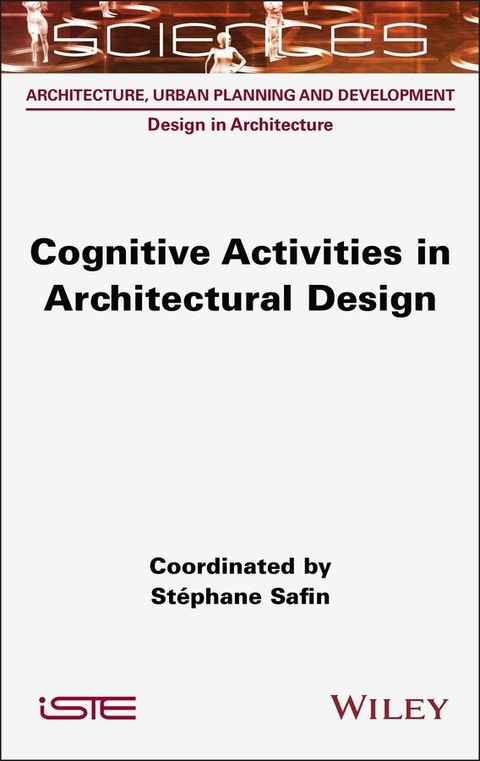
Cognitive Activities in Architectural Design (eBook)
437 Seiten
Wiley-Iste (Verlag)
978-1-394-41120-7 (ISBN)
Architectural design relies on distinct cognitive processes that have been the subject of research for several decades. However, in light of recent social and technological shifts reshaping the discipline, there is a pressing need for new insights to better understand how these changes influence the design process.
This collective work offers an overview of research in the field, opening up perspectives towards an ever-finer understanding of the cognitive processes involved in architectural design: design neuroscience, uses induced or offered by building information modeling (BIM), information retrieval, representational processes, AI in ideation, and the values and processes used in active participation.
Cognitive Activities in Architectural Design is aimed at researchers in the design sciences seeking a deeper understanding of design processes, architectural teachers looking to reflect on and enhance their teaching practices, and practitioners interested in how scientific research can define and conceptualize their professional work.
Stéphane Safin is Professor of Cognitive Ergonomics and Work Psychology at Université Libre de Bruxelles, Belgium, and Télécom Paris (Institut Polytechnique de Paris), France. His research focuses on the analysis of ideation and participation activities in design and architecture.
Introduction
Stéphane SAFIN
i3, CNRS, Télécom Paris, Institut polytechnique de Paris, Palaiseau, France PsyTC, Université libre de Bruxelles, Brussels, Belgium
Scientists have been studying cognitive activities of design since the 1970s. The aim has been to decipher the specific modes of thought involved in design in general, as well as in its various sub-fields (computer design, industrial design, etc., not forgetting architecture, of course). Starting from the idea that design is a singular activity with specific characteristics, researchers have worked hard to observe, analyze, describe, conceptualize and model the cognitive processes at work when an architect or designer considers a problem to be solved, elaborates ideas, refines them and ends up with the complete definition of an artifact: object, building, software, illustration, etc. In 1982, through the notion of designerly ways of knowing, Nigel Cross posited the specificity of design as a singular mode of thinking, doing and knowing.
The numerous theorizations and, above all, the large number of empirical studies carried out, mainly in laboratories under controlled conditions, as well as in pedagogical and real-life situations (projects and agencies), have the particularity of crossing perspectives from the social sciences (psychology, ergonomics, sociology, management), engineering sciences and design sciences (in particular architectural sciences). Design activity, meaning design being done, has gradually become an object of study in its own right and has given structure to a research community in design sciences, not only in France but also internationally.
Architectural design holds a special place in this general landscape. Firstly, it is one of the most intensively studied fields in the design sciences as architectural research was historically structured earlier than design research. Secondly, architecture produces unique artifacts, with each building requiring its own design process. The question of understanding this process, this design activity and its cognitive substrates – and no doubt also a certain desire for rationalization – has long been one of the major concerns of the disciplinary field. The discipline is also at the crossroads of the engineering sciences and artistic approaches, and therefore lends itself well to an attempt to rationalize, or at least decipher, its methods and practices. Finally, of course, as a discipline, architecture has its own characteristics that set it apart from other fields of design: 1) projects are partly structured by legal and administrative frameworks and obligations; 2) gravity being what it is, in the vast majority of cases it imposes perfectly horizontal floors and vertical walls on buildings, which makes it possible to make extensive use of two-dimensional plan projections, in all stages of the project; 3) architectural design is always collective, and the architect, even alone, is called upon to collaborate with other individuals and other trades.
Design sciences, in which architecture plays a central role, have led through study to the definition of a stabilized body of knowledge that has gradually spread beyond the confines of research circles, percolating down to the general public through the discourse – and above all the methods – of design thinking. Behind this term lie two realities (Cross 2023): that of researchers trying to understand the thought processes of professional designers, as well as of lay designers engaged in creative design activities, and to which this book relates; and that of managers, consultancies and trainers, who offer, at best, innovative tools for tackling complex problems in a different way, “designer-style”, or, at worst, “toolboxes” of simple recipes and decontextualized exercises for “unleashing creativity”, sometimes forgetting that training in real design thinking takes time.
This book aims to break new ground beyond this stabilized knowledge base. After a brief review of cognitive and collective design activities (this chapter), the book takes a more detailed look at new research avenues open to the study of design processes in architecture. These new avenues of research are largely influenced by three factors: the rise of neuroscience, which opens up the possibility of investigating the neurophysiological substrate of design activities (see Chapter 1); the revival of participatory approaches to design (see Chapters 5 and 7); and the new digital tools that are being rapidly integrated into the world of architectural agencies: BIM (building information modeling, Chapters 6 and 7), parametric modeling tools (see Chapter 4), virtual reality (see Chapter 7) and AI (see Chapter 8). Three chapters also explore, through the proposal of original models of analysis and understanding, three central issues in design: the role of representations and the act of representing (see Chapter 3), information-seeking processes (see Chapter 4) and the question of values in design (see Chapter 2).
This book is addressed to researchers in the design sciences and the humanities and social sciences who wish to deepen their knowledge of design activities and pave the way for new avenues of research. Doctoral and master’s students wishing to embark on research into design activities will also find a wealth of knowledge that will undoubtedly provide them with a good starting point for their work. Practitioners in architecture, and other design fields, will also gain an insight into how scientists define and conceptualize their work activity, and will certainly find food for thought relevant to their practice.
In this introductory chapter, we present a brief overview of what is known about the cognitive activities involved in architectural design, and what is the consensus in the scientific community involved in their construction. The other chapters will be introduced here in relation to the new avenues they open up for an ever finer understanding of design activities.
I.1. Architectural design: towards a definition
As a preamble, we feel it necessary to review the definition of the very notion of design activities. This introduction is intended to be concise, and the interested reader will be able to find further details in various major publications in the field (Cross 1982, 2007; Visser 2006, for example). First of all, we can define design in its broadest sense as a process of successive transformations leading, from initial data, to the definition of an object possessing two characteristics: both original, meaning non-existent prior to design, and relevant, meaning adapted to its context of reception, and responding to needs, goals and constraints (Visser 2009).
Within this definition, architectural design has a special place. Architecture is a process structured around long-term projects, and design can be considered on two scales: a global project scale, where design is defined as all the stages leading from a client’s request to the construction and commissioning of a building; and the scale of the architects’ design activity, meaning, on the one hand, the elaboration and definition of the main principles of the building, in formal and technical terms, which will subsequently enable contracts to be signed with the trades involved in the construction and, on the other hand, the resolution of a certain number of problems that may arise later and require the redefinition of certain elements of the project. This book focuses on this second scale, using a specific lens: that of cognition. The aim is to understand design through the observation of architects’ behavioral structures and the inference of underlying mental processes. We seek to understand what goes on “in the head” of architects, and in their immediate environment (see Chapter 3 on the importance of an externalized, interactionist view of cognition in design), when they are engaged in defining the future built environment. Furthermore, we focus our attention on the early stages of the project, identified as the preliminary or creative stages. These are the project definition stages, where the bulk of the decisions framing the project are made, and where the majority of the building’s information emerges.
I.2. Architectural project
Architectural design projects are generally considered to involve three categories of actors. The project owners initiate the project, set the program, allocate resources and make the final decisions. This is usually the client or one of their representatives. The project managers include architects and their design partners (specialized engineers, other designers (landscape architects, interior designers, etc.)). They are responsible for defining the project and supervising its implementation. The project users (Folcher 2015; Fenker and Zetlaoui-Leger 2022), a more recently introduced term, refers to the building’s target users. These are the workers, residents and services adjacent to the building. Strictly speaking, they have no legal status in architectural projects, so their voice is not always directly integrated into design practices. This integration is one of the aims of participatory design approaches (see Chapter 5) and user-centered design approaches (see Chapter 7).
An architectural project is a process structured in several key stages, depending in particular on the profession’s regulations, which respond to different...
| Erscheint lt. Verlag | 9.9.2025 |
|---|---|
| Reihe/Serie | ISTE Invoiced |
| Sprache | englisch |
| Themenwelt | Technik ► Architektur |
| Schlagworte | AI in ideation • architectural design • Architecture • Building information modeling (BIM) • Cognition • cognitive processes • design neuroscience • Design Sciences • Information Retrieval • representational processes |
| ISBN-10 | 1-394-41120-0 / 1394411200 |
| ISBN-13 | 978-1-394-41120-7 / 9781394411207 |
| Informationen gemäß Produktsicherheitsverordnung (GPSR) | |
| Haben Sie eine Frage zum Produkt? |
 EPUB (Adobe DRM)
Kopierschutz: Adobe-DRM
Adobe-DRM ist ein Kopierschutz, der das eBook vor Mißbrauch schützen soll. Dabei wird das eBook bereits beim Download auf Ihre persönliche Adobe-ID autorisiert. Lesen können Sie das eBook dann nur auf den Geräten, welche ebenfalls auf Ihre Adobe-ID registriert sind.
Details zum Adobe-DRM
Dateiformat: EPUB (Electronic Publication)
EPUB ist ein offener Standard für eBooks und eignet sich besonders zur Darstellung von Belletristik und Sachbüchern. Der Fließtext wird dynamisch an die Display- und Schriftgröße angepasst. Auch für mobile Lesegeräte ist EPUB daher gut geeignet.
Systemvoraussetzungen:
PC/Mac: Mit einem PC oder Mac können Sie dieses eBook lesen. Sie benötigen eine
eReader: Dieses eBook kann mit (fast) allen eBook-Readern gelesen werden. Mit dem amazon-Kindle ist es aber nicht kompatibel.
Smartphone/Tablet: Egal ob Apple oder Android, dieses eBook können Sie lesen. Sie benötigen eine
Geräteliste und zusätzliche Hinweise
Buying eBooks from abroad
For tax law reasons we can sell eBooks just within Germany and Switzerland. Regrettably we cannot fulfill eBook-orders from other countries.
aus dem Bereich