


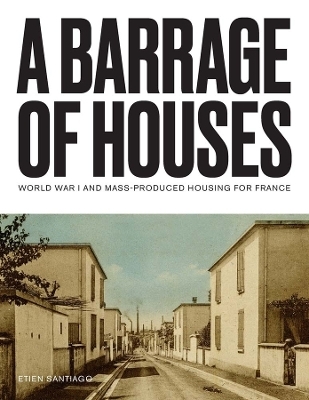
A Barrage of Houses
World War I and Mass-Produced Housing for France
Seiten
2026
Yale University Press (Verlag)
978-0-300-28441-6 (ISBN)
Yale University Press (Verlag)
978-0-300-28441-6 (ISBN)
- Noch nicht erschienen (ca. August 2026)
- Versandkostenfrei
- Auch auf Rechnung
- Artikel merken
A fascinating investigation of the World War I origins of mass-produced architecture
Mass-produced housing became increasingly prevalent through the second half of the twentieth century and is nearly ubiquitous today. Though its popularity and widespread adoption have been primarily connected to the post–World War II housing boom, Etien Santiago weaves together architectural, construction, and sociopolitical history to reveal how its foundations were laid earlier, during World War I.
Prior to World War I, buildings that were made serially—quickly, cheaply, and in large numbers—were typically limited to utilitarian colonial or military applications. Such buildings were moreover assumed to be temporary. Yet the Great War shattered these assumptions, pushing architects, designers, and engineers to appropriate military advances in construction to create a new form of permanent residential architecture. A Barrage of Houses charts the rise of mass-produced dwellings in France from 1914 to the mid-1920s, as demonstrated through housing designs by Auguste and Gustave Perret, Henri Sauvage, and Le Corbusier. Through their use of concrete, metal, modular wooden parts, and new materials, these housing schemes addressed the tangible fallout of the war as well as its thorny conceptual challenges.
Mass-produced housing became increasingly prevalent through the second half of the twentieth century and is nearly ubiquitous today. Though its popularity and widespread adoption have been primarily connected to the post–World War II housing boom, Etien Santiago weaves together architectural, construction, and sociopolitical history to reveal how its foundations were laid earlier, during World War I.
Prior to World War I, buildings that were made serially—quickly, cheaply, and in large numbers—were typically limited to utilitarian colonial or military applications. Such buildings were moreover assumed to be temporary. Yet the Great War shattered these assumptions, pushing architects, designers, and engineers to appropriate military advances in construction to create a new form of permanent residential architecture. A Barrage of Houses charts the rise of mass-produced dwellings in France from 1914 to the mid-1920s, as demonstrated through housing designs by Auguste and Gustave Perret, Henri Sauvage, and Le Corbusier. Through their use of concrete, metal, modular wooden parts, and new materials, these housing schemes addressed the tangible fallout of the war as well as its thorny conceptual challenges.
Etien Santiago is a licensed architect and a historian of modern architecture and construction at the Hillier College of Architecture and Design at New Jersey Institute of Technology.
| Erscheint lt. Verlag | 25.8.2026 |
|---|---|
| Zusatzinfo | 64 color + 85 b-w illus. |
| Sprache | englisch |
| Maße | 216 x 279 mm |
| Themenwelt | Technik ► Architektur |
| ISBN-10 | 0-300-28441-1 / 0300284411 |
| ISBN-13 | 978-0-300-28441-6 / 9780300284416 |
| Zustand | Neuware |
| Informationen gemäß Produktsicherheitsverordnung (GPSR) | |
| Haben Sie eine Frage zum Produkt? |
Mehr entdecken
aus dem Bereich



aus dem Bereich
Grundlagen, Normen, Vorschriften
Buch | Hardcover (2024)
Springer Vieweg (Verlag)
CHF 219,95
Tragkonstruktion und Schichtaufbau
Buch | Hardcover (2024)
Birkhäuser (Verlag)
CHF 119,95
Raumheizungen fachgerecht planen und bauen
Buch | Hardcover (2023)
Beuth (Verlag)
CHF 86,80


