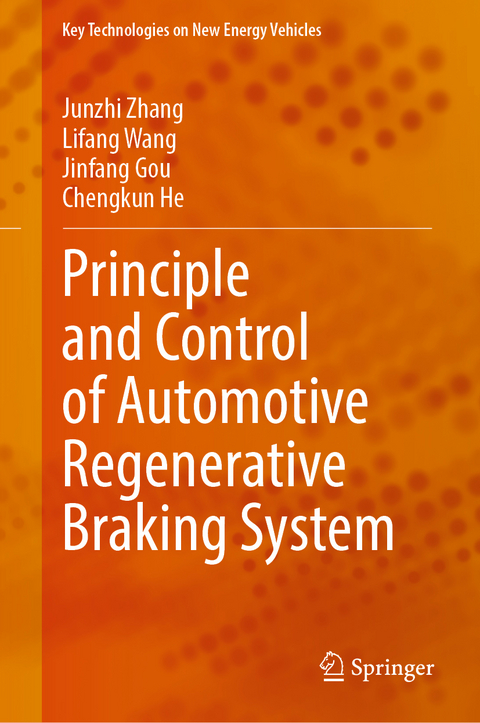
Principle and Control of Automotive Regenerative Braking System
Springer Verlag, Singapore
978-981-95-3424-1 (ISBN)
- Titel nicht im Sortiment
- Artikel merken
Dr. Junzhi Zhang, Professor of the School of Vehicle and Mobility at Tsinghua University and chairman of the Intelligent Chassis Branch of the Chinese Society of Automotive Engineering, is the first to conduct research on energy feedback braking systems, hybrid power systems, and high-precision dynamic load simulation tests for powertrains in China. In recent years, he has presided over more than 10 projects such as national key research and development program, National 863 project, National Natural Science Foundation project, published more than 150 SCI/EI papers, and authorized more than 70 national invention patents. The research achievements of the braking energy recovery of electric vehicles won the second prize of the National Science and Technology Progress Award (ranking 1), the first prize of China Automobile Industry Science and Technology Invention (ranking 1) and the first prize of Beijing Science and Technology (ranking 1). The research achievements of hybrid power won the second prize of National Science and Technology Progress (ranking 3), the second prize of National Science and Technology Invention (ranking 4) and the first prize of China Automobile Industry Technology Progress (ranking 1). Dr. Lifang Wang is a researcher at the Institute of Electrical Engineering, Chinese Academy of Sciences, and the director of the Research Department of Automotive Energy System and Control Technology. She has been engaged in the research work of electric vehicle and intelligent vehicle control, wireless charging, power battery system and electromagnetic compatibility for a long time. She has published more than 100 SCI/EI papers and authorized more than 70 national invention patents. The research results won the second prize of the National Science and Technology Progress Award (ranking 2), the first prize of China Automobile Industry Scientific and Technological Invention (ranking 2), the first prize of Beijing Science and Technology (ranking 2), and the first prize of China Automobile Industry Technological Progress (ranking 3). Dr. Jinfang Gou, Senior engineer at the Institute of Electrical Engineering, Chinese Academy of Sciences, has long been engaged in the research of energy feedback braking technology and electric vehicle dynamics control technology. The research results won the second prize of the National Science and Technology Progress Award, the first prize of China's Automobile Industry Science and Technology Invention, the first prize of Beijing Science and Technology and the first prize of China's Automobile Industry Technology Progress. Dr. Chengkun He, Assistant researcher of School of Vehicle and Delivery, Tsinghua University, Secretary General of Intelligent Chassis Branch of China Society of Automotive Engineering, has long been engaged in high-precision dynamic load simulation test of vehicle energy feedback braking system and intelligent chassis control research work. The research results won the second prize of National Science and Technology Progress Award and the first prize of China Automobile Industry Technology Progress Award
.- Chapter 1 Introduction.- Chapter 2 Design of energy feedback braking system.- Chapter 3 Regenerative control strategy for normal braking.- Chapter 4 The optimal control of regenerative braking system considering nonlinear characteristics.- Chapter 5 Regenerative control strategy for anti-lock braking.- Chapter 6 Hydraulic braking force control method.- Chapter 7 Pneumatic braking force control method.- Chapter 8 Test and evaluation of regenerative braking system.
| Erscheint lt. Verlag | 12.6.2026 |
|---|---|
| Reihe/Serie | Key Technologies on New Energy Vehicles |
| Zusatzinfo | Approx. 210 p. |
| Verlagsort | Singapore |
| Sprache | englisch |
| Maße | 155 x 235 mm |
| Themenwelt | Technik ► Elektrotechnik / Energietechnik |
| Technik ► Fahrzeugbau / Schiffbau | |
| Technik ► Maschinenbau | |
| Schlagworte | Coordinated Control • Electric Vehicle • Friction braking • hydraulic • pneumatic • Regenerative Braking System |
| ISBN-10 | 981-95-3424-0 / 9819534240 |
| ISBN-13 | 978-981-95-3424-1 / 9789819534241 |
| Zustand | Neuware |
| Informationen gemäß Produktsicherheitsverordnung (GPSR) | |
| Haben Sie eine Frage zum Produkt? |
aus dem Bereich