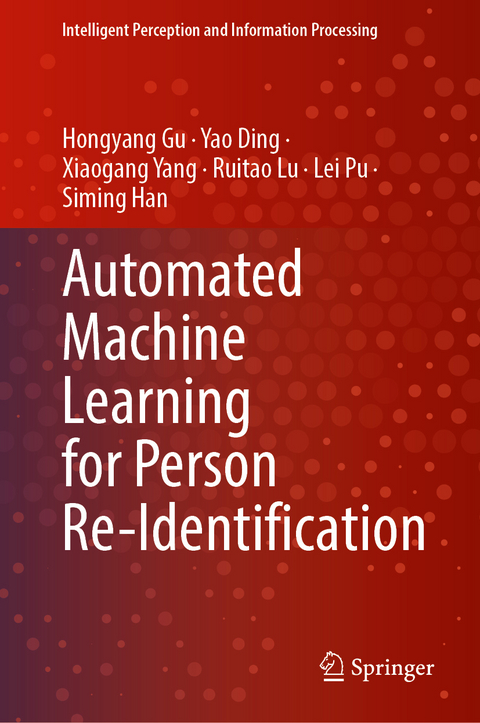
Automated Machine Learning for Person Re-Identification
Springer Verlag, Singapore
978-981-95-3432-6 (ISBN)
- Titel nicht im Sortiment
- Artikel merken
Readers will discover five innovative methods designed to overcome specific limitations in existing ReID systems. These include automated erasing data augmentation for more effective erased regions, two distinct AutoML approaches for optimizing multi-scale features in both single-branch and multi-branch architectures, and dynamic and static search methods for refining margin-based Softmax losses. The book's strength lies in its detailed exposition of search algorithms, regularization techniques, and reinforcement learning applications, all contributing to highly efficient and performant ReID solutions.
The primary value of this book for readers lies in its comprehensive overview of advanced AutoML strategies tailored for ReID, offering practical insights into developing more robust and accurate models. It provides a structured exploration of complex concepts, empowering researchers and practitioners to push the boundaries of their own work. This book is an essential resource for researchers, graduate students, and engineers in computer vision, machine learning, and artificial intelligence, particularly those focused on person re-identification and automated deep learning.
Dr. Hongyang Gu received the M.S. and Ph.D. degrees from the Xi’an Research Institute of High Technology, Xi’an 710025, China, in 2017 and 2022, respectively. Since Jun. 2022, Dr. Gu has been in the Department of Computer Science and Technology, Xi’an Research Institute of High Technology as a Lecturer. Dr. Gu focuses on the research of metric learning, automated machine learning, and person reidentification, with a focus on developing intelligent video surveillance systems based on deep learning. Dr. Gu has published several papers in CVPR, PR, KBS, Neurocomputing, etc. Dr. Yao Ding received the M.S. and Ph.D. degrees from the Key Laboratory of Optical Engineering, Xi’an Research Institute of High Technology, Xi’an 710025, China, in 2013 and 2022. Dr. Ding’s research interests include neural network, computer vision, image processing, and hyperspectral image clustering. He has published several papers in IEEE Trans. on Geoscience and Remote Sensing (TGRS), IEEE Trans. on Multimedia (TMM), Expert Systems with Applications (ESWA), Defence Technology (DT), IEEE Geoscience and Remote Sensing Letters (GRSL), Neurocomputing, etc. Furthermore, he has published three monographs, and eight patents have been granted. He has received excellent doctoral dissertations from the China Simulation Society and the China Ordnance Industry Society in 2023. He also has received HIGHLY CITED AWARDS from Defence Technology (DT) journal. At present, he has twelve ESI highly cited papers. In addition, he is also the reviewer of TIP, TGRS, TNNLS, PR, JAG, INFFUS, ESWA, KBS, etc. He has also served as an Editorial Board Member of the Journal of Information and Intelligence. Prof. Xiaogang Yang received the Ph.D. degree from the Xi’an Research Institute of High Technology, Xi’an, China, in 2006. Prof. Yang is currently a Professor with the Xi’an Research Institute of High Technology, Xi’an, China. He is a distinguished scholar and researcher, currently serving as a committee member of the Image Application and System Integration Professional Committee of the Chinese Society of Image and Graphics, as well as a committee member of the Shaanxi General Aviation System Engineering Research Center. He has dedicated his career to the fields of image recognition and precision guidance, as well as machine vision and intelligent control. Dr. Ruitao Lu received the Ph.D. degree in control science from the National University of Defense Technology, Changsha, China, in 2016. Dr. Lu is currently an Associate Professor with the Department of Control Engineering, Xi’an Research Institute of High Technology, Xi’an, China. His current research interests include pattern recognition, image processing, and machine learning. Dr. Lei Pu received the M.S. and Ph.D. degrees both from Air Force Engineering University, Xi’an, China, in 2016 and 2020, respectively. Dr. Pu has been a Lecturer with the Combat Support College, Xi’an Research Institute of High Technology, Xi’an. His main research interests include visual tracking, pattern recognition, and computer vision. Mr. Siming Han received the M.S. degree in School of Computer Science from Shaanxi Normal University, Xi’an, China, in 2019. Mr. Han is currently a Lecturer with the Department of Computer Science and Technology, Xi’an Research Institute of High Technology, Xi’an, China. His research interests include remote sensing and computer vision.
Introduction.- Automated Erasing Data Augmentation for Person Re-Identification.- Learning Auto-Scale Representations for Person Re-Identification.- Searching for A Multi-Branch ConvNet for Person Re-Identification.- Dynamic Loss Function Search for Person Re-Identification.- Searching Static Generalized Margin-based Softmax Loss Function for Person Re-identification.- Conclusion and Future Work.
| Erscheinungsdatum | 29.11.2025 |
|---|---|
| Reihe/Serie | Intelligent Perception and Information Processing |
| Zusatzinfo | 41 Illustrations, color; 2 Illustrations, black and white |
| Verlagsort | Singapore |
| Sprache | englisch |
| Maße | 155 x 235 mm |
| Themenwelt | Informatik ► Grafik / Design ► Digitale Bildverarbeitung |
| Informatik ► Theorie / Studium ► Künstliche Intelligenz / Robotik | |
| Technik ► Elektrotechnik / Energietechnik | |
| Schlagworte | Artificial Intelligence • Automated Machine Learning (AutoML) • computer vision • Data Augmentation • Deep learning • Loss Function Search • metric learning • Network Architecture Search (NAS) • Person Re-identification (Re-ID) |
| ISBN-10 | 981-95-3432-1 / 9819534321 |
| ISBN-13 | 978-981-95-3432-6 / 9789819534326 |
| Zustand | Neuware |
| Informationen gemäß Produktsicherheitsverordnung (GPSR) | |
| Haben Sie eine Frage zum Produkt? |
aus dem Bereich