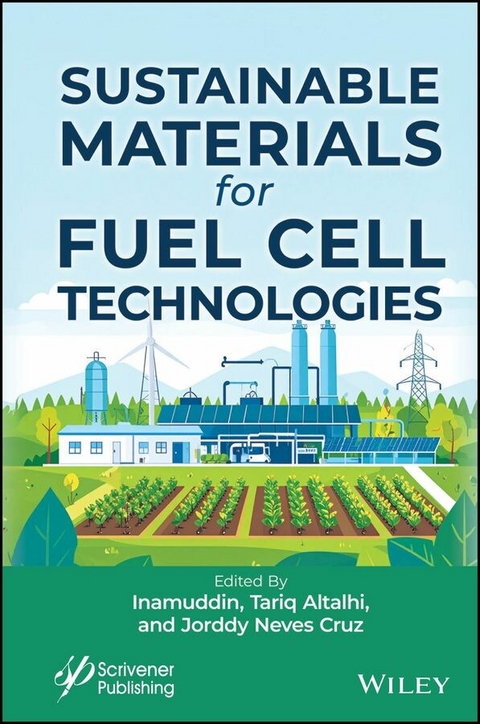
Sustainable Materials for Fuel Cell Technologies (eBook)
955 Seiten
Wiley-Scrivener (Verlag)
978-1-394-24776-9 (ISBN)
Sustainable Materials for Fuel Cell Technologies offers a comprehensive look at the advancements, challenges, and future of sustainable materials in fuel cell technology, making it essential for anyone interested in the drive towards a cleaner energy future.
The development of fuel cell technologies is driven by the growing demand for clean and sustainable energy solutions. The applications of fuel cells span a wide range of sectors, including transportation, stationary power generation, and portable electronics. The development of sustainable materials for fuel cells is crucial for overcoming the challenges that hinder the widespread adoption of this technology. These challenges include cost, durability, efficiency, and the use of precious metals in catalysts. Researchers and industries are actively working to address these challenges by developing new materials, improving manufacturing processes, and exploring innovative approaches such as using abundant and low-cost materials as catalysts. Overall, the field of sustainable materials for fuel cells is an exciting and rapidly evolving area of research and development. This book aims to provide a comprehensive understanding of the disciplinary and industry aspects of fuel cell technologies, highlighting the advancements, challenges, and future prospects of sustainable materials that are vital for driving the transition towards a more sustainable and clean energy future.
Inamuddin, PhD, is an assistant professor at the Department of Applied Chemistry, Zakir Husain College of Engineering and Technology, Faculty of Engineering and Technology, Aligarh Muslim University, Aligarh, India. He has extensive research experience in multidisciplinary fields of analytical chemistry, materials chemistry, electrochemistry, renewable energy, and environmental science. He has worked on different research projects funded by various government agencies and universities and is the recipient of awards, including the Department of Science and Technology, India, Fast-Track Young Scientist Award and Young Researcher of the Year Award 2020 from Aligarh Muslim University. He has published about 210 research articles in various international scientific journals, many book chapters, and dozens of edited books, many with Wiley-Scrivener.
Tariq Altalhi, PhD, is an associate professor in the Department of Chemistry at Taif University, Saudi Arabia. He received his doctorate degree from University of Adelaide, Australia in the year 2014 with Dean's Commendation for Doctoral Thesis Excellence. He has worked as head of the Chemistry Department at Taif university and Vice Dean of Science College. In 2015, one of his works was nominated for Green Tech awards from Germany, Europe's largest environmental and business prize, amongst top 10 entries. He has also co-edited a number of scientific books.
Jorddy Neves Cruz is a researcher at the Federal University of Pará and the Emilio Goeldi Museum. He has experience in multidisciplinary research in the areas of medicinal chemistry, drug design, extraction of bioactive compounds, extraction of essential oils, food chemistry and biological testing. He has published several research articles in scientific journals and is an associate editor of the Journal of Medicine.
Sustainable Materials for Fuel Cell Technologies offers a comprehensive look at the advancements, challenges, and future of sustainable materials in fuel cell technology, making it essential for anyone interested in the drive towards a cleaner energy future. The development of fuel cell technologies is driven by the growing demand for clean and sustainable energy solutions. The applications of fuel cells span a wide range of sectors, including transportation, stationary power generation, and portable electronics. The development of sustainable materials for fuel cells is crucial for overcoming the challenges that hinder the widespread adoption of this technology. These challenges include cost, durability, efficiency, and the use of precious metals in catalysts. Researchers and industries are actively working to address these challenges by developing new materials, improving manufacturing processes, and exploring innovative approaches such as using abundant and low-cost materials as catalysts. Overall, the field of sustainable materials for fuel cells is an exciting and rapidly evolving area of research and development. This book aims to provide a comprehensive understanding of the disciplinary and industry aspects of fuel cell technologies, highlighting the advancements, challenges, and future prospects of sustainable materials that are vital for driving the transition towards a more sustainable and clean energy future.
Preface
The topic of the book lies at the intersection of various disciplines and industries, driving the development of sustainable energy solutions. Fuel cell technologies offer a promising alternative to traditional energy sources by efficiently converting chemical energy into electrical energy, with minimal environmental impact. The focus of this book is on the materials aspect of fuel cell technologies, which plays a crucial role in their performance, durability, and overall feasibility for commercial applications. From a disciplinary perspective, the field of sustainable materials for fuel cells encompasses materials science, chemistry, electrochemistry, chemical engineering, and related disciplines. Materials scientists and engineers work on developing novel materials, such as catalysts, membranes, and electrodes, that can enhance the efficiency, stability, and cost-effectiveness of fuel cells. Electrochemists study the electrochemical reactions taking place within fuel cells and investigate ways to optimize the materials and design for improved performance.
The industry development of fuel cell technologies is driven by the growing demand for clean and sustainable energy solutions. The applications of fuel cells span a wide range of sectors, including transportation, stationary power generation, and portable electronics. In the automotive industry, fuel cells are seen as a promising technology for zero-emission vehicles, offering longer driving ranges and shorter refueling times compared to battery electric vehicles. In stationary power generation, fuel cells provide a reliable and environmentally friendly alternative to conventional power sources. Additionally, portable fuel cells are being explored for powering devices such as smartphones, laptops, and drones.
The development of sustainable materials for fuel cells is crucial for overcoming the challenges that hinder the widespread adoption of this technology. These challenges include cost, durability, efficiency, and the use of precious metals in catalysts. Researchers and industries are actively working to address these challenges by developing new materials, improving manufacturing processes, and exploring innovative approaches such as using abundant and low-cost materials as catalysts. Overall, the field of sustainable materials for fuel cells is an exciting and rapidly evolving area of research and development. This book aims to provide a comprehensive understanding of the disciplinary and industry aspects of fuel cell technologies, highlighting the advancements, challenges, and future prospects of sustainable materials that are vital for driving the transition towards a more sustainable and clean energy future.
Sustainable Materials for Fuel Cell Technologies book discusses advances in the area of sustainable materials for fuel cells. The book thoroughly covers the subject, from the fundamentals of fuel cell materials to advanced materials and the challenges and future perspectives of the field. It offers a holistic view of sustainable materials in fuel cell technologies, making it a valuable reference for researchers and practitioners. The chapters included in the book are summarized below:
Chapter 1 discusses the concept of fuel cells, their classification, and their history from their humble beginnings to current technological advancements. This chapter explains the current choice of fuel cells as an energy trend. The applications of fuel cells, from space applications to hydrogen vehicles, are discussed.
Chapter 2 covers the classification of organic-inorganic composite membranes for low-temperature fuel cells, their requirements, and approaches to their synthesis. The effect of the morphology of inorganic particles on membrane performance is discussed. Membranes containing hydrophosphates, oxides of multivalent metals, silica, polyoxometalates, MOFs, and advanced carbon nanomaterials are reviewed.
Chapter 3 involves a detailed analysis of recent improvements, materials, and innovations in fuel cells. A strategic evaluation is carried out using multi-criteria decision analysis to select the most effective fuel cell among the popular types.
Chapter 4 details the polymers used as proton exchange membranes (PEM), such as Nafion, poly(ether ketone) sulfonated, poly(aryl ether sulfone) sulfonated, polybenzimidazole, poly(ether sulfone) sulfonated, and chitosan sulfonated. Different catalysts used in PEM, such as zeolites, TiO2, ZrO2, graphene, and carbon nanotubes, are also discussed.
Chapter 5 looks at cutting-edge manufacturing techniques and scale-up strategies, focusing on cost reduction and efficiency. It emphasizes economic benefits, technology breakthroughs, and practical implementations, providing a comprehensive guide for optimizing production in various industries.
Chapter 6 discusses the molecular structure, morphology, and chemical composition of proton exchange membranes (PEMs) to enhance fuel cell performance. It covers advancements in polymer synthesis, blending, and nanomaterial integration, focusing on maintaining PEM stability. Incorporating functional groups such as sulfonic, phosphonic, carboxylic acids, and hydroxyl into polymers optimizes transport properties. Blending sulfonated aromatic with hydrocarbon-based polymers balances strength and conductivity. Nanomaterials like titanium dioxide, graphene, and carbon nanotubes innovate PEM design. Despite progress, stability challenges remain, highlighting the need for interdisciplinary collaboration and material innovation for durable, efficient PEMs in electrochemical applications.
Chapter 7 explores the fundamental and operational principles of solid oxide fuel cells (SOFCs), focusing on the selection of materials suitable for intermediate operating conditions. Additionally, it discusses the enhanced stability and electrochemical performance of LSCF-based cathode materials, accompanied by detailed characterization of these cathodes.
Chapter 8 focuses on microbial fuel cells (MFCs) and their varied designs in terms of cathode and anode ions in various fuel cell applications. It also covers the many types of anodes and cathode membranes, as well as the materials used to build MFCs at a low cost and with increased bioavailability on selected targets. MFC-loaded materials and nanoparticles are addressed. The chapter examines MFC’s many roles as synthetic biology enhancers and mediators in microorganism biology, as well as its benefits and drawbacks. Finally, future outlooks and strategies are discussed.
Chapter 9 provides an overview of the electrochemical and thermodynamic concepts in fuel cell (FC) technology. It covers principles of FC operation, reaction kinetics, mass and energy migrations, and the effects of thermodynamic parameters. It also discusses different types of FCs and the importance of electrode nature.
Chapter 10 discusses the applicability of enzymatic fuel cells (EFC) in different sensor devices and implantable medical devices. The chapter starts with an elaboration on the fundamentals of EFC, how enzymes work in boosting the microwatts through the electron transfer mechanism, and concludes with a note on designing stable bio-electrodes.
Chapter 11 covers fuel cells, their fundamentals, applications, and classifications. It addresses design challenges in PEMFC systems, explores fuel cells in transportation, outlines electric vehicle design using fuel cells, and discusses demonstrations of fuel cell electric vehicles in transportation and stationary sectors.
Chapter 12 explores the synthesis and characterization of fuel cell materials using deep eutectic solvents (DES). It highlights DES’s role in advancing fuel cell technology, discussing innovative synthesis techniques and detailed material analysis. Emphasis is placed on DES’s benefits in enhancing fuel cell efficiency and sustainability, and its potential in energy applications.
Chapter 13 focuses on advancements in materials, catalysts, electrochemical reactions, and membranes for Direct Methanol Fuel Cells (DMFCs). It details the oxidation mechanism and components, highlighting the importance of durable, efficient membranes and catalysts. The chapter encourages further research to optimize substrates, nano-catalysts, and their structures.
Chapter 14 explains the testing and diagnostic methods for Proton Exchange Membrane Fuel Cells (PEMFCs), focusing on electrochemical and chemical/physical techniques. It compares various methods like polarization curves, electrochemical impedance spectroscopy, and magnetic resonance imaging, highlighting their applications and importance in diagnosing PEMFCs’ performance, efficiency, and reliability.
Chapter 15 outlines the advancements in materials and components of phosphoric acid fuel cells (PAFCs). It emphasizes the significance of phosphoric acid as an electrolyte. Major focus is given to advancing materials, such as membrane electrode assembly, gas diffusion layers, electrodes, and electrolytes used for enhancing the efficiency of PAFCs.
Chapter 16 explores cathode materials for Solid Oxide Fuel Cells (SOFCs), which efficiently convert chemical energy to electricity. Perovskite materials are promising due to their oxygen ion conductivity. The chapter delves into single and double perovskite structures, along with Ruddlesden-Popper oxides, explaining their crystal structures and key properties for optimal SOFC cathode performance.
Chapter 17 reviews the role of Solid Oxide...
| Erscheint lt. Verlag | 3.9.2025 |
|---|---|
| Sprache | englisch |
| Themenwelt | Technik ► Elektrotechnik / Energietechnik |
| Technik ► Maschinenbau | |
| Schlagworte | Advanced materials • Catalysts for Fuel • Direct Methanol • Durability of Fuel • Fuel Cell Advancements • Fuel Cell Characterization • Fuel Cell Materials • Fuel cells • fuel cell technologies • Materials in Fuel Cells • Membrane Fuel Cells • renewable energy • Renewable Fuel Cells • Sustainable energy • sustainable materials |
| ISBN-10 | 1-394-24776-1 / 1394247761 |
| ISBN-13 | 978-1-394-24776-9 / 9781394247769 |
| Informationen gemäß Produktsicherheitsverordnung (GPSR) | |
| Haben Sie eine Frage zum Produkt? |
 EPUB (Adobe DRM)
Kopierschutz: Adobe-DRM
Adobe-DRM ist ein Kopierschutz, der das eBook vor Mißbrauch schützen soll. Dabei wird das eBook bereits beim Download auf Ihre persönliche Adobe-ID autorisiert. Lesen können Sie das eBook dann nur auf den Geräten, welche ebenfalls auf Ihre Adobe-ID registriert sind.
Details zum Adobe-DRM
Dateiformat: EPUB (Electronic Publication)
EPUB ist ein offener Standard für eBooks und eignet sich besonders zur Darstellung von Belletristik und Sachbüchern. Der Fließtext wird dynamisch an die Display- und Schriftgröße angepasst. Auch für mobile Lesegeräte ist EPUB daher gut geeignet.
Systemvoraussetzungen:
PC/Mac: Mit einem PC oder Mac können Sie dieses eBook lesen. Sie benötigen eine
eReader: Dieses eBook kann mit (fast) allen eBook-Readern gelesen werden. Mit dem amazon-Kindle ist es aber nicht kompatibel.
Smartphone/Tablet: Egal ob Apple oder Android, dieses eBook können Sie lesen. Sie benötigen eine
Geräteliste und zusätzliche Hinweise
Buying eBooks from abroad
For tax law reasons we can sell eBooks just within Germany and Switzerland. Regrettably we cannot fulfill eBook-orders from other countries.
aus dem Bereich