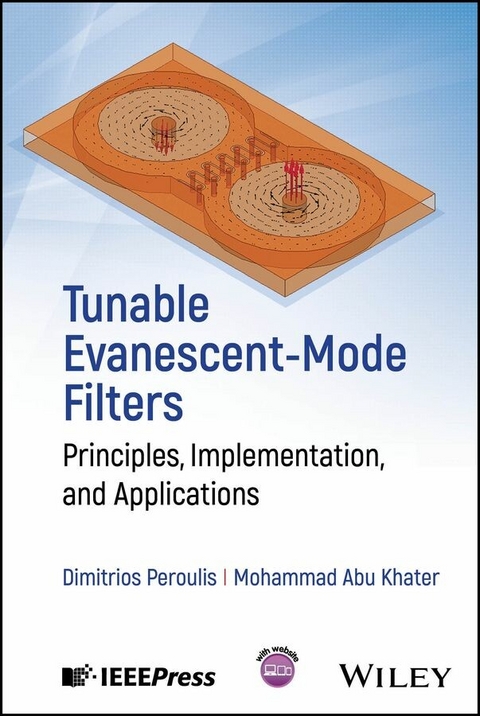
Tunable Evanescent-Mode Filters (eBook)
516 Seiten
Wiley-IEEE Press (Verlag)
9781394216826 (ISBN)
Comprehensive resource presenting tunable evanescent-mode filters design principles, implementation technologies, and applications, with hardware demonstrations and illustrations to support concepts
Covering all recent advancements in the field, Tunable Evanescent-Mode Filters discusses fundamentals and applications in tunable evanescent-mode filters with concepts supported by hardware demonstrations to help the reader design experiments, a variety of detailed illustrations to aid in reader comprehension, and worked-out examples to help connect theory to practice.
The book is divided into three parts. The first part introduces associated physics, providing background information on topics such as filter anatomy, coupling matrix and routing diagrams, evanescent-mode resonators, and more. The second part covers implementation, describing topics like printed circuit boards, silicon microfabrication, and injection molding. The last part covers applications and discusses a broad range of topics including absorptive bandstop filters, bandwidth and passband control, high-order and fractional-order evanescent-mode filters, advanced evanescent-mode filter structures, and phase-locked loop and balanced-balanced tunable filtering.
Written by two highly qualified academics with significant research experience in the field, Tunable Evanescent-Mode Filters also explores topics such as:
- Filter examples, including Chebyshev bandpass filters and Butterworth bandstop filters, and coupling techniques, including external and inter-resonator coupling
- The constant bandwidth coupling concept, covering BW variation versus T-line length and tuning range, as well as phase variation
- Bandpass-to-Bandstop reconfigurable filters, covering the switching coupling structure
- Single-ended (SE) and balanced (BAL) diplexers, covering the dual-mode diplexing concept and its architecture and resonant frequency misalignment
- Monitoring and control of silicone-based filters, covering spiral inductors and circuit optimization
Tunable Evanescent-Mode Filters is a one-of-a-kind and completely up-to-date reference on the subject for both beginners in tunable RF systems looking for learning the fundamentals, as well as advanced researchers who are interested in the most effective techniques and latest developments in the field.
Dimitrios Peroulis is the Senior Vice President for Purdue University Online and the Reilly Professor of Electrical and Computer Engineering at Purdue University, USA. He is an IEEE and IET Fellow and has co-authored over 450 journal and conference papers.
Mohammad Abu Khater was a research scientist at Purdue University working on adaptive RF front-ends and their applications. Currently, he is the founder and CEO of Philowave.
1
Background
1.1 Introduction
1.1.1 Filters Necessity
Each component in a wireless chain contributes to increasing at least one of the following: power consumption, noise, size, or nonlinearity. It is clearly desirable then to minimize the number of components. Filters are no exception, adding to the size and cost of the system. Nearly all wireless transceivers contain several filter types. This is primarily because filters provide indispensable functions to transceivers. We discuss a few examples below.
Wireless receivers need to accommodate a wide dynamic range of received signal powers. For example, the required adjacent channel leakage in Long Term Evolution (LTE) can be as high as −50 dBm (from a nearby user, for example), while the received signal can be below −100 dBm. To put that into perspective, the sun is approximately 400,000 times brighter than the full Moon. This translates to 56 dB difference in brightness. Such a large input range can cause low‐noise amplifiers (LNAs) to become non‐linear, which can result in intermodulation or distortion. Channel filters can help by reducing leakage to a level where the LNA can operate with acceptable linearity, ensuring proper reception. This is typically achieved with bandpass fliters (BPFs).
In bidirectional communication systems (e.g., cellular phones), it is desirable to split transmit and receive frequencies. This allows frequency division multiplexing (FDM). Transmitted power is usually much higher than received power. This can cause numerous problems including saturating or even damaging the receiver in some applications. We can limit transmitter leakage to the receiver path by employing diplex filters.
Power amplifiers in transmitters usually operate in the nonlinear region to optimize their power efficiency. Nonlinearity at the transmitter can result in out‐of‐band emissions, which can violate transmission regulations. Those emissions can be suppressed using filters.
Although the examples mentioned above are very common, they are not an exhaustive list. The important role of filters in a communication system cannot be easily replaced by alternatives. Significant research efforts, however, are investigating filterless wireless front‐ends. This is discussed in the next section.
1.1.2 Alternative Filtering Methods
While tunable and reconfigurable filters have been under development in recent years, other dynamic spectral isolation technologies have also been, and continue to be, investigated. The development of these technologies has been driven by the desire to eliminate filters from RF front‐ends. This is particularly important in applications that demand minimal system size, such as consumer electronics, where the cost of off‐chip filtering is also a major concern. Moreover, there are high‐end applications that require significant isolation, such as the close physical proximity of airborne radars and satellite communication systems.
We discuss below some of the technologies that have been investigated including antenna isolation baffles, mixer‐first receiver designs, and self‐interference cancellation through beamforming.
Tunable antenna isolation baffles have been used to obtain up to 60 dB of narrow‐band isolation between co‐located antennas and elements of an antenna array [1]. These devices are physically placed between antennas to shift the phase of coupling energy so that it destructively interferes at the receive antenna(s). The phase shift is made tunable through the use of varactors that load the baffles, making them resonant near the frequency of interest. In [1], more than 40 dB isolation was achieved over 10 MHz bandwidths from 3.2 to 3.4 GHz at a variety of scan angles. Such capability can be very useful to increase the transmit‐receive isolation in microwave systems. However, due to its reliance on destructive interference, it is difficult to adjust the shape and bandwidth of the high isolation region of the spectrum that results from this technique. Therefore, such a concept could provide valuable supplemental isolation to a reconfigurable filter in diplexing applications, but it remains to be shown that it could replace filtering completely.
Mixer‐first receiver designs, that do not require RF filtering to operate in some environments, are also under active development [2–6]. These receivers use the impedance‐transformation property of passive mixers to implement high‐quality‐factor filtering by transforming low‐quality‐factor baseband impedances to RF. Such designs chop a cycle of the clock into multiple pieces with non‐overlapping pulses and have distinct advantages over tunable and reconfigurable filters. For example, the center frequency of the passband response is directly controlled by a clock frequency, which is easier to manage than most tunable resonators. In addition, the structures are implemented with switches and capacitors only, enabling them to be linear and designed in integrated circuit technology. Ideally, since no DC current passes through the switches, flicker noise is not a concern. However, receivers that implement mixer‐first designs also have some limitations. First, many circuit parameters and performance metrics that are tied to them are in direct competition with each other. Some of these trade‐offs are similar to those of classical filters, such as bandwidth versus insertion loss (IL) and selectivity versus noise figure. An increase in selectivity can reduce the level of stopband rejection or decrease the bandwidth over which the system's antenna can be instantaneously impedance matched, as their parameters are linked [7]. In classical filters, stopband rejection is often limited by adjacent coupling paths and is less dependent on selectivity. In addition, there is a theoretical advantage to chopping a clock cycle into numerous short pulses. However, generating multiple non‐overlapping pulses that are fractions of the clock frequency is difficult at high frequencies. With current technologies, these systems show excellent performance below 1 GHz and tend to degrade at higher frequencies. Nevertheless, mixer‐first designs show great promise for filterless operation in some environments and as isolation supplements to reconfigurable filters.
Near field cancellation at receive antenna locations through beamforming has also been recently investigated as a method for increasing isolation between microwave systems. In these systems, antenna excitations are synthesized so that desired far field radiation patterns are maintained while near field patterns destructively interfere at the location of receive antennas. In [8], more than 50 dB isolation improvement was achieved over a 15 MHz bandwidth from 3.1 to 3.6 GHz using beamforming techniques. However, these techniques are limited to narrow bandwidths and require multiple transmit antennas, which may not be possible to implement in some systems.
The techniques discussed above, and others like them, add valuable isolation capability to microwave systems. Nonetheless, their bandwidth limitations, linked parameters and specifications, difficulty/cost in implementation, and/or requirement for multiple antennas or circuit paths lead to capability levels that cannot replace conventional filtering in many applications. While these techniques are important options for supplementing filter technology, reconfigurable filters will likely remain an integral part of dynamic systems, particularly in high‐interference environments for the foreseeable future.
1.2 Filter Anatomy and Representation
1.2.1 The Basic Coupling Matrix ( Matrix)
In the early days of filter synthesis (1920s–1970s), nearly all techniques involved the extraction of electrical elements (lumped capacitors and inductors, as well as transmission line lengths) from the polynomials that represented the filter's electrical performance [9]. This method was adequate for the technologies and synthesis demands of the era, but it involved element‐by‐element extraction of the circuit network and in many cases demanded starting designing from the beginning when a characteristic of the network needed to be changed. As communication systems became more advanced and prolific, new filter synthesis techniques were developed in order to aid designers in meeting increasingly difficult specifications that included innovations like transmission zeros at designed frequencies and group delay equalization across the passband of bandpass filters. One of these advanced filter synthesis methods was developed in 1974 by Atia and Williams [10] to help design filters with challenging specifications associated with satellite communications. The coupling matrix provides a one‐to‐one correspondence between its elements and the physical resonators and coupling structures of the filter. This is a significant advancement beyond element‐by‐element extraction because it allows direct modeling of both the resonators (elements) of a filter and all of their couplings, thus enabling faster synthesis of advanced filtering functions. Cameron later developed general techniques to synthesize and generate the coupling matrix in an efficient fashion. This was performed in the low‐pass domain, where different topologies may be conveniently obtained using similarity transformations...
| Erscheint lt. Verlag | 3.9.2025 |
|---|---|
| Sprache | englisch |
| Themenwelt | Technik ► Elektrotechnik / Energietechnik |
| Schlagworte | absorptive bandstop filters • bandwidth control • coupling matrix diagrams • evanescent-mode resonators • filter anatomy • injection molding • passband control • Printed Circuit Boards • routing diagrams • silicon microfabrication |
| ISBN-13 | 9781394216826 / 9781394216826 |
| Informationen gemäß Produktsicherheitsverordnung (GPSR) | |
| Haben Sie eine Frage zum Produkt? |
 EPUB (Adobe DRM)
Kopierschutz: Adobe-DRM
Adobe-DRM ist ein Kopierschutz, der das eBook vor Mißbrauch schützen soll. Dabei wird das eBook bereits beim Download auf Ihre persönliche Adobe-ID autorisiert. Lesen können Sie das eBook dann nur auf den Geräten, welche ebenfalls auf Ihre Adobe-ID registriert sind.
Details zum Adobe-DRM
Dateiformat: EPUB (Electronic Publication)
EPUB ist ein offener Standard für eBooks und eignet sich besonders zur Darstellung von Belletristik und Sachbüchern. Der Fließtext wird dynamisch an die Display- und Schriftgröße angepasst. Auch für mobile Lesegeräte ist EPUB daher gut geeignet.
Systemvoraussetzungen:
PC/Mac: Mit einem PC oder Mac können Sie dieses eBook lesen. Sie benötigen eine
eReader: Dieses eBook kann mit (fast) allen eBook-Readern gelesen werden. Mit dem amazon-Kindle ist es aber nicht kompatibel.
Smartphone/Tablet: Egal ob Apple oder Android, dieses eBook können Sie lesen. Sie benötigen eine
Geräteliste und zusätzliche Hinweise
Buying eBooks from abroad
For tax law reasons we can sell eBooks just within Germany and Switzerland. Regrettably we cannot fulfill eBook-orders from other countries.
aus dem Bereich