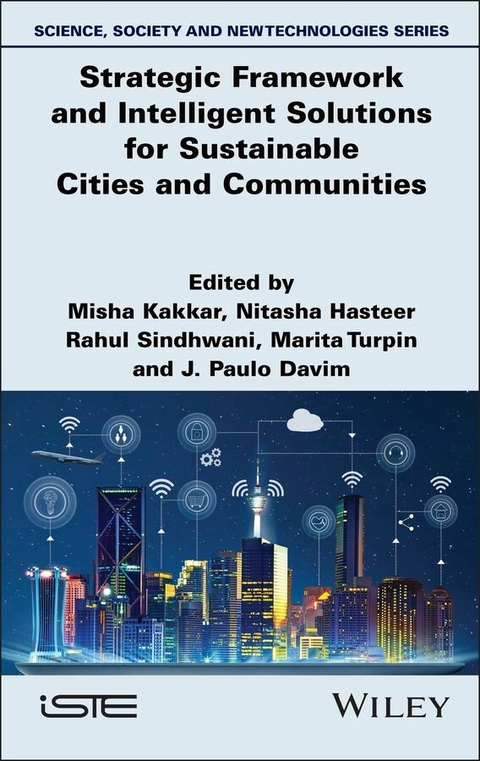
Strategic Framework and Intelligent Solutions for Sustainable Cities and Communities (eBook)
267 Seiten
Wiley-Iste (Verlag)
978-1-394-40634-0 (ISBN)
Strategic Framework and Intelligent Solutions for Sustainable Cities and Communities is a compilation of recent advancements in disruptive technologies such as AI, IoT, and Data Science, and ways to combat the challenges that are necessary for making our cities and communities sustainable.
Misha Kakkar is Associate Professor and Head of Accreditation, Ranking and Quality Assurance at the Amity School of Engineering and Technology, Amity University Uttar Pradesh, India.
Nitasha Hasteer is Professor, Head of the Information Technology Department and Deputy Director (Academics) at the Amity School of Engineering and Technology, Amity University Uttar Pradesh, India.
Rahul Sindhwani is Assistant Professor at IIM Sambalpur, India.
Marita Turpin is Full Professor in Informatics at the University of Pretoria, South Africa.
J. Paulo Davim is Full Professor at the University of Aveiro, Portugal, and a Fellow (FIET) of the Institution of Engineering and Technology (UK).
In developing economies, due to rising population and increasing migration, cities are rapidly growing. By 2050, two-thirds of all humanity (6.5 billion people) will be living in cities. Sustainable development cannot be achieved without significantly transforming how we build and manage our cities and develop communities. There is an urgent need to make our cities sustainable (i.e. creating more jobs, safe and affordable housing, and building resilient societies and economies). Technology has always been a crucial driver for economic development, and AI, IoT and Data Science should be leveraged to manage public transport, clean water and eco-friendly ways to manage waste, improve urban planning and create a sustainable environment for growth. Strategic Framework and Intelligent Solutions for Sustainable Cities and Communities is a compilation of recent advancements in disruptive technologies such as AI, IoT, and Data Science, and ways to combat the challenges that are necessary for making our cities and communities sustainable.
1
Artificial Intelligence and Sustainable Development Goals: An Overview
Sustainable development goals (SDGs) were established by the United Nations in 2015 to foster global collaboration among nations to end poverty, protect the planet and ensure peace and prosperity by 2030. Disruptive technologies such as artificial intelligence (AI) along with data science play an important role in preparing a road map on how these SDGs can be attained. This chapter highlights how AI is crucial and can help attain 11 out of 17 SDGs. Various real-life case studies and examples are discussed on how AI can be beneficial and is used by various countries as well as organizations.
1.1. Introduction
The SDGs are a collection of 17 global goals established by the United Nations in 2015 as part of the 2030 Agenda for Sustainable Development. They aim to address the world’s most pressing challenges: poverty, inequality, climate change and peace. The SDGs provide a shared blueprint for peace and prosperity for all people and the planet. They are universal, applying to every developed or developing country, ensuring no one is left behind. The SDGs, adopted by the United Nations in 2015, provide a framework for addressing the world’s most pressing issues, such as poverty, inequality, climate change and access to education. These 17 goals are a roadmap for creating a sustainable and equitable future by 2030 (Ahmad et al. 2021). The SDGs were established to address the following questions:
1) Addressing global challenges: the world faces complex, interrelated challenges such as poverty, inequality, environmental degradation and climate change. The SDGs provide a roadmap for systematically tackling these issues.
2) Building on the millennium development goals (MDGs): the SDGs were designed to build on the progress and lessons learned from the MDGs, which focused primarily on reducing extreme poverty from 2000 to 2015. While the MDGs made significant strides, they had gaps (e.g. inequality and environmental concerns) that the SDGs aim to fill.
3) Promoting sustainable development: the SDGs emphasize balancing economic growth, social inclusion and environmental protection – essential components of sustainable development.
4) Global collaboration and accountability: the SDGs encourage countries, organizations and individuals to work together toward shared goals, fostering global cooperation. They also provide measurable targets and indicators to track progress and ensure accountability.
The SDGs are built on five key themes:
– people: eradicating poverty and hunger while ensuring dignity and equality;
– planet: protecting natural resources and combating climate change;
– prosperity: promoting sustainable economic growth and innovation;
– peace: fostering just, inclusive societies;
– partnerships: encouraging global cooperation to achieve the goals.
A total of 17 SDGs are designed on these themes having 169 targets. AI has a direct impact on 11 of the SDGs. These goals are as follows:
1) SDG 1 – no poverty;
2) SDG 2 – zero hunger;
3) SDG 3 – good health and well-being;
4) SDG 4 – quality education;
5) SDG 6 – clean water and sanitation;
6) SDG 7 – affordable and clean energy;
7) SDG 8 – decent work and economic growth;
8) SDG 11 – sustainable cities and communities;
9) SDG 13 – climate change;
10) SDG 14 – life below water;
11) SDG 15 – life on land.
These SDGs are a universal call to action to end poverty, protect the planet and ensure peace and prosperity by 2030 (Wang et al. 2019; Ahmad et al. 2021). AI, with its ability to analyze data, predict outcomes and optimize processes, offers unique solutions to many of these goals. For example, AI can identify poverty hotspots, predict climate impacts, or enhance education systems, contributing significantly to global progress.
1.1.1. SDG 1 – no poverty
Poverty elimination remains a cornerstone of sustainable development. AI helps by analyzing satellite images and socioeconomic data to map poverty in real time. Organizations like the World Bank use these insights to better allocate resources. Additionally, AI can also enhance access to microloans through credit scoring systems for unbanked populations, promoting financial inclusion. To effectively tackle poverty, it is crucial to grasp its multidimensional nature. Poverty is not just the lack of income but encompasses the inability to access opportunities, resources and basic services.
Types of poverty are as follows:
1) Absolute poverty: is defined by living below a certain income threshold (e.g. $2.15/day, according to the World Bank). This type of poverty is common in low-income countries and characterized by lack of food, shelter and healthcare.
2) Relative poverty: is based on income levels relative to the median of a specific society. This type of poverty is found even in developed nations, manifesting as inequality in living standards.
3) Multidimensional poverty: includes factors like lack of education, poor health outcomes and inadequate housing. It is measured by the multidimensional poverty index (MPI), which looks beyond income.
Poverty mapping refers to the process of identifying and visualizing poverty-stricken regions using data to guide interventions. AI is transformative in making poverty mapping more accurate, efficient and actionable. By combining satellite imagery, socioeconomic data and machine learning algorithms, AI-driven poverty mapping offers more profound insights into poverty’s distribution and root causes. AI can be used in the following ways for poverty mapping:
1) Satellite imagery analysis: AI models, particularly those involving computer vision, analyze high-resolution satellite images to detect indicators of poverty, such as:
– infrastructure quality: roads, housing materials and urban density;
– agricultural patterns: crop health, land use and deforestation;
– energy access: the presence of electricity grids and light emissions at night.
2) Integrating multidimensional data: AI integrates diverse datasets, such as:
– census information: population density, literacy rates and income levels;
– mobile phone data: communication patterns and financial transactions indicating economic activity;
– climate data: environmental stressors impacting livelihoods, like droughts or floods.
By combining these datasets, AI creates multidimensional poverty indices tailored to specific regions.
3) Identifying hidden patterns: AI uncovers correlations and trends that might not be evident through traditional data analysis. For instance:
– linking educational outcomes to infrastructure quality;
– highlighting regions where environmental factors exacerbate poverty.
4) Real-time and dynamic updates: AI allows for dynamic, real-time poverty mapping by continuously analyzing incoming data, such as:
– changes in urbanization or migration patterns;
– impacts of natural disasters or economic shocks.
This capability enables timely responses to emerging crises.
5) Cost-effective and scalable solutions: Traditional poverty assessments require extensive field surveys, which are expensive and time-consuming. AI dramatically reduces costs by automating data collection and analysis, making large-scale poverty mapping feasible even in resource-limited settings (Khan et al. 2020).
Figure 1.1. Case study.
1.1.2. SDG 2 – zero hunger
Sustainable development goal 2 aims to create a hunger-free world by 2030. The global issue of hunger and food insecurity has increased alarmingly since 2015, exacerbated by a combination of factors, including the pandemic, conflict, climate change and deepening inequalities. By 2022, around 9.2% of the world’s population was in a state of chronic hunger, a staggering rise compared to 2019. These data underscore the severity of the situation, revealing a growing crisis. Around 2.4 billion people are estimated to face moderate to severe food insecurity in 2022. This classification signifies their lack of access to sufficient nourishment. This number escalated by an alarming 391 million people compared to 2019. We can harness AI for sustainable food security (Liu et al. 2021). Food security, defined as the availability, accessibility and affordability of nutritious food, is one of the most pressing global challenges. Achieving it is central to sustainable development goal 2 (zero hunger), especially in the face of population growth, climate change and resource constraints. AI is a powerful tool for addressing these challenges, offering innovative solutions to ensure food security while promoting sustainability. Various key applications of AI in agriculture are as follows:
1) Precision agriculture: AI applications can be used to optimize resource use and boost productivity by providing data-driven insights for farming practices. AI models assess soil health, nutrient content and moisture levels, recommending appropriate fertilizers and irrigation schedules. Drones equipped with AI-powered cameras detect crop health issues, such as pest infestations or nutrient deficiencies. Machine learning algorithms analyze historical and real-time data to...
| Erscheint lt. Verlag | 27.8.2025 |
|---|---|
| Reihe/Serie | ISTE Invoiced |
| Sprache | englisch |
| Themenwelt | Technik ► Architektur |
| Schlagworte | AI • Data Science • developing economies • economic development • IOT • migration • Public Transport • sustainable development • urban planning |
| ISBN-10 | 1-394-40634-7 / 1394406347 |
| ISBN-13 | 978-1-394-40634-0 / 9781394406340 |
| Informationen gemäß Produktsicherheitsverordnung (GPSR) | |
| Haben Sie eine Frage zum Produkt? |
 EPUB (Adobe DRM)
Kopierschutz: Adobe-DRM
Adobe-DRM ist ein Kopierschutz, der das eBook vor Mißbrauch schützen soll. Dabei wird das eBook bereits beim Download auf Ihre persönliche Adobe-ID autorisiert. Lesen können Sie das eBook dann nur auf den Geräten, welche ebenfalls auf Ihre Adobe-ID registriert sind.
Details zum Adobe-DRM
Dateiformat: EPUB (Electronic Publication)
EPUB ist ein offener Standard für eBooks und eignet sich besonders zur Darstellung von Belletristik und Sachbüchern. Der Fließtext wird dynamisch an die Display- und Schriftgröße angepasst. Auch für mobile Lesegeräte ist EPUB daher gut geeignet.
Systemvoraussetzungen:
PC/Mac: Mit einem PC oder Mac können Sie dieses eBook lesen. Sie benötigen eine
eReader: Dieses eBook kann mit (fast) allen eBook-Readern gelesen werden. Mit dem amazon-Kindle ist es aber nicht kompatibel.
Smartphone/Tablet: Egal ob Apple oder Android, dieses eBook können Sie lesen. Sie benötigen eine
Geräteliste und zusätzliche Hinweise
Buying eBooks from abroad
For tax law reasons we can sell eBooks just within Germany and Switzerland. Regrettably we cannot fulfill eBook-orders from other countries.
aus dem Bereich