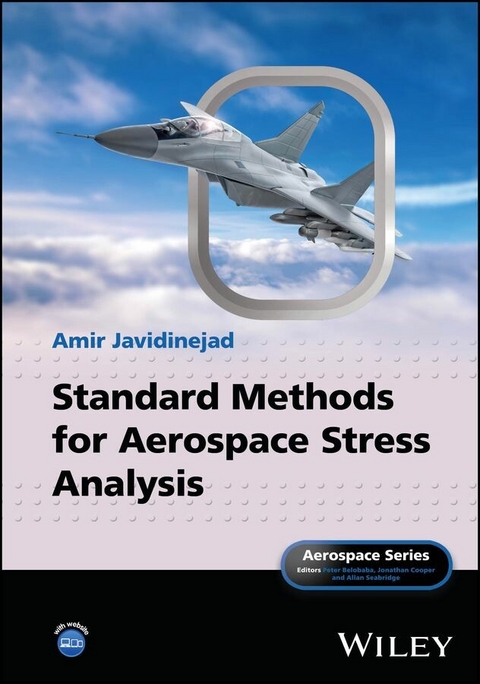
Standard Methods for Aerospace Stress Analysis (eBook)
548 Seiten
Wiley (Verlag)
978-1-394-33019-5 (ISBN)
Standard Methods for Aerospace Stress Analysis
Create safer, more reliable planes with this crucial guide
Aerospace Stress Analysis is the field of research and engineering that evaluates stresses and strains on aerospace structures. By analyzing how different materials and components respond to forces, it helps aerospace engineers build for structural integrity and safety. Combining mathematical and computational models with experimental techniques, it's a crucial component of developing viable aerospace technologies.
Standard Methods for Aerospace Stress Analysis offers a thorough, practical overview of the structural and stress analysis of both principal and secondary aircraft structures. It covers both fundamental concepts and advanced computational methods, along with key applications. With coverage of both interior and exterior structures, it's a one-stop shop for all major aspects of stress analysis.
Standard Methods for Aerospace Stress Analysis features:
- Step-by-step examples for every aircraft section
- Detailed discussion of methods including Finite Element Analysis
- An overview of key information on static, fatigue, damage tolerance, buckling, and more
Standard Methods for Aerospace Stress Analysis is ideal for professional mechanical and aerospace engineers working in the aircraft or space industries, as well as students in the field.
Amir Javidinejad received his Ph.D. in Mechanical Engineering from the University of Texas at Arlington, his M.S. in Engineering Mechanics from Georgia Institute of Technology, his B.S. in Mechanical Engineering from the University of Cincinnati, and holds a Certificate in Leadership Mastery from the UCLA-Extension. He has extensive experience in structural/solid mechanics, Finite Element Methods, machine design, and various other stress analysis methods from aerospace, military, and commercial industries, as well as from academia. His expertise and knowledge include space structures analysis, micro sensors analysis, rocket design analysis, helicopter structural repair analysis, airplane structures modifications, aircraft interior monument structures analysis, and certification and qualification testing. He has also been involved in research in the areas of structural mechanics of isotropic, anisotropic, and composite materials. Dr. Javidinejad is a Licensed Professional Mechanical Engineer in the State of California, License #38567, and in the State of Texas, License #141561. Dr. Javidinejad is a member of the Pi Tau Sigma mechanical engineering honor society, a member of the American Society of Mechanical Engineers (ASME), and a member of the American Society of Engineering Education (ASEE). Also, Dr. Javidinejad is currently a part-time Lecturer of Mechanical Engineering in the California State Polytechnic University, Pomona.
Standard Methods for Aerospace Stress Analysis Create safer, more reliable planes with this crucial guide Aerospace Stress Analysis is the field of research and engineering that evaluates stresses and strains on aerospace structures. By analyzing how different materials and components respond to forces, it helps aerospace engineers build for structural integrity and safety. Combining mathematical and computational models with experimental techniques, it s a crucial component of developing viable aerospace technologies. Standard Methods for Aerospace Stress Analysis offers a thorough, practical overview of the structural and stress analysis of both principal and secondary aircraft structures. It covers both fundamental concepts and advanced computational methods, along with key applications. With coverage of both interior and exterior structures, it s a one-stop shop for all major aspects of stress analysis. Standard Methods for Aerospace Stress Analysis features: Step-by-step examples for every aircraft section Detailed discussion of methods including Finite Element Analysis An overview of key information on static, fatigue, damage tolerance, buckling, and more Standard Methods for Aerospace Stress Analysis is ideal for professional mechanical and aerospace engineers working in the aircraft or space industries, as well as students in the field.
List of Figures
| Figure 1.1 | Stress–Strain Curve for a Typical Steel |
| Figure 1.2 | Stress–Strain Curve for a Typical Aluminum |
| Figure 1.3 | Stress–Strain Curve for a Typical Metallic Material |
| Figure 1.4 | Material Grain Direction for a Typical Metallic Material |
| Figure 1.5 | Stress–Strain Curve for typical Brittle Material (Glass, Cast Iron, and Composites) |
| Figure 1.6 | Stress Analysis Approach |
| Figure 2.1 | Semimonocoque Airframe Construction |
| Figure 2.2 | Shear‐Tie and Floating Frames |
| Figure 2.3 | The Wing Construction |
| Figure 2.4 | Metallic Wing Spars Configurations |
| Figure 2.5 | Metallic Truss Wing Spars Configurations |
| Figure 2.6 | Ribs Inside the Aircraft Wings |
| Figure 2.7 | The Vertical Stabilizer Construction |
| Figure 2.8 | The Major Component Construction of a Helicopter |
| Figure 2.9 | The SpaceX Dragon Cargo Craft and the Canadarm2 Robotic Arm |
| Figure 2.10 | The Cygnus Cargo Craft from Northrop Grumman |
| Figure 2.11 | The Lunar Module with Astronaut Edwin E. Aldrin |
| Figure 2.12 | Centroid of an Object |
| Figure 2.13 | The 2D State of Stress for an Inclined Angle |
| Figure 2.14 | Mohr’s Circle |
| Figure 3.1 | FEA Model of the Aircraft Buildup |
| Figure 3.2 | FEA Model of the Aircraft Bay Frame for Buckling |
| Figure 3.3 | Total Displacement at the Different Rocket Engine Layers due to Propellant Burn |
| Figure 3.4 | Galley Mode Shapes at Its First Two Resonance Frequencies |
| Figure 3.5 | Simulated Buckling of a Beam Member |
| Figure 3.6 | CAD Model to FEA Model |
| Figure 3.7 | Free‐body Loads on a Beam Frame from FEA Model |
| Figure 3.8 | Output Listing of Loads on a Beam Frame from FEA Model |
| Figure 3.9 | The Rod “Truss” Member at an Inclined Angle |
| Figure 3.10 | The Truss Assembly System Finite Element Model |
| Figure 3.11 | The Beam Member Deformation |
| Figure 3.12 | The Torsional Deformation of a Beam |
| Figure 3.13 | (a) Free‐Mesh and (b) High‐Density Free‐Mesh Using Membrane Shell Elements |
| Figure 3.14 | (a) High Aspect Ratio Mapped‐Mesh. (b) Low Aspect Ratio Mapped‐Mesh Using Membrane Shell Elements |
| Figure 3.15 | Von Mises Stress Levels Around the Plate Hole Radius for Different Meshes |
| Figure 3.16 | Typical Bolt Sections |
| Figure 3.17 | FEA Model of a Typical Wing Under Applied Loading |
| Figure 3.18 | Deflection Contours of a Typical Wing Under Applied Loading |
| Figure 3.19 | Beam Stress Contours of a Typical Wing Under Applied Loading |
| Figure 3.20 | Plate Stress Contours of a Typical Wing Under Applied Loading |
| Figure 3.21 | Facing Orthotropic Material Card |
| Figure 3.22 | Core Orthotropic Material Card |
| Figure 3.23 | Composite Honeycomb Sandwich Builtup Layup Card |
| Figure 3.24 | Sandwich Composite Element Properties Card |
| Figure 3.25 | Sandwich Composite Mesh Modeling |
| Figure 3.26 | Boundary Constraints for the Lavatory Attachment Interface Nodes |
| Figure 3.27 | Boundary Constraints for the Lavatory Attachment Interface Nodes |
| Figure 3.28 | FEA Model of the Aircraft Lavatory Shell Structure |
| Figure 3.29 | Failure Index Results Contour of the Aircraft Lavatory Shell Structure (F.I. > 1.00 is failure) |
| Figure 5.1 | Concentrated Loading on a Beam Structure |
| Figure 5.2 | Distributed Loading on a Beam Structure |
| Figure 5.3 | Gradually Increasing Distributed Loading on a Beam Structure |
| Figure 5.4 | Moment or Coupled Loading on a Beam Structure |
| Figure 5.5 | Beam Boundary Conditions |
| Figure 5.6 | Beam Free‐Body Diagram |
| Figure 5.7 | Shear–Moment Diagram |
| Figure 5.8 | The Bending of the Beam Between z‐ and y‐Axes |
| Figure 5.9 | Transverse Shear of the Beam Cross Section |
| Figure 5.10 | Beam Cross Section First Moment of Area Segment |
| Figure 5.11 | The “I” Beam Shear‐Stress Distribution |
| Figure 5.12 | The “T” Beam Shear‐Stress Distribution |
| Figure 5.13 | The “C‐Channel” Beam Cross Section |
| Figure 5.14 | The “C‐Channel” Beam Shear‐Stress Distribution |
| Figure 5.15 | The “Box” Beam Under Torsion |
| Figure 5.16 | Wing Ribs System |
| Figure 7.1 | Long Rectangular Membrane with Four Sides Clamped |
| Figure 7.2 | Long Rectangular Membrane with Long Sides Clamped |
| Figure 7.3 | Short Rectangular Membrane Clamped on Four Sides |
| Figure 7.4 | Coefficients (n) of Stress Equations |
| Figure 7.5 | Plate Buckling Coefficients Kc |
| Figure 7.6 | Long Plate Buckling Coefficients Kc Simply Supported |
| Figure 7.7 | Long Plate Buckling Coefficients Kc‐Fixed Supported |
| Figure 7.8 | Wide Plate Buckling Coefficients Kc Simply Supported |
| Figure 7.9 | Wide Plate Buckling Coefficients Kc‐Fixed Supported |
| Figure 7.10 | Stiffened Shear‐Resistant Beam |
| Figure 7.11 | Shear Coefficient of Buckling Ks |
| Figure 7.12 | Fscr vs. Fscr/n for Aluminum |
| Figure 7.13 | Riveted Plates |
| Figure 7.14 | Beam Under Diagonal Tension |
| Figure 7.15 | Thin Shell with Frame Rings and Stringers |
| Figure 7.16 | Frame Rings Cross Section |
| Figure 7.17 | Shear Web Beam with Cutouts |
| Figure 7.18 | Shear Web Beam with Cutouts and Stiffeners |
| Figure 7.19 | The General S–N Curve for Steel... |
| Erscheint lt. Verlag | 22.8.2025 |
|---|---|
| Reihe/Serie | Aerospace Series |
| Sprache | englisch |
| Themenwelt | Technik ► Maschinenbau |
| Schlagworte | aircraft design • buckling analysis • Composites • Damage Tolerance • Dynamic Analysis • Fatigue tolerance • FEA • Geometry • Metal Analysis • Metallic Structures • running load • Static and Dynamics • static tolerance • Stress • Structures Analysis |
| ISBN-10 | 1-394-33019-7 / 1394330197 |
| ISBN-13 | 978-1-394-33019-5 / 9781394330195 |
| Informationen gemäß Produktsicherheitsverordnung (GPSR) | |
| Haben Sie eine Frage zum Produkt? |
 EPUB (Adobe DRM)
Kopierschutz: Adobe-DRM
Adobe-DRM ist ein Kopierschutz, der das eBook vor Mißbrauch schützen soll. Dabei wird das eBook bereits beim Download auf Ihre persönliche Adobe-ID autorisiert. Lesen können Sie das eBook dann nur auf den Geräten, welche ebenfalls auf Ihre Adobe-ID registriert sind.
Details zum Adobe-DRM
Dateiformat: EPUB (Electronic Publication)
EPUB ist ein offener Standard für eBooks und eignet sich besonders zur Darstellung von Belletristik und Sachbüchern. Der Fließtext wird dynamisch an die Display- und Schriftgröße angepasst. Auch für mobile Lesegeräte ist EPUB daher gut geeignet.
Systemvoraussetzungen:
PC/Mac: Mit einem PC oder Mac können Sie dieses eBook lesen. Sie benötigen eine
eReader: Dieses eBook kann mit (fast) allen eBook-Readern gelesen werden. Mit dem amazon-Kindle ist es aber nicht kompatibel.
Smartphone/Tablet: Egal ob Apple oder Android, dieses eBook können Sie lesen. Sie benötigen eine
Geräteliste und zusätzliche Hinweise
Buying eBooks from abroad
For tax law reasons we can sell eBooks just within Germany and Switzerland. Regrettably we cannot fulfill eBook-orders from other countries.
aus dem Bereich