


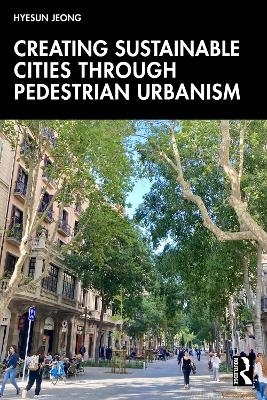
Creating Sustainable Cities Through Pedestrian Urbanism
Seiten
2026
Routledge (Verlag)
978-1-032-48326-9 (ISBN)
Routledge (Verlag)
978-1-032-48326-9 (ISBN)
- Noch nicht erschienen (ca. Februar 2026)
- Versandkostenfrei
- Auch auf Rechnung
- Artikel merken
This book explores how communities worldwide are rethinking the relationship between mobility, place, and belonging. It traces how walkable environments support environmental goals while fostering social connection and cultural vitality, demonstrating that sustainable cities are also more equitable and livable cities.
As cities grapple with climate change and social inequality, a growing movement recognizes walking as fundamental to urban sustainability. Creating Sustainable Cities Through Pedestrian Urbanism explores how communities worldwide are rethinking the relationship between mobility, place, and belonging.
Drawing from diverse cities across North America, Europe, and Asia, this book examines the shift from car-dominated planning toward human-centered design. It traces how walkable environments support environmental goals while fostering social connection and cultural vitality, demonstrating that sustainable cities are also more equitable and livable cities.
This book investigates varied examples: cultural programming in transit stations, night festivals and murals, pedestrian-friendly street transformations, adaptive public spaces, and community-led initiatives. It considers how everyday elements—café culture, green infrastructure, neighborhood events—contribute to places that are both environmentally responsible and socially cohesive.
Written for urban practitioners, community advocates, and engaged citizens, this book offers insights rather than prescriptions, recognizing that each place requires its own approach to pedestrian urbanism. By examining what works and what doesn't across different contexts and scales, Creating Sustainable Cities Through Pedestrian Urbanism contributes to ongoing conversations about building cities that serve both people and planet. Sustainable urban futures, it suggests, may be closer than we walk.
As cities grapple with climate change and social inequality, a growing movement recognizes walking as fundamental to urban sustainability. Creating Sustainable Cities Through Pedestrian Urbanism explores how communities worldwide are rethinking the relationship between mobility, place, and belonging.
Drawing from diverse cities across North America, Europe, and Asia, this book examines the shift from car-dominated planning toward human-centered design. It traces how walkable environments support environmental goals while fostering social connection and cultural vitality, demonstrating that sustainable cities are also more equitable and livable cities.
This book investigates varied examples: cultural programming in transit stations, night festivals and murals, pedestrian-friendly street transformations, adaptive public spaces, and community-led initiatives. It considers how everyday elements—café culture, green infrastructure, neighborhood events—contribute to places that are both environmentally responsible and socially cohesive.
Written for urban practitioners, community advocates, and engaged citizens, this book offers insights rather than prescriptions, recognizing that each place requires its own approach to pedestrian urbanism. By examining what works and what doesn't across different contexts and scales, Creating Sustainable Cities Through Pedestrian Urbanism contributes to ongoing conversations about building cities that serve both people and planet. Sustainable urban futures, it suggests, may be closer than we walk.
Hyesun Jeong is an architect, urban designer, and researcher whose work explores the intersection of cultural placemaking, sustainable urbanism, and public space. She is Assistant Professor of Urban Design at the University of Cincinnati.
Introduction
1. Utopian Visions and Future Cities
2. Human-Scale and Multimodal Cities
3. Main Street as Everyday Urbanism
4. Café Urbanism: How Bohemian Culture Activates City Streets
5. Ecological Urbanism: Trails, Greenways, and Climate Resilience
6. Cultural Placemaking in Global Cities
Conclusion
| Erscheint lt. Verlag | 1.2.2026 |
|---|---|
| Zusatzinfo | 8 Tables, black and white; 9 Line drawings, black and white; 72 Halftones, black and white; 81 Illustrations, black and white |
| Verlagsort | London |
| Sprache | englisch |
| Maße | 156 x 234 mm |
| Themenwelt | Naturwissenschaften ► Geowissenschaften ► Geografie / Kartografie |
| Sozialwissenschaften ► Soziologie | |
| Technik ► Bauwesen | |
| ISBN-10 | 1-032-48326-1 / 1032483261 |
| ISBN-13 | 978-1-032-48326-9 / 9781032483269 |
| Zustand | Neuware |
| Informationen gemäß Produktsicherheitsverordnung (GPSR) | |
| Haben Sie eine Frage zum Produkt? |
Mehr entdecken
aus dem Bereich

aus dem Bereich
Buch | Hardcover (2024)
Schweizerbart'sche, E. (Verlag)
CHF 33,55
Sammlung vermessungstechnischer Aufgaben mit ausführlichen Lösungen
Buch | Softcover (2025)
Wichmann, H (Verlag)
CHF 37,80
über eine faszinierende Welt zwischen Wasser und Land und warum sie …
Buch | Hardcover (2023)
dtv (Verlag)
CHF 33,55


