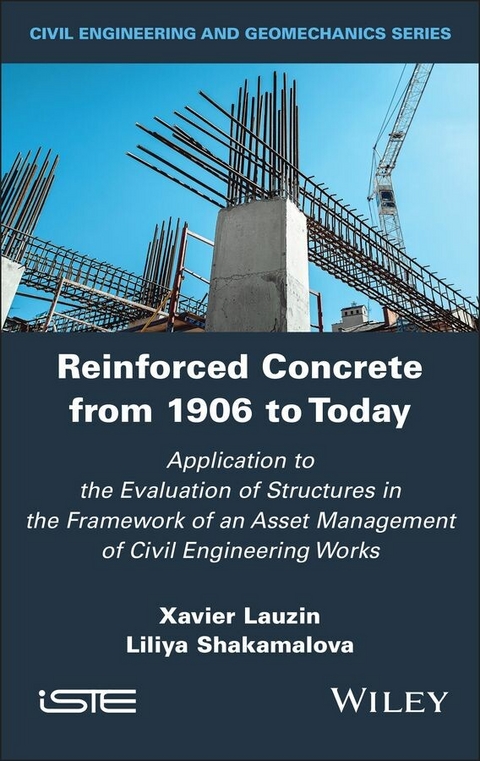
Reinforced Concrete from 1906 to Today (eBook)
501 Seiten
Wiley-Iste (Verlag)
978-1-394-40168-0 (ISBN)
The question that regularly arises for the engineer charged with assessing an existing structure that has not deteriorated concerns how to establish the structural diagnosis of the structure. First, it is necessary to ensure that the structure, when subjected to loads and overloads, retains its normal behavior, i.e. conforms to the design predictions. It is essential to understand why and how design and construction rules have evolved, as well as their inaccuracies, shortcomings and even errors.
Reinforced Concrete from 1906 to Today details the various calculation codes introduced into French regulations, from the first in 1906 to Eurocode 2, which is currently in force.
Xavier Lauzin is an expert in civil engineering structures. He is a graduate of ESTP and teaches at CESI, Conservatoire national des arts et métiers, Office International de l'Eau and ENGEES, France.
Liliya Shakamalova is a specialist in Franco-Russian building and civil engineering structures. She is a graduate of the Engineering Faculty of the Russian Peoples' Friendship University, Department of Construction, Russia.
The question that regularly arises for the engineer charged with assessing an existing structure that has not deteriorated concerns how to establish the structural diagnosis of the structure. First, it is necessary to ensure that the structure, when subjected to loads and overloads, retains its normal behavior, i.e. conforms to the design predictions. It is essential to understand why and how design and construction rules have evolved, as well as their inaccuracies, shortcomings and even errors. Reinforced Concrete from 1906 to Today details the various calculation codes introduced into French regulations, from the first in 1906 to Eurocode 2, which is currently in force.
Introduction
In 1897, Charles Rabut created the first course on reinforced concrete at the École des Ponts, France. Initially composed of four lessons, the course was increased to 10 lessons in 1910. This course provided an explanation of the French ministerial regulations on reinforced concrete as well as detailed explanations of around 30 most interesting constructions.
In Chapter 2 of his 1910 course on the “General Design of Reinforced Concrete”, Charles Rabut defined this construction method as “a generic form embracing an unlimited number of very different construction processes, several of which may have a broader scope than that of masonry and almost as broad as that of steel framework. The elements differentiating these systems are the relative positions of the steel and the concrete; the steel can be added to concrete (reinforced concrete), the concrete inside the metal (fretted concrete), or even incomplete penetration of one into the other, which can be achieved in various ways”.
The course discussed the advantages of this new construction method, namely:
- Flexibility: it was possible to make many more different combinations with reinforced concrete than with traditional masonry or metal elements. Concrete thus offered a greater number of solutions; it could adapt better to more varied needs.
- Resistance compared to that of masonry in extension and that of metal in compression.
- Safety: Charles Rabut specified that “if unforeseen circumstances occur leading to an overturning in the direction of the forces, a masonry structure (which acts on the extension) becomes compromised and a metal structure buckles. Concrete combining the two types of resistance copes better with these unforeseen forces”.
- Better resistance to dynamic loads: in particular, in terms of shocks and vibrations. This conclusion was reached following the results of a Franco–Swiss study on around 10 reinforced concrete structures in the former Jura-Simplon railway network, classified as bridges with a span of 2–5 m, built 8–15 years before. These structures with heavily loaded tracks showed no cracks.
- Better resistance to fire.
- Resistance to bad weather: the course specified that “one can wonder if the metal could be affected by humidity in cracks occurring in the concrete. If cracks occur, they always stop at the reinforcements and narrow from the external surface to the steel present, where their opening reaches zero”.
- Resistance to locomotive smoke.
- Ease of execution: ease of transport of constituent materials and ease of implementation (compared to metal frames or masonry assemblies).
- Increasing stability with age of construction.
Nowadays, the engineer responsible for assessing an existing, non-damaged structure must know how to perform a structural diagnosis of the structure. First, it is necessary to ensure that the latter, subjected to loads and live loads, maintains normal behavior, that is, as considered during the design. It will therefore be necessary to determine and consider its general or local resistance according to the rules applicable at the date of construction. It is indeed necessary to know why and how the calculation and construction rules have changed, what are their inaccuracies, their inadequacies and sometimes even their errors.
The purpose of this book is to provide the different calculation codes introduced into French regulations from the first in 1906 to Eurocode 2 applicable today.
It was decided to present the different regulations as summarized by Eurocodes to facilitate understanding and comparisons:
- section 1: general overview;
- section 2: bases of design;
- section 3: materials;
- section 4: durability and cover for reinforcement;
- section 5: structural analysis;
- section 6: calculation of structures;
- section 7: constructive provisions.
Figure I.1. Reinforced concrete course (in French) by Charles Rabut
The main dates of change in regulatory texts are summarized in Table I.1.
Table I.1. Classification of regulations in chronological order
(source: SETRA)
| Year | Name | Classification | Domain | Reference | Subtitle |
|---|
| Reinforced concrete | Prestressed concrete | Metal | Mixed | Civil loads | Military loads |
|---|
| August 1852 | X | Decree of August 10, 1852, regulating the policing of traffic and public messaging |
| February 1858 | X | Memorandum on railway bridge tests (for the record) |
| June 1869 | X | X | Memorandum of June 15, 1869, relating to the tests to be carried out on metal bridges intended for land routes | First regulation of loads and calculation for metal road bridges. Refers to the memorandum of February 26, 1858, relating to the tests of railway bridges |
| July 1877 | X | X | Memorandum of July 8, 1877, relating to the February 26, 1858, and June 15, 1869, revisions relating to the testing of metal bridges | This memorandum deals with both the rules of loads and calculation |
| August 1891 | X | X | Memorandum of August 29, 1891, relating to the revision of the 1877 memorandum on new rules relating to the testing of metal bridges | This memorandum, like the previous one, deals with both loads and calculations. |
| October 1906 | BA_06 | ? | X | X | X | Memorandum October 20, 1906 | Use of reinforced concrete |
| January 1915 | RC_1915 | 15-1 | X | X | X | Memorandum of January 8, 1915 | Metal bridges – Load regulation |
| June 1920 | ? | X | Memorandum of June 1, 1920 |
| May 1927 | RC_1927 | 27-2 | X | X | X | Memorandum series A No. 3 of May 10, 1927 | Metal bridges and reinforced concrete bridges |
| May 1930 | ? | X | Memorandum of May 5, 1930 |
| February 1933 | 33-1 | X | Memorandum series A No. 1 of February 7, 1933 | Metal bridges and reinforced concrete bridges |
| July 1934 | BA_34 | 34-1 | X | Memorandum series A No. 8 of July 19, 1934 | Regulation BA 34 |
| May 1937 | ? | Memorandum series A No. 3 of May 10, 1937 |
| March 1939 | 39-2 | X | Memorandum series A No. 4 of March 7, 1939 | Metal bridges and reinforced concrete bridges |
| May 1939 | 39-1 | X | Memorandum of May 5, 1939 | Resistance conditions of civil engineering structures |
| August 1940 | RC_1940 | 40-1 | X | Memorandum A-1 of August 29, 1940 | Metal bridges and reinforced concrete bridges |
| October 1944 | 44-1 | X | Memorandum series A No. 27 of October 14, 1944 | Amendment of Article 2 of the Regulation of May 10, 1927, for the calculation and testing of metal bridges |
| February 1946 | 46-2 | X | Memorandum series A No. 27 of February 11, 1946 | Guidelines relating to the memorandum on heavy military equipment on civil engineering structures |
| February 1946 | 46-2 | X | Memorandum series B No. 27 of February 11, 1946 | Guidelines on the movement of heavy military equipment on civil engineering structures |
| April 1946 | 46-4 | X | Memorandum series A No. 21 of April 30, 1946 | Guidelines for the calculation of steel frames and... |
| Erscheint lt. Verlag | 20.8.2025 |
|---|---|
| Reihe/Serie | ISTE Invoiced |
| Sprache | englisch |
| Themenwelt | Naturwissenschaften ► Chemie |
| Technik ► Maschinenbau | |
| Schlagworte | Building Materials • Building Regulations • calculation codes • Civil Engineering • Construction rules • Geomechanics • reinforced concrete |
| ISBN-10 | 1-394-40168-X / 139440168X |
| ISBN-13 | 978-1-394-40168-0 / 9781394401680 |
| Informationen gemäß Produktsicherheitsverordnung (GPSR) | |
| Haben Sie eine Frage zum Produkt? |
 EPUB (Adobe DRM)
Kopierschutz: Adobe-DRM
Adobe-DRM ist ein Kopierschutz, der das eBook vor Mißbrauch schützen soll. Dabei wird das eBook bereits beim Download auf Ihre persönliche Adobe-ID autorisiert. Lesen können Sie das eBook dann nur auf den Geräten, welche ebenfalls auf Ihre Adobe-ID registriert sind.
Details zum Adobe-DRM
Dateiformat: EPUB (Electronic Publication)
EPUB ist ein offener Standard für eBooks und eignet sich besonders zur Darstellung von Belletristik und Sachbüchern. Der Fließtext wird dynamisch an die Display- und Schriftgröße angepasst. Auch für mobile Lesegeräte ist EPUB daher gut geeignet.
Systemvoraussetzungen:
PC/Mac: Mit einem PC oder Mac können Sie dieses eBook lesen. Sie benötigen eine
eReader: Dieses eBook kann mit (fast) allen eBook-Readern gelesen werden. Mit dem amazon-Kindle ist es aber nicht kompatibel.
Smartphone/Tablet: Egal ob Apple oder Android, dieses eBook können Sie lesen. Sie benötigen eine
Geräteliste und zusätzliche Hinweise
Buying eBooks from abroad
For tax law reasons we can sell eBooks just within Germany and Switzerland. Regrettably we cannot fulfill eBook-orders from other countries.
aus dem Bereich