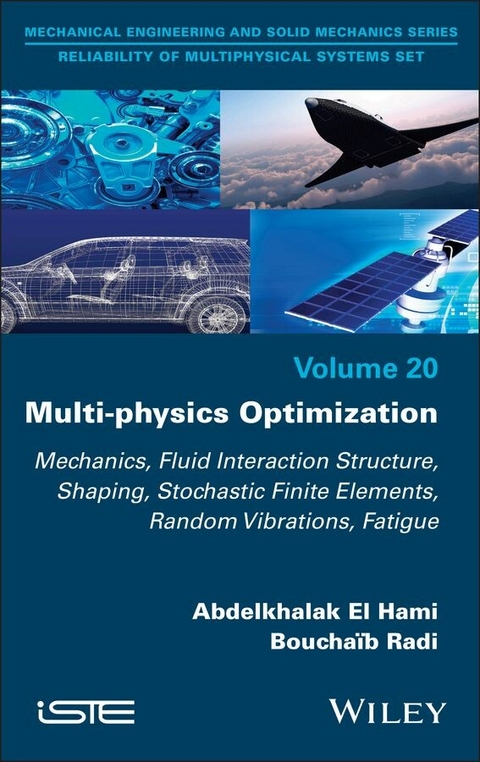
Multi-physics Optimization (eBook)
364 Seiten
Wiley-Iste (Verlag)
978-1-394-40171-0 (ISBN)

This book illustrates, in detail, the state of the art in the multidisciplinary science of multi-physics optimization. In a context of the perpetual search for improved industrial competitiveness, the evolution of product design and optimization methods and tools appears to be a strategic necessity in view of the imperative to reduce costs. In the aeronautics sector, resources are mainly focused on forecasting and controlling the costs incurred by failures that occur at commissioning, during the warranty period, and during aircraft operation. However, in the future, new contracts for the sale of aeronautical equipment will become increasingly oriented toward sales by the hour of operation.
The aim of this book is to propose new methods for reliability-based optimization, enabling an analysis of a system's life cycle. The V-cycle allows development phases to be viewed in terms of development time and levels of integration complexity.
Multi-physics Optimization is dedicated to optimization methods for multi-physics problems. Each chapter clearly sets out the techniques used and developed and accompanies them with illustrative examples. The book is aimed at students but is also a valuable resource for practicing engineers and research lecturers.
Abdelkhalak El Hami is University Professor at INSA Rouen Normandie, France, and is the author (or co-author) of over sixty books. He is responsible for several European educational and/or research projects as a specialist in the fields of optimization, reliability and AI of multiphysics systems.
Mohamed Eid is University Professor at the Settat Faculty of Science and Technology, Hassan Premier University, Morocco. He is the author of several books, specializing in numerical optimization methods and system reliability.
This book illustrates, in detail, the state of the art in the multidisciplinary science of multi-physics optimization. In a context of the perpetual search for improved industrial competitiveness, the evolution of product design and optimization methods and tools appears to be a strategic necessity in view of the imperative to reduce costs. In the aeronautics sector, resources are mainly focused on forecasting and controlling the costs incurred by failures that occur at commissioning, during the warranty period, and during aircraft operation. However, in the future, new contracts for the sale of aeronautical equipment will become increasingly oriented toward sales by the hour of operation. The aim of this book is to propose new methods for reliability-based optimization, enabling an analysis of a system s life cycle. The V-cycle allows development phases to be viewed in terms of development time and levels of integration complexity. Multi-physics Optimization is dedicated to optimization methods for multi-physics problems. Each chapter clearly sets out the techniques used and developed and accompanies them with illustrative examples. The book is aimed at students but is also a valuable resource for practicing engineers and research lecturers.
1
Introduction to Optimization in Mechanics
1.1. Introduction
The purpose of this chapter is to present a nonexhaustive state of the art of all of the fields that will be directly or indirectly covered in this book.
The first section of this chapter is dedicated to the general study of structural dynamics. This study will make it possible to define the notations essential to the calculation of dynamic responses, to the calculation of frequencies, eigenmodes and response functions. All of these aspects will be addressed in detail and through practical applications.
One of two conventional strategies can be used to solve the system of dynamical equilibrium equations of a structure [IMB 95]. The most common solution strategy in dynamic range is modal superposition, which is suitable for linear structures in which only the first modes are excited. On the other hand, direct solving methods use the integration of equations of motion, in order to deal with nonlinear structures. The latter can also be applied when the frequency content of the excitation covers a large number of modes of the mechanical structure under study.
The second section of this chapter is a presentation of a bibliographic study of structural optimization. The goal is to obtain the appropriate shapes for a part by minimizing a given criterion. In every area of structural mechanics, the impact of the proper design of a part is very important for its strength, service life and application use. This challenge is a daily one in high-tech sectors. The development of the art of engineering requires considerable effort to constantly improve structural design techniques. Optimization is essential in increasing performance and reducing the weight of aerospace and automotive vehicles, thus leading to substantial energy savings.
The last section of this chapter is dedicated to the description of the different tools for structural analysis with uncertain parameters. The taking into account of parameter uncertainty is a particularly critical problem in vibrational mechanics. However, the consideration of this effect can respond to different types of needs, where two main categories can be distinguished: analysis and design. In general, the modeled parts or structures must satisfy given specifications, which require, for example, that safety, reliability or comfort standards be observed.
During deterministic design, engineers try to find the best possible design among all of the potential solutions they have to study. This choice is based on cost as well as on improving product quality. In this case, the designer’s objectives to get an optimal design are devised without worrying about the accuracy of the mechanical characteristics of the materials, the geometry and loading (uncertainty effects). The resulting optimal design may therefore represent an inadequate level of reliability. The objective of the approach integrating reliability analysis into the optimization problem and called RBDO (for Reliability Based Design Optimization) is to design structures while establishing the best compromise between cost and the proper functioning of the device
1.2. Problems of general dynamics
Figure 1.1. System Ω subject to forces.
The formulation of a problem of dynamics in small perturbations on a domain Ω of boundary (see Figure 1.1) and in a time interval [0, T] is:.
Initial conditions:
Boundary conditions:
u is the displacement vector, σ and ε are respectively the stress and strain tensor. ρ is the density. Vectors g, f and u respectively represent the volume force, the external force and the imposed displacement. is the normal vector to the surface.
In the case of an isotropic elastic domain, the law of behavior is written as:.
l and m are the functions of Young’s modulus and Poisson’s ratio n:
The dynamic problem presented above for this elastic example can be represented by the Navier equation as follows:
where ∇2 denotes the Laplacian operator: and “∇” is the notation of the divergence operator:
1.2.1. Finite element methods
For structures with complex geometries, numerical methods such as the finite element method are used. In an elastodynamic problem, the displacements are generally expressed by a combination of vectors [GMÜ 97]:
where [B(x)] is the matrix of shape functions, and {q (t )} is the vector of discrete real displacements, whose components are the discrete unknowns of the approximation.
In general, a structural mechanics problem, after discretization, is described by a system of second-order equations:.
where N is the number of degrees of freedom of the system; M ( N × N ) is the positive definite symmetric mass matrix, C ( N × N ) and K ( N × N ) are the viscous damping and stiffness non-negative definite symmetric matrices respectively. F is the vector of the applied forces.
Mathematically, equation [1.11] represents a system of second-order differential equations that can be solved either by a direct integration method or by the mode superposition method
1.2.2. Modal assumption method
We apply the following modal transformation to system [1.11]:
{p} is the vector of generalized coordinates; [Φ] is the modal matrix verifying the orthogonality properties: [Φ]T [M ][Φ] = I and [Φ]T [K][Φ] = [w2] with: , where wi is the natural angular frequency, equation [1.12] reverts to:.
where {P} = [Φ]T {F} is the modal force vector.
It can be assumed that the damping matrix is proportional to the mass and stiffness matrix. This assumption, known as the Rayleigh assumption, is quite commonly used in structural analysis. It therefore postulates that:
which amounts to writing that:
The decoupled system becomes:
The factor ζi is called the reduced damping coefficient for the i-th mode. α and β are the initially unknown values and are calculated from the reduced damping coefficient ζi.
Figure 1.2. Damping coefficient graph.
In Figure 1.2, we graphically present the modal damping coefficient ζ; note that the sum of the two functions is almost constant at damping over the frequency range of interest. Thereby, given the modal damping (ζ) and a frequency interval (f1 and f2), the two equations can be simultaneously solved to determine α and β
and
1.2.3. Direct integration
There are many methods to integrate differential equations. The general procedure consists of discretizing time and formulating what happens at time “t+Δt” as a function of what happens at time “t” based on Taylor expansions; in this part, we present the Newmark method and the Wilson method.
1.2.3.1. Newmark method
Newmark proposed a method where the velocity and displacements at t+Δt are estimated with respect to and to accelerations . In addition, the displacement and velocity are developed in the Taylor series using the two independent parameters β and γ as well as the time step [KLE 92]:
where and are the approximations of and respectively, and tn+1 = tn + Δ t, with Δt being the time steps, the two independent parameters β and γ ensure the accuracy and stability of the solution. When γ ≥ 1/ 2. β ≥ (γ + 0.5) / 4.
By carrying these equations forward into the equation of motion, the following matrix relation is obtained:
with and
The acceleration at time t = 0 is provided by the equilibrium conditions and the initial conditions on {q} and . The solution of equation [1.23] requires that a linear system be solved at each time step.
1.2.3.2. The Wilson-q method
This is an extension of a method in which the acceleration is assumed to linearly vary over the interval [ n Δ t , ( n + 1) Δ t ]; Wilson [KLE 92] assumes that this linear variation occurs over the interval [ n Δ t , ( n + 1)...
| Erscheint lt. Verlag | 19.8.2025 |
|---|---|
| Reihe/Serie | ISTE Invoiced |
| Sprache | englisch |
| Themenwelt | Technik ► Maschinenbau |
| Schlagworte | Aeronautics • fatigue • fluid interaction structure • Industrial competitiveness • Mechanics • multi-physics optimization • Product design • random vibrations • Shaping • Stochastic Finite Elements • V-cycle |
| ISBN-10 | 1-394-40171-X / 139440171X |
| ISBN-13 | 978-1-394-40171-0 / 9781394401710 |
| Informationen gemäß Produktsicherheitsverordnung (GPSR) | |
| Haben Sie eine Frage zum Produkt? |
 EPUB (Adobe DRM)
Kopierschutz: Adobe-DRM
Adobe-DRM ist ein Kopierschutz, der das eBook vor Mißbrauch schützen soll. Dabei wird das eBook bereits beim Download auf Ihre persönliche Adobe-ID autorisiert. Lesen können Sie das eBook dann nur auf den Geräten, welche ebenfalls auf Ihre Adobe-ID registriert sind.
Details zum Adobe-DRM
Dateiformat: EPUB (Electronic Publication)
EPUB ist ein offener Standard für eBooks und eignet sich besonders zur Darstellung von Belletristik und Sachbüchern. Der Fließtext wird dynamisch an die Display- und Schriftgröße angepasst. Auch für mobile Lesegeräte ist EPUB daher gut geeignet.
Systemvoraussetzungen:
PC/Mac: Mit einem PC oder Mac können Sie dieses eBook lesen. Sie benötigen eine
eReader: Dieses eBook kann mit (fast) allen eBook-Readern gelesen werden. Mit dem amazon-Kindle ist es aber nicht kompatibel.
Smartphone/Tablet: Egal ob Apple oder Android, dieses eBook können Sie lesen. Sie benötigen eine
Geräteliste und zusätzliche Hinweise
Buying eBooks from abroad
For tax law reasons we can sell eBooks just within Germany and Switzerland. Regrettably we cannot fulfill eBook-orders from other countries.
aus dem Bereich