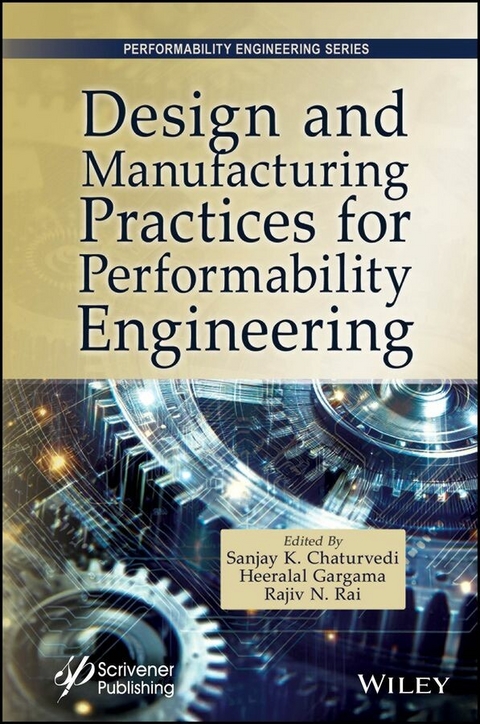
Design and Manufacturing Practices for Performability Engineering (eBook)
628 Seiten
Wiley-Scrivener (Verlag)
978-1-394-34571-7 (ISBN)
'As technology continues to reshape the world, this book stands as a testament to the importance of maintaining the highest standards of performability engineering in the pursuit of progress. I expect that this book will inspire the next generation of innovators and problem solvers to tackle the challenges and opportunities of today and tomorrow, ensuring a future where technology serves humanity with utmost dependability and safety'. Professor Way Kuo in the Foreword to Design and Manufacturing Practices for Performability Engineering
There are several aspects involved when evaluating a system's performance, such as reliability, cost, quality, safety, maintainability, risks, and performance-related characteristics. Performability engineering provides a unified framework for integrating these aspects in a quantified manner, enabling informed decisions about a system. However, this field faces the daunting task of unifying diversified disciplines and theories that address issues such as quality, reliability, availability, maintainability, and safety (QRAMS), as well as engineering characteristics, statistical data analysis, multi-criteria decision-making, and applications of deep and machine learning. This book documents the latest ideas presented by world leaders in the QRAMS domain. Through diverse chapters, this volume represents the vitality of QRAMS in performability engineering. Design and Manufacturing Practices for Performability Engineering serves as a useful resource for practicing engineers and researchers pursuing this challenging and relevant area for sustainable development.
Readers will find the book:
- Describes network reliability measures and algorithms to evaluate them in an easily understandable manner;
- Introduces the notion of global cuts and their applications to evaluate reliability measures and flow network reliability, and provides a general framework for reliability evaluation;
- Serves as a valuable reference and primer in the area of network reliability;
- Offers up-to-date research in the field of network reliability.
Audience
Researchers and educators of reliability engineering, electrical, computer science, electronics, and communication engineering with their associated allied areas. Industry analysts and design engineers of engineering systems will also find this book valuable.
Sanjay K. Chaturvedi, PhD is a professor and former head of the Subir Chowdhury School of Quality and Reliability, Indian Institute of Technology, Kharagpur (WB), India with 33 years of teaching and research experience. He's executed several research and consultancy projects in the QRAMS domain sponsored by private and government organizations. He has published multiple journals articles and three books. His research interests include reliability modeling, analysis, and data, repairable systems, and maintenance.
Heeralal Gargama, PhD is an assistant professor at the Subir Chowdhury School of Quality and Reliability, Indian Institute of Technology, Kharagpur (WB), India since 2021. He has worked in the private industry performing Reliability Availability Maintainability and Safety (RAMS) studies and implementing various projects in the railway, defense, commercial aerospace equipment, and automotive industries. His research focuses on railway RAMS, functional safety, physics of failure, and system modeling and analysis.
Rajiv N. Rai, PhD is an associate professor at the Subir Chowdhury School of Quality and Reliability, Indian Institute of Technology, Kharagpur (WB), India with over 29 years of experience in the field of reliability, quality, and maintenance engineering. He has 23 years of industrial experience with the Indian Air Force, working at all levels of maintenance, repair, and overhaul of aircraft, aeroengines, and their components. His research interests include repairable systems reliability analysis, quality engineering and management, and reliability and maintenance engineering.
As technology continues to reshape the world, this book stands as a testament to the importance of maintaining the highest standards of performability engineering in the pursuit of progress. I expect that this book will inspire the next generation of innovators and problem solvers to tackle the challenges and opportunities of today and tomorrow, ensuring a future where technology serves humanity with utmost dependability and safety . Professor Way Kuo in the Foreword to Design and Manufacturing Practices for Performability Engineering There are several aspects involved when evaluating a system s performance, such as reliability, cost, quality, safety, maintainability, risks, and performance-related characteristics. Performability engineering provides a unified framework for integrating these aspects in a quantified manner, enabling informed decisions about a system. However, this field faces the daunting task of unifying diversified disciplines and theories that address issues such as quality, reliability, availability, maintainability, and safety (QRAMS), as well as engineering characteristics, statistical data analysis, multi-criteria decision-making, and applications of deep and machine learning. This book documents the latest ideas presented by world leaders in the QRAMS domain. Through diverse chapters, this volume represents the vitality of QRAMS in performability engineering. Design and Manufacturing Practices for Performability Engineering serves as a useful resource for practicing engineers and researchers pursuing this challenging and relevant area for sustainable development. Readers will find the book: Describes network reliability measures and algorithms to evaluate them in an easily understandable manner; Introduces the notion of global cuts and their applications to evaluate reliability measures and flow network reliability, and provides a general framework for reliability evaluation; Serves as a valuable reference and primer in the area of network reliability; Offers up-to-date research in the field of network reliability. Audience Researchers and educators of reliability engineering, electrical, computer science, electronics, and communication engineering with their associated allied areas. Industry analysts and design engineers of engineering systems will also find this book valuable.
Preface
In this rapidly evolving world of engineering, where reliability and performance are paramount, it is crucial to stay abreast of the latest design and manufacturing practices that can enhance the performability of engineering systems. The field of performability engineering encompasses the integration of some of its limbs, namely, quality, reliability, maintainability, availability, and safety (QRAMS) considerations into the design and manufacturing processes. It recognizes that a system’s performance is not solely determined by its functionality but also by its ability to operate reliably, be easily maintained, and ensure the safety of its users.
The COVID-19 pandemic has not only significantly impacted people’s livelihoods, health, food systems, and the global education system but also affected millions of students, exacerbating existing challenges in technical education systems worldwide. The pandemic caused a dramatic loss of human life worldwide and presented an unprecedented challenge to almost all walks of life. Many people who were not connected to the internet lost access to health care and education during the pandemic. During the first 12 months of the pandemic, 1.5 billion students across 188 countries were unable to attend school in person due to lockdowns. Nearly 147 million children missed more than half of their in-person schooling between 2020 and 2022. The disruption caused by closures of institutions has resulted in significant learning loss for an entire generation. According to a report by the World Bank, UNESCO, and UNICEF, this generation of students risks losing US $17 trillion in lifetime earnings due to school closures. Practical skills training, assessment, and certification were severely affected, as hands-on learning became challenging during the pandemic.
In summary, the pandemic has highlighted the need for resilience, innovation, and global cooperation to mitigate the long-term effects of disrupted education systems. And so, there was a revolution in the extensive use of internet-based online platforms and innovations in content delivery. Platforms such as Microsoft Teams, Zoom, and Webex became essential and inseparable tools for virtual meetings, video conferencing, and collaboration. The prevailing situation of COVID-19 inspired us to organize a fortnightly thematic series on performability engineering, covering its components QRAMS. This was incarnated as a distinguished speaker series on QRAMS, wherein 23 eminent speakers participated to deliver one-hour lectures from January 2022 to December 2022. The recorded lectures of these series can be found at https://www.youtube.com/channel/UCAN8cwhMgqPDj7ARaTKIbvA/videos.
This edited book is an outcome of the lectures in the above lecture series. It consists of 16 chapters, with 12 chapters based on the authors’ talks in that series. The other four chapters give a glimpse of the type of current research work that is being carried out at our school, Subir Chowdhury School of Quality and Reliability, IIT Kharagpur, West Bengal, India.
This book aims to provide a comprehensive overview of modern design and manufacturing practices that can effectively address the challenges of performability engineering. The journey through this book begins with an exploration of the mathematical and physical realities of reliability discussed in Chapter 1. It delves into the importance of understanding the duality between mathematical predictions and physical observations, highlighting the discrepancies that can arise and the implications for reliability engineering. From childhood dreams of motorsport to assembling a car and participating in rallies, the author explored the challenges faced in maintaining reliability and crossing the finish line. Through these experiences, he comes to realize the limitations of traditional mechanical engineering knowledge in addressing the complexities of reliability. Drawing from the author’s personal experiences and real-world examples, it discusses the significance of reliability in various industries, such as defense, aerospace, and nuclear power systems. Through scientific studies and observations of failure events, it also uncovers the complexities and nuances of reliability in practice, emphasizing the need for a holistic approach that considers both mathematical models and physical realities.
Chapter 2 discusses models and solutions for practical reliability and availability assessment in modern technical systems, emphasizing their importance due to potential economic losses, reputation damage, and loss of lives from system failures. It highlights the need for scalable and high-fidelity quantitative assessment techniques and introduces two approaches: data-driven and model-driven. Focusing on the model-driven approach, specifically stochastic models that rely on understanding system behavior and component interactions, it explains how these models can provide insights and identify bottlenecks. The chapter discusses methods for solving stochastic models, including analytic-numeric techniques and discrete-event simulation, mentioning software like SHARPE and SPNP for analysis. It concludes by covering different modeling formalisms used in reliability and availability assessment, such as monolithic and multi-level models, emphasizing the importance of considering dependencies among components and using state space and non-state-space formalisms to capture the dynamic behavior of complex systems.
Chapter 3 is about the reliability prediction of artificial hip joints and the development of a physics-based wear degradation model to estimate wear volume and reliability metrics. This chapter provides a comprehensive overview of the development and validation of a physics-based wear degradation model for artificial hip joint bearings. The chapter discusses the factors that contribute to wear in hip implants, such as bearing materials, geometries, loading, and motion. It introduces the Archard Law wear modeling approach and the use of a stochastic gamma process for wear degradation modeling. The chapter also explores the effects of various factors on the wear volume of hip implants, including implant materials, implant geometry, patient activity level, and patient weight changes. The validation of the wear degradation model using experimental data from hip simulator tests is discussed, along with the estimation of the mean time to failure and reliability prediction of hip implants. Overall, this chapter provides valuable insights into the field of hip implant research and development, offering a physics-based approach to predicting wear volume and assessing the reliability of artificial hip joints.
Chapter 4 provides valuable insights into the principles and practices of quality improvement and highlights the interconnectedness of various qualities in a system. It talks about the principles and philosophy for an integrated and distributed approach to reliability and extensions to other qualities. This chapter examines the various dimensions of performability engineering, including quality, reliability, maintainability, safety, security, robustness, resilience, and sustainability. It emphasizes the importance of understanding and defining these qualities to effectively communicate and improve them. The chapter also delves into the principles and philosophy behind quality improvement, as well as the integration of time-oriented qualities. Additionally, this chapter explores the role of probability and statistics in measuring and predicting quality and introduces the concepts of prognostics and feedforward control as methods for preventing future failures.
Chapter 5 provides an overview of the analytical toolbox designed to optimize Condition-Based Maintenance (CBM) decisions, focusing on the use of proportional hazards models (PHM) and economic considerations in predictive maintenance strategies. Offering valuable insights and realworld examples for professionals and researchers interested in optimizing evidence-based asset management decisions, the chapter discusses the evolution of condition-based maintenance, advancements in condition monitoring technologies, and the integration of statistical process control methods with modern analytical techniques. It presents three case studies from various industries—vibration monitoring in a pulp mill using the CBM decision support software EXAKT to analyze maintenance data and monthly vibration readings on pumps; oil sampling in a coal mining company where statistical regression methods and quality control charts were used to analyze oil analysis results from haul truck wheel motors and make optimal recommendations; and repairable systems in diesel engines on frigates, where ten failure modes were analyzed and the health of seven could be identified from oil analysis using EXAKT to obtain simultaneous decisions for each failure mode. These case studies demonstrate the practicality and effectiveness of CBM and reliability engineering in various industries and highlight how collaborations between the University of Toronto’s CBM Lab and industry partners have led to significant advancements in asset management and maintenance decision-making. The chapter emphasizes the importance of university-industry collaborations in advancing maintenance engineering research and practice.
Chapter 6 discusses degradation modeling with imperfect maintenance. It explores the modeling of degradation processes and the statistical analysis of degradation data. It discusses the use of the Wiener process as a degradation model and the inclusion of time-variant covariates. The chapter also examines different observation schemes for degradation data and presents the...
| Erscheint lt. Verlag | 19.8.2025 |
|---|---|
| Reihe/Serie | Performability Engineering Series |
| Sprache | englisch |
| Themenwelt | Technik ► Elektrotechnik / Energietechnik |
| Schlagworte | All Terminal Reliability • and resilience • Asset Management • Capability Related Reliability • Flow Network Reliability • K-Terminal Reliability • Minimal Cut • minimal path • Multi-Variable Inversion Technique • Network Reliability • quality • Reliability • Subset Cut • Sum-of-Disjoint Product • Two Terminal Reliability |
| ISBN-10 | 1-394-34571-2 / 1394345712 |
| ISBN-13 | 978-1-394-34571-7 / 9781394345717 |
| Informationen gemäß Produktsicherheitsverordnung (GPSR) | |
| Haben Sie eine Frage zum Produkt? |
 EPUB (Adobe DRM)
Kopierschutz: Adobe-DRM
Adobe-DRM ist ein Kopierschutz, der das eBook vor Mißbrauch schützen soll. Dabei wird das eBook bereits beim Download auf Ihre persönliche Adobe-ID autorisiert. Lesen können Sie das eBook dann nur auf den Geräten, welche ebenfalls auf Ihre Adobe-ID registriert sind.
Details zum Adobe-DRM
Dateiformat: EPUB (Electronic Publication)
EPUB ist ein offener Standard für eBooks und eignet sich besonders zur Darstellung von Belletristik und Sachbüchern. Der Fließtext wird dynamisch an die Display- und Schriftgröße angepasst. Auch für mobile Lesegeräte ist EPUB daher gut geeignet.
Systemvoraussetzungen:
PC/Mac: Mit einem PC oder Mac können Sie dieses eBook lesen. Sie benötigen eine
eReader: Dieses eBook kann mit (fast) allen eBook-Readern gelesen werden. Mit dem amazon-Kindle ist es aber nicht kompatibel.
Smartphone/Tablet: Egal ob Apple oder Android, dieses eBook können Sie lesen. Sie benötigen eine
Geräteliste und zusätzliche Hinweise
Buying eBooks from abroad
For tax law reasons we can sell eBooks just within Germany and Switzerland. Regrettably we cannot fulfill eBook-orders from other countries.
aus dem Bereich