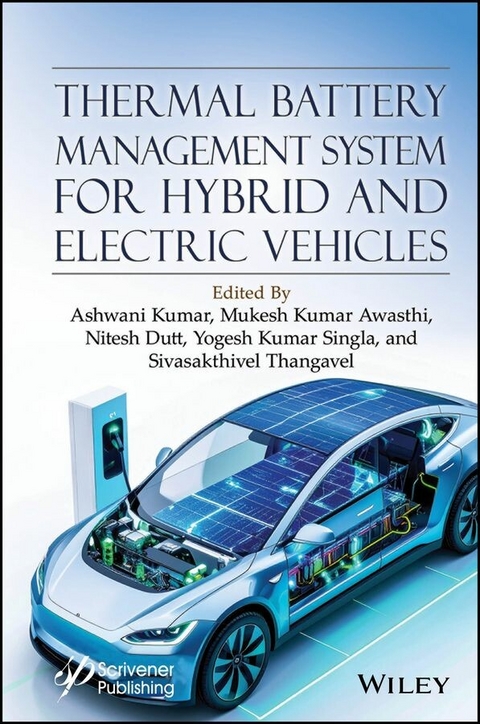
Thermal Battery Management System for Hybrid and Electric Vehicles (eBook)
621 Seiten
Wiley-Scrivener (Verlag)
978-1-394-28921-9 (ISBN)
Thermal Battery Management System for Hybrid and Electric Vehicles is essential for anyone seeking to understand the cutting-edge advancements and challenges in battery thermal management, providing valuable insights that drive innovation and improve the performance of electric and hybrid vehicles.
Thermal Battery Management System for Hybrid and Electric Vehicles investigates the technological advancements, challenges, and future perspectives of battery thermal management systems (BTMS) for electric vehicles (EV) and hybrid electric vehicles (HEV). By researching BTMS, engineers can develop novel thermal management systems and cooling technologies, leading to advancements in the field of electric and hybrid vehicles. This book explores existing research on thermal management systems for EV and HEV batteries, challenges and issues related to thermal management in EV and HEV battery systems, including battery heat generation, temperature, and thermal hazards, and evaluates the impact of temperature on battery performance and the overall efficiency of EV and HEV systems. In summation, this book is a definitive compendium that delves into the intricate tapestry of BTMS applications across diverse industries. Its holistic approach underscores the pivotal role of BTMS in current industrial landscapes and explores its transformative potential as a catalyst for future advancements and innovation.
Ashwani Kumar, PhD is a senior lecturer at the Technical Education Department of Uttar Pradesh. He has over 260 publications, including more than 20 books and numerous book chapters and articles. His research interests include vibration analysis, finite element analysis, finite element modelling, and renewable energy technologies.
Mukesh Kumar Awasthi, PhD is an assistant professor in the Department of Mathematics at Babasaheb Bhimarao Ambedkar University. He has over 170 publications, including several books, patents, and articles in international journals. His research interests include heat and mass transfer, fluid mechanics, and computational fluid dynamics.
Nitesh Dutt, PhD is an associate professor and the Head of the Department of Mechanical Engineering at COER University with over ten years of teaching experience. He has authored three books, four patents, and several articles in international journals. His research focuses on computational fluid dynamics, solar energy, heat transfer, and nuclear energy.
Yogesh Kumar Singla, PhD is a research associate in the Department of Engineering at the University of Idaho. He has over 40 publications to his credit, including five books and numerous book chapters and journal articles. His research interests include welding, manufacturing, surface engineering, and tribology.
Sivasakthivel Thangavel, PhD is a senior lecturer in the Department of Mechanical Engineering at the Global College of Engineering and Technology. He has published over 30 articles in international journals of repute. His research interests include pyrolosis, gasification and combustion, hydrogen energy, and industrial safety analysis.
Thermal Battery Management System for Hybrid and Electric Vehicles is essential for anyone seeking to understand the cutting-edge advancements and challenges in battery thermal management, providing valuable insights that drive innovation and improve the performance of electric and hybrid vehicles. Thermal Battery Management System for Hybrid and Electric Vehicles investigates the technological advancements, challenges, and future perspectives of battery thermal management systems (BTMS) for electric vehicles (EV) and hybrid electric vehicles (HEV). By researching BTMS, engineers can develop novel thermal management systems and cooling technologies, leading to advancements in the field of electric and hybrid vehicles. This book explores existing research on thermal management systems for EV and HEV batteries, challenges and issues related to thermal management in EV and HEV battery systems, including battery heat generation, temperature, and thermal hazards, and evaluates the impact of temperature on battery performance and the overall efficiency of EV and HEV systems. In summation, this book is a definitive compendium that delves into the intricate tapestry of BTMS applications across diverse industries. Its holistic approach underscores the pivotal role of BTMS in current industrial landscapes and explores its transformative potential as a catalyst for future advancements and innovation.
1
Battery Thermal Management System (BTMS) and Recent Advancements
Neha Singh Raghuvanshi1*, Yogesh Kumar Singla2 and Ashwani Kumar3
1 Department of Applied Science & Humanities, ABES Engineering College, Ghaziabad, Uttar Pradesh, India
2 School of Engineering, Math & Technology, Navajo Technical University Crownpoint, New Mexico, USA
3 Mechanical Engineering, Technical Education Department, Uttar Pradesh, Kanpur, India
Abstract
The Battery Thermal Management System (BTMS) plays a crucial role in maintaining the efficient operation, safety, and longevity of modern batteries, especially in electric vehicles and high-performance electronics. This chapter delves into the core principles of BTMS, including how heat is generated and dissipated across different battery types. It examines conventional cooling and heating methods, such as air and liquid cooling, alongside more advanced techniques like micro-channel cooling and phase change materials. Recent innovations feature the incorporation of artificial intelligence for adaptive thermal management, the development of new materials to improve thermal conductivity, and the progression of smart BTMS integrated with Battery Management Systems (BMS). Additionally, the chapter addresses current challenges and future directions, emphasizing the continual advancements that enhance thermal management efficiency and system dependability.
Keywords : Battery thermal management, heat dissipation, cooling techniques, artificial intelligence, advanced materials
1.1 Introduction: Overview and Significance of Battery Thermal Management Systems
Battery Thermal Management Systems (BTMS) are crucial for keeping batteries in good working condition. These systems use various methods to control the temperature of batteries, which can change depending on how they’re used and the surrounding environment. By managing both heat removal and heat retention, BTMS ensures that batteries stay at a proper temperature, which helps them perform better and last longer. BTMS is especially important in electric vehicles (EVs), electronics, and energy storage systems. For example, in electric cars, good thermal management can affect how far the car can go on a single charge, how quickly it can charge, and how safe it is. In electronics, BTMS prevents overheating, which can cause devices to malfunction or wear out faster.
Thermal management is essential for several reasons. Batteries work best within a certain temperature range. Too much heat can speed up the breakdown of battery materials and reduce its performance. On the other hand, very cold temperatures can make the battery less effective and might even cause damage. Keeping the battery at the right temperature is also crucial for safety. Overheating can lead to a dangerous situation called thermal runaway, where the battery’s temperature rises rapidly and could cause a fire or explosion. Good thermal management systems help prevent this by efficiently managing any heat produced. Longevity is another key benefit. Batteries that stay within their ideal temperature range last longer because extreme temperatures can damage the battery materials. By controlling the temperature, BTMS helps extend the battery’s life, making the battery-powered systems more reliable and cost-effective. Battery Thermal Management Systems are vital for making sure batteries work safely, efficiently, and last as long as possible. They help improve performance, avoid safety issues, and extend the life of batteries in various advanced technologies [1, 2].
1.2 Fundamentals of Battery Thermal Management
Batteries generate heat as a by-product of their chemical reactions during operation. When a battery discharges, it releases electrical energy through the movement of ions between the anode and cathode. This process involves several reactions that occur within the battery’s electrolyte and electrodes. These reactions are not perfectly efficient; some of the electrical energy is converted into thermal energy due to resistive losses in the battery’s internal components. There are a few key sources of heat generation in batteries:
- Internal Resistance: All batteries have some degree of internal resistance, which causes energy loss in the form of heat as the battery charges or discharges. The amount of heat generated is proportional to the current flowing through the battery and its internal resistance. For instance, if the battery has a higher internal resistance, it will generate more heat when providing high power during demanding tasks such as gaming or video editing.
- Electrochemical Reactions: The chemical reactions that occur during charging and discharging are exothermic, meaning they release heat. This is particularly true in highcharge or high-discharge situations where the battery is operating under stress. For example, during rapid acceleration, the battery’s chemical reactions generate additional heat due to the increased current flow and stress on the battery. This heat needs to be managed to ensure the battery operates safely and efficiently.
- Inefficiencies in Charging: Not all the electrical energy supplied is stored as chemical energy when charging a battery. Some of it is lost as heat due to inefficiencies in the charging process and internal resistance. For instance, during fast charging, the charger and battery both experience higher power levels, leading to increased heat generation. This heat is due to resistive losses in the battery and inefficiencies in the charging circuitry.
- Self-heating: Batteries can also heat up due to self-heating effects, where heat generated within the battery accumulates and raises its temperature, particularly during periods of high current flow or prolonged use. For example, if a cordless drill is used for extended drilling tasks, the battery’s internal heat generation from high current flow causes it to warm up. This self-heating effect can impact battery performance and longevity if not properly managed with cooling systems or thermal management strategies.
1.2.1 Thermal Characteristics of Battery Types
Different types of batteries have unique thermal characteristics due to their distinct chemical compositions and designs. Understanding these properties is essential for effective thermal management (Figure 1.1).
- Lithium-Ion Batteries (Li-ion): Table 1.1 highlights that Li-ion batteries are widely used in consumer electronics and electric vehicles due to their high energy density and long cycle life. They generate significant heat during both charging and discharging, particularly at high currents. Li-ion batteries are sensitive to temperature extremes. High temperatures can accelerate degradation and reduce battery life, while low temperatures can impair performance and capacity. Effective cooling strategies, such as liquid cooling or advanced thermal interface materials, are often required to manage the heat generated.
- Nickel-Metal Hydride Batteries (NiMH): NiMH batteries are commonly used in hybrid vehicles and various consumer devices. They have a lower energy density compared to Li-ion batteries but are known for their robustness and safety. NiMH batteries also produce heat during operation, though typically less than Li-ion batteries. They are less sensitive to temperature variations, but excessive heat can still affect their performance and lifespan. Cooling systems for NiMH batteries often focus on ensuring uniform temperature distribution rather than addressing extreme temperature variations.
- Lead-Acid Batteries: Lead-acid batteries are one of the oldest types of rechargeable batteries, commonly used in automotive and backup power applications. They generate heat during charging due to the exothermic nature of the chemical reactions involved. While they are less efficient and have a lower energy density compared to modern batteries, they are relatively tolerant to temperature variations. However, excessive heat can cause water loss from the electrolyte, reducing battery life and performance. Proper ventilation and cooling are necessary to manage heat in lead-acid batteries.
- Solid-State Batteries: Solid-state batteries are an emerging technology that uses a solid electrolyte instead of a liquid or gel electrolyte. They promise improved safety and energy density. However, they still generate heat during operation, and managing this heat is crucial for maintaining performance and safety. The thermal management strategies for solid-state batteries are still under development, with ongoing research focusing on optimizing materials and designs to enhance thermal stability.
Figure 1.1 Thermal characteristics of battery types.
Table 1.1 Comparison of various battery types [31–37].
| Battery type | Heat generation | Temperature sensitivity | Thermal management strategies |
|---|
| Lithium-Ion (Li-ion) | High during charging and discharging, especially at high currents | High temperatures accelerate degradation; low temperatures impair performance and capacity | Liquid cooling, advanced thermal interface materials, and heat spreaders |
| Nickel-Metal Hydride (NiMH) | Moderate heat generation | Less sensitive to temperature extremes but still affected... |
| Erscheint lt. Verlag | 19.8.2025 |
|---|---|
| Sprache | englisch |
| Themenwelt | Technik ► Maschinenbau |
| Schlagworte | batteries • battery management system • Digital Twin • Energy-Efficient • EV • green electronics • HEV • Portable Applications Charging • Power Electronic Converters • power management • Powertrains • Predictive Maintenance • state of health estimation • System • thermal management |
| ISBN-10 | 1-394-28921-9 / 1394289219 |
| ISBN-13 | 978-1-394-28921-9 / 9781394289219 |
| Informationen gemäß Produktsicherheitsverordnung (GPSR) | |
| Haben Sie eine Frage zum Produkt? |
 EPUB (Adobe DRM)
Kopierschutz: Adobe-DRM
Adobe-DRM ist ein Kopierschutz, der das eBook vor Mißbrauch schützen soll. Dabei wird das eBook bereits beim Download auf Ihre persönliche Adobe-ID autorisiert. Lesen können Sie das eBook dann nur auf den Geräten, welche ebenfalls auf Ihre Adobe-ID registriert sind.
Details zum Adobe-DRM
Dateiformat: EPUB (Electronic Publication)
EPUB ist ein offener Standard für eBooks und eignet sich besonders zur Darstellung von Belletristik und Sachbüchern. Der Fließtext wird dynamisch an die Display- und Schriftgröße angepasst. Auch für mobile Lesegeräte ist EPUB daher gut geeignet.
Systemvoraussetzungen:
PC/Mac: Mit einem PC oder Mac können Sie dieses eBook lesen. Sie benötigen eine
eReader: Dieses eBook kann mit (fast) allen eBook-Readern gelesen werden. Mit dem amazon-Kindle ist es aber nicht kompatibel.
Smartphone/Tablet: Egal ob Apple oder Android, dieses eBook können Sie lesen. Sie benötigen eine
Geräteliste und zusätzliche Hinweise
Buying eBooks from abroad
For tax law reasons we can sell eBooks just within Germany and Switzerland. Regrettably we cannot fulfill eBook-orders from other countries.
aus dem Bereich