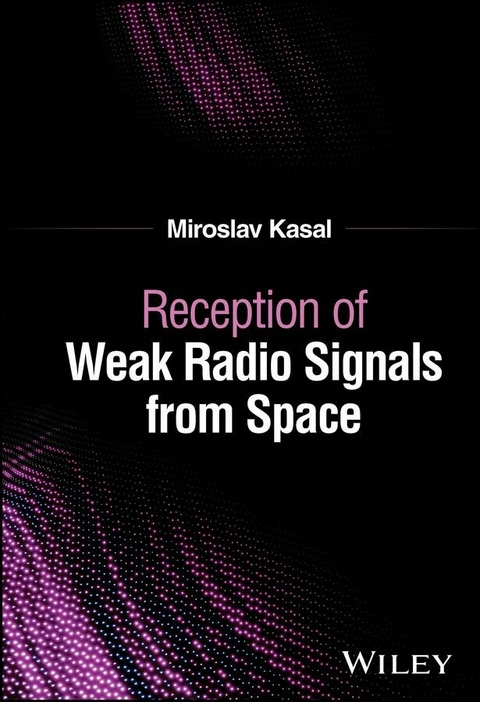
Reception of Weak Radio Signals from Space (eBook)
382 Seiten
Wiley (Verlag)
978-1-394-29274-5 (ISBN)
Comprehensive resource on the dynamically developing issue of radio communication over long distances, especially in outer space
Reception of Weak Radio Signals from Space explores all aspects of detecting and making sense of extremely weak radio frequency (RF) signals, especially those emanating from space. The subject matter ranges from general physics fundamentals to highly specialized issues of design and optimization of microwave antennas, low-noise amplifiers, receivers, transmitters, and frequency synthesizers with very specific characteristics.
Special consideration is paid to the advanced technique of radio linking by reflection of signals from the lunar surface, where, using modern software for digital communication, it is possible to realize links with signals ten or more decibels weaker compared to analogue modes. Each chapter briefly summarizes the theory and applicable relationships and complements the discussed topic with descriptions of specific solutions for individual parts of the communication system. Detailed annotated examples of calculations and implementations are included to aid in reader understanding.
The book also discusses specific properties of antennas including brightness and noise temperature, directivity, and polarization, and covers the technical characteristics of interplanetary probes such as Voyager, Cassini, Mars Odyssey, and others.
Additional topics in Reception of Weak Radio Signals from Space include:
- Microwave receivers, covering noise matching, cooled amplifiers, noise figure measurement, and low-noise amplifiers for 1.3 and 10 GHz bands
- Wave propagation in free space and the influence of the atmosphere via precipitation clouds and the ionosphere, including techniques for measuring the figure of merit G/T of the receiving system
- Local oscillators, including direct digital and phase-locked loop synthesizers
- High-frequency rectangular and circular waveguides and coaxial and planar transmission lines
- Parabolic antennas, describing mirror geometry and its radiation as well as scalar radiator feeds
Reception of Weak Radio Signals from Space is an excellent resource on up-to-date information for engineers and scientists working in space communications as well as graduate and senior undergraduate students and radio amateurs.
Miroslav Kasal, PhD, is a Professor Emeritus at Brno University of Technology (BUT) in the Czech Republic. He was previously a scientific worker at the Institute of Scientific Instruments within the Academy of Sciences of the Czech Republic's Department of RF Spectroscopy. He last held the position of Department Head. He is an experienced experimenter and lifelong active amateur radio operator with a vast amount of theoretical knowledge and practical experience in the field.
List of Symbols
- a
- radius
- a
- longer transverse dimension of rectangular waveguides
- A
- amplitude
- A
- power transmission
- A
- counter filling
- Ac
- carrier amplitude
- AdB
- gain in dB
- As
- amplitude of the strongest higher harmonic component
- AR
- axial ratio
- b
- normalized susceptance
- b
- attenuation
- b
- shorter transverse dimension of rectangular waveguides
- B
- magnetic induction
- B
- bandwidth
- B
- count of least significant bits
- Bn
- noise bandwidth
- c
- speed of light propagation in free space
- C
- carrier power
- CS
- clear sky noise
- d
- length
- d
- aperture diameter
- D
- distance of the Moon from the Earth
- D
- antenna directivity
- D
- variance D = σ2
- D
- DAC bit count
- Deff
- effective DAC bit count
- Eb
- energy per bit
- Erms
- effective phase error
- Es
- energy per symbol
- Et
- decrease of power at the edge of the aperture
- E0
- breakdown intensity of electric field in dielectrics
- f
- focal length
- f, F
- frequency
- F
- noise factor (-)
- fb
- information (bit) frequency
- fc
- cutoff frequency
- fc
- clock frequency
- f/d
- ratio of the focal distance f and the aperture diameter d of a parabolic antenna
- FdB
- noise figure (dB)
- fIF
- intermediate frequency
- fo
- oscillator frequency
- foff
- frequency offset
- FRX
- receiver frequency
- F(s)
- Laplace transform image of a transfer function
- FTX
- transmitter frequency
- G(θ, φ)
- antenna gain
- Gr
- receiving antenna gain
- G(s)
- Laplace transform image of the transfer function in a direct branch
- Gt
- transmitting antenna gain
- G/T
- figure of merit of the receiving system
- h
- Planck constant 6.63 × 10⁻³⁴ J s
- h
- substrate thickness
- H0
- DC magnetic field intensity
- H(s)
- Laplace transform image of the transfer function in a feedback branch
- hα
- coefficients of piecewise linearized noise characteristics
- ID
- drain current
- IDQ
- quiescent drain current
- IM3
- third-order intermodulation
- I(s)
- Laplace transform image of a closed loop gain
- Jν
- monochromatic brightness
- k
- Boltzmann constant 1.38 × 10⁻²³ J K–1
- k
- constant
- Kd
- conversion gain of the phase detector
- Ko
- conversion gain of the voltage-controlled oscillator
- l
- length
- L
- relative power loss (inverse value of the power transmission A, A < 1)
- LdB
- loss (dB)
- m
- the first mode number
- M
- count of symbol bits
- M
- count of the most significant bits
- MN
- Moon noise
- n
- the second mode number
- n
- frequency multiplication factor
- N
- number of electrons per unit volume
- N
- number of bits of the phase accumulator status word FSW
- N
- noise power
- N
- frequency divider ratio in the feedback
- NMI
- noise power at the mixer input
- Nph
- power spectral density of the phase noise
- N0, Nd, Nν
- noise power spectral density
- P
- power
- P1dB
- power at 1dB compression
- Pout
- output power
- Pph
- phase noise power
- Pr
- receiver input power
- Pt
- transmitter power
- Q
- quality factor
- Q0
- quality factor of an unloaded resonator
- r, R
- radius, distance
- R
- resistance
- R
- frequency divider ratio of the reference signal
- r0, R0
- radii of the inner and outer conductor of a coaxial line
- Rn
- equivalent noise resistance
- Rs
- high-frequency surface resistance
- s
- Laplace operator
- s
- effective reflecting surface of the Moon
- sij
- scattering parameters
- S
- geometric area of an antenna
- Seff
- effective area of an antenna or of a reflecting surface
- Si
- effective aperture of an isotropic radiator
- SΦ
- output phase power spectral density
- SN
- Sun noise
- t
- microstrip thickness
- T
- thermodynamic temperature (K)
- T0
- ambient temperature
- TA
- antenna noise temperature
- Tb
- brightness temperature
- TCH
- MMIC channel internal temperature
- Te
- equivalent noise temperature
- TG
- noise temperature contribution from the Earth
- TMo
- Moon brightness temperature
- TR
- receiver equivalent noise temperature
- Ts
- equivalent noise temperature of a receiving system
- TSKY
- sky brightness temperature
- U0, Ui
- root-mean-square value of noise voltage
- v
- wave propagation velocity
- VDD
- drain voltage
- vph
- phase velocity in a waveguide
- w
- microstrip width
- weff
- effective microstrip width
- Y
- Y-factor
- y(t)
- relative frequency deviation
- Z
- impedance
- Z0
- characteristic impedance
- α
- half aperture angle from the focal point of the paraboloid
- α
- specific attenuation
- αd
- attenuation factor of the dielectric in Np m–1
- αmn
- the nth root of the Bessel function of the first kind of the mth order
- the nth root of the derivative of the Bessel function of the first kind of the mth order
- Γopt
- reflection coefficient of the signal source in case of noise matching
- Γs
- reflection coefficient of the signal source
- δ
- penetration depth
- Δω(t)...
| Erscheint lt. Verlag | 4.8.2025 |
|---|---|
| Sprache | englisch |
| Themenwelt | Technik ► Elektrotechnik / Energietechnik |
| Schlagworte | Communication technology • High Gain Antennas • Low Noise Amplifiers • noise temperature • Radio Communication • Signal Processing • Thermal noise • Waveguides • wave propagation • weak microwave signals • wireless communication |
| ISBN-10 | 1-394-29274-0 / 1394292740 |
| ISBN-13 | 978-1-394-29274-5 / 9781394292745 |
| Informationen gemäß Produktsicherheitsverordnung (GPSR) | |
| Haben Sie eine Frage zum Produkt? |
 EPUB (Adobe DRM)
Kopierschutz: Adobe-DRM
Adobe-DRM ist ein Kopierschutz, der das eBook vor Mißbrauch schützen soll. Dabei wird das eBook bereits beim Download auf Ihre persönliche Adobe-ID autorisiert. Lesen können Sie das eBook dann nur auf den Geräten, welche ebenfalls auf Ihre Adobe-ID registriert sind.
Details zum Adobe-DRM
Dateiformat: EPUB (Electronic Publication)
EPUB ist ein offener Standard für eBooks und eignet sich besonders zur Darstellung von Belletristik und Sachbüchern. Der Fließtext wird dynamisch an die Display- und Schriftgröße angepasst. Auch für mobile Lesegeräte ist EPUB daher gut geeignet.
Systemvoraussetzungen:
PC/Mac: Mit einem PC oder Mac können Sie dieses eBook lesen. Sie benötigen eine
eReader: Dieses eBook kann mit (fast) allen eBook-Readern gelesen werden. Mit dem amazon-Kindle ist es aber nicht kompatibel.
Smartphone/Tablet: Egal ob Apple oder Android, dieses eBook können Sie lesen. Sie benötigen eine
Geräteliste und zusätzliche Hinweise
Buying eBooks from abroad
For tax law reasons we can sell eBooks just within Germany and Switzerland. Regrettably we cannot fulfill eBook-orders from other countries.
aus dem Bereich