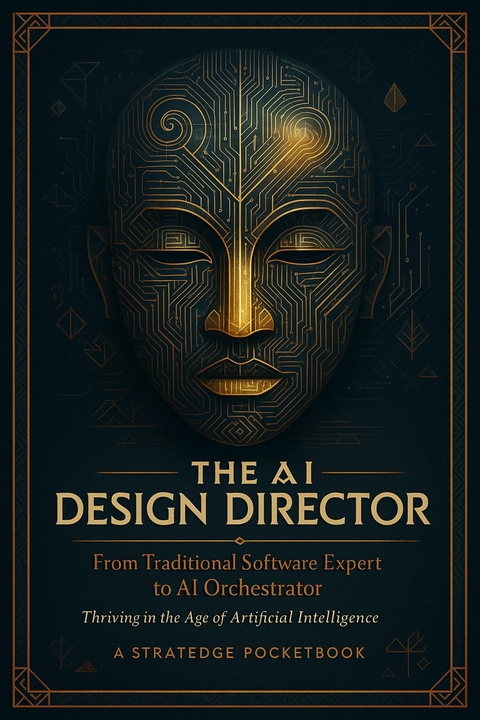
The AI Design Director (eBook)
131 Seiten
Publishdrive (Verlag)
978-0-00-099294-9 (ISBN)
Cape Town's tech scene meets Harare's innovation spirit in this regional guide to AI-powered design leadership. Drawing from consultations with successful Southern African tech entrepreneurs and design directors, this book reveals how traditional software expertise transforms into AI orchestration skills. Navigate client expectations, manage AI-human design teams, and deliver world-class digital products from African bases. The future of design leadership speaks with a Southern African accent.
Chapter 3: From Tool Operator to Creative Orchestrator
The rise of AI necessitates a fundamental shift in how designers perceive their role. It's no longer enough to be a skilled technician, a master of software. The future belongs to the creative orchestrator – the visionary who can direct AI, synthesise its outputs, and imbue the final work with strategy, emotion, and human insight. This chapter explores this crucial mindset evolution.
Mindset shift: Stop thinking like a Photoshop user, start thinking like a creative director
This section challenges designers to elevate their thinking from task execution ("How do I create this effect in Photoshop?") to strategic direction ("What is the core message, who is the audience, and how can AI help me explore the most impactful visual solutions?"). It's about moving from "doing" to "directing," leveraging AI as your extended creative team.
For years, a designer's proficiency was often measured by their mastery over complex software like Adobe Photoshop, Illustrator, or Figma. The focus was on the "how" – how to manipulate pixels, how to create effects, how to build layouts. AI challenges this paradigm. While technical skills remain relevant, their emphasis is diminishing as AI takes over many execution-oriented tasks. The new imperative is to think like a creative director: focusing on the "what" and the "why."
This means prioritising:
-
Vision Setting: Defining the overall creative direction, the message to be conveyed, and the emotional impact desired.
-
Strategic Thinking: Understanding the project's goals, the target audience's needs, and the broader business or cultural context.
-
Problem Solving: Identifying the core communication challenge and devising creative strategies to address it.
-
Curation and Judgment: Evaluating AI-generated options, selecting the most promising ones, and providing feedback for refinement.
The designer becomes less of a pixel-pusher and more of a conductor, leading an orchestra of AI tools to produce a harmonious and impactful creative output. This shift requires a letting go of minute control over every detail of execution and embracing a role that leverages human strengths in ideation, strategy, and critical evaluation.
The new designer skill stack: Prompt mastery + Creative strategy + AI orchestration
The designer of tomorrow will be defined by a new trinity of skills. Prompt mastery is the technical foundation. Creative strategy provides the "why" and "what." AI orchestration is the ability to weave these together, managing AI tools and their outputs to achieve a cohesive and impactful final design. This section breaks down each component and how they interrelate.
To thrive as an AI Design Director, a new combination of skills is essential:
-
Prompt Mastery: As detailed in Chapter 2, this is the foundational technical skill. It's the ability to communicate effectively with AI, translating creative intent into precise instructions that yield desired results. This includes understanding different prompting techniques, frameworks like PACED, and iterative refinement.
-
Creative Strategy: This encompasses the core human intelligences that AI cannot replicate. It involves:
-
Conceptual Thinking: Developing original ideas and overarching concepts.
-
Storytelling: Crafting narratives that resonate with an audience.
-
Empathy & User Understanding: Deeply understanding user needs, motivations, and cultural contexts.
-
Critical Thinking & Aesthetic Judgment: Evaluating design effectiveness, making informed choices about style, tone, and composition, and ensuring quality.
-
Ethical Consideration: Ensuring designs are inclusive, respectful, and avoid harm.
-
-
AI Orchestration: This is the ability to manage and integrate AI tools effectively within the design workflow. It includes:
-
Tool Selection: Knowing which AI tools are best suited for specific tasks (e.g., image generation, text generation, video creation, data analysis).
-
Workflow Design: Structuring processes that combine AI capabilities with human oversight and intervention at critical points.
-
Multi-Agent Management: Potentially using multiple AI tools in sequence or parallel to achieve complex outcomes.
-
Curation and Refinement: Sifting through AI-generated outputs, selecting the best options, and guiding further refinement either through more prompts or manual adjustments.
-
This new skill stack positions the designer as a strategic leader who leverages AI to amplify their creative potential and efficiency
Understanding AI limitations and human-AI collaboration sweet spots
AI is powerful, but it's not infallible or omniscient. It lacks true understanding, common sense, and ethical judgment. This section identifies the current limitations of AI in design (e.g., nuanced cultural understanding, originality beyond its training data, complex emotional expression) and highlights where human oversight, curation, and creative intervention are absolutely critical – the "sweet spots" for human-AI collaboration.
While AI offers remarkable capabilities, it's crucial to understand its limitations to foster effective human-AI collaboration. AI models:
-
Lack True Understanding: They process information based on patterns in data, not genuine comprehension or common sense.
-
Are Not Truly Original: AI generates content by remixing and reconfiguring data it was trained on. Truly novel, out-of-the-box ideas still primarily originate from human creativity.
-
Struggle with Nuance and Emotion: AI can mimic emotional expression but lacks genuine empathy or the ability to understand subtle emotional or cultural nuances without explicit prompting.
-
Can Perpetuate Bias: If trained on biased data, AI can generate outputs that reflect and even amplify those biases.
-
Lack Ethical Reasoning: AI cannot make ethical judgments or understand the broader societal impact of its creations without human guidance and oversight.
Recognising these limitations helps identify the "sweet spots" for human-AI collaboration. As highlighted by various experts, AI is not a job thief but a complementary tool (Medium, Oct 2023; Medium, Aug 2023).
-
Tasks Best Suited for AI:
-
Generating a wide range of initial ideas and variations quickly.
-
Automating repetitive tasks (e.g., resizing, background removal, basic formatting).
-
Performing data analysis and identifying patterns.
-
Creating multiple versions for A/B testing.
-
Assisting with research and information gathering.
-
-
Tasks Requiring Human Expertise:
-
Defining the core creative strategy and project goals.
-
Making final judgments on aesthetics, quality, and brand alignment.
-
Ensuring cultural sensitivity and ethical considerations.
-
Communicating with clients and understanding their nuanced needs.
-
Injecting genuine emotion, originality, and storytelling.
-
Complex problem-solving that requires contextual understanding beyond AI's training.
-
The AI Design Director excels by strategically delegating tasks to AI where it offers an advantage, while reserving their unique human skills for areas where they add irreplaceable value.
Building creative confidence in an AI-assisted workflow
It's natural to feel a dip in creative confidence when a machine can generate visuals rapidly. This section addresses how to rebuild and enhance creative confidence by reframing your role as the visionary, the curator, and the strategic thinker. Your value lies not in manual execution, but in your unique taste, judgment, and ability to guide AI to create something truly meaningful and effective.
The rise of AI can, for some, trigger a crisis of creative confidence. If a machine can generate visually appealing designs, what is the designer's unique worth? The key to overcoming this is to shift the definition of creative value.
Creative confidence in the age of AI is built by:
-
Focusing on Human Strengths: Recognising and valuing the skills AI cannot replicate – strategic thinking, empathy, ethical judgment, true originality, and nuanced cultural understanding.
-
Embracing AI as an Enhancer: Viewing AI not as a competitor, but as a tool that can augment one's abilities, allowing for the exploration of more ideas and the pushing of creative boundaries. AI can help overcome creative blocks by offering unexpected starting points.
-
Redefining Your Role: Seeing oneself as an "AI Design Director" – a leader and orchestrator – rather than just an executor. This reframing elevates the designer's role to one of strategic importance.
-
Continuous Learning: Actively engaging with AI tools and techniques builds familiarity and reduces fear. Mastery breeds confidence.
-
Valuing the Process, Not Just the...
| Erscheint lt. Verlag | 4.8.2025 |
|---|---|
| Sprache | englisch |
| Themenwelt | Technik |
| ISBN-10 | 0-00-099294-1 / 0000992941 |
| ISBN-13 | 978-0-00-099294-9 / 9780000992949 |
| Informationen gemäß Produktsicherheitsverordnung (GPSR) | |
| Haben Sie eine Frage zum Produkt? |
 EPUB (Adobe DRM)
Größe: 4,2 MB
Kopierschutz: Adobe-DRM
Adobe-DRM ist ein Kopierschutz, der das eBook vor Mißbrauch schützen soll. Dabei wird das eBook bereits beim Download auf Ihre persönliche Adobe-ID autorisiert. Lesen können Sie das eBook dann nur auf den Geräten, welche ebenfalls auf Ihre Adobe-ID registriert sind.
Details zum Adobe-DRM
Dateiformat: EPUB (Electronic Publication)
EPUB ist ein offener Standard für eBooks und eignet sich besonders zur Darstellung von Belletristik und Sachbüchern. Der Fließtext wird dynamisch an die Display- und Schriftgröße angepasst. Auch für mobile Lesegeräte ist EPUB daher gut geeignet.
Systemvoraussetzungen:
PC/Mac: Mit einem PC oder Mac können Sie dieses eBook lesen. Sie benötigen eine
eReader: Dieses eBook kann mit (fast) allen eBook-Readern gelesen werden. Mit dem amazon-Kindle ist es aber nicht kompatibel.
Smartphone/Tablet: Egal ob Apple oder Android, dieses eBook können Sie lesen. Sie benötigen eine
Geräteliste und zusätzliche Hinweise
Buying eBooks from abroad
For tax law reasons we can sell eBooks just within Germany and Switzerland. Regrettably we cannot fulfill eBook-orders from other countries.
aus dem Bereich