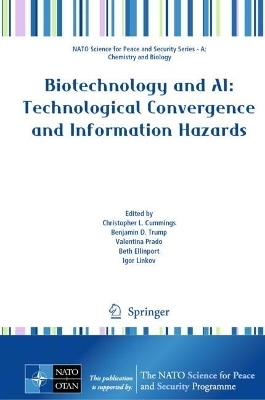
Biotechnology and AI: Technological Convergence and Information Hazards
Springer International Publishing (Verlag)
978-3-032-05245-2 (ISBN)
- Noch nicht erschienen - erscheint am 24.01.2026
- Versandkostenfrei
- Auch auf Rechnung
- Artikel merken
This book offers a forward-looking perspective on the convergence of artificial intelligence (AI) and biotechnology, and its transformative impact on synthetic biology. As these fields evolve rapidly, their integration is reshaping science, industry, and society in profound ways.
Through a collection of rigorously researched chapters, the volume provides a comprehensive analysis of this dynamic relationship, offering valuable insights for researchers, practitioners, policymakers, and educators.
I Convergence of AI and Biotechnology
An overview of how AI-driven analytics and machine learning are revolutionizing biotechnological applications, enabling innovative solutions and breakthroughs in synthetic biology.
II Modernization of Biotechnology
A comparative look at traditional methods versus AI-enhanced approaches in areas such as drug discovery, genetic engineering, and bioinformatics, highlighting increased precision and accelerated progress.
III Governance, Risk, and ELSI
Examining the ethical, legal, and social implications (ELSI) of AI-biotech integration, this section discusses frameworks for responsible innovation, emphasizing transparency and public engagement.
IV Information Hazards
A critical exploration of data privacy, security risks, and ethical dilemmas arising from the convergence of these technologies, with strategies to mitigate potential harms while maximizing societal benefits.
This book is an essential resource for understanding the evolving landscape of synthetic biology and the broader implications of AI-biotech convergence.
Christopher L. CUMMINGS, PhD, is a Research Social Scientist and Lead for the Center for Health Engineering at the U.S. Army Engineer Research and Development Center (ERDC). His research advances engagement with science and technological governance, risk communication theory, and health decision making across the life span. An experienced behavioral theorist and risk communication scholar, Dr. Cummings employs quantitative, qualitative, and mixed methods, with work featured in leading journals, global media, and over 70 applied science and health venues. He was recently appointed to the U.S. National Academies of Sciences, Engineering, and Medicine (NASEM) Committee for the External Review of Ethical, Legal, Environmental, Safety, Security, and Societal Issues of Engineering Biology Research and Development. His contributions have been recognized with multiple honors, including ERDC s 2024 International R&D Award, Technology Transition Award, and Lab Innovation of the Year, as well as the 2021 Excellence in Research and Practice Award for international coordination of COVID-19 risk communication from the Society for Risk Analysis, the 2019 Distinguished Alumni Award from North Carolina State University, and the 2017 Nanyang Education Award for Best College Professor from Nanyang Technological University, Singapore.Dr. Benjamin D. Trump is the President of Tor Intelligence, LLC. He is a resilience and risk governance expert with over a decade of experience analyzing complex systems under conditions of uncertainty, fragility, and rapid change. He most recently served as a Senior Research Social Scientist and Lead of the Center for Health Engineering at the U.S. Army Engineer Research and Development Center, where he led interdisciplinary projects on infrastructure, public health, environmental security, and systemic risk across more than 50 countries. Dr. Trump has advised or partnered with institutions such as OECD, UNDRR, NATO, and FEMA, and was awarded the Presidential Early Career Award for Scientists and Engineers (PECASE). For 2023 2024, he served as the first US Embassy Science Fellow to Turkmenistan, specializing in environmental security and resilience (he later received the US Army Commander s Award for Civilian Service for his efforts). He currently serves as the President-Elect of the Society for Risk Analysis and is internationally recognized for advancing practical tools and policy frameworks to assess, manage, and govern systemic and human factors risk across sectors and regions. He was awarded SRA s Chauncey Starr Award for outstanding achievement in science or public policy relating to risk analysis and exceptional promise for continued contributions to risk analysis. Dr. Trump was commended for his two years of service as an emergency responder for the COVID pandemic, including the receipt of The Army Civilian Medal for Humanitarian Service, and the Army Superior Civilian Service Award for hands-on work that saved many lives in his area of responsibility. He received his PhD from the University of Michigan, School of Public Health, where he currently serves as an Adjunct Associate Professor.
Introduction to Biotechnology: Technological Convergence and Information Hazards.- A Brief Introduction to the Convergence of Artificial Intelligence and Biotechnology.- Safeguarding the Responsible Use and Equitable Benefit-Sharing of Biotechnology in an Age of Scientific Modernization.- Information Hazards and Biotechnology.- Risk Culture in a Time of Biotechnological Convergence: Implications for Regulatory Divergence and Bioeconomic Development.- Governance Frameworks and Scenario Evaluation Exercises on AI and SB Ethical Dilemmas.- Ethical Implications and Governance Solutions for the Convergence of AI and Synthetic Biology in Healthcare and Agriculture.- Assessing Governance and Regulatory Frameworks for Converging Technologies: The Case of Artificial Intelligence in Biological Engineering and Design Technologies.- Non-genetic Optoelectronic Biointerfaces.- AlphaFold and the Protein-folding Problem.- Bridging the Biotechnology Valley of Death: Modernizing the TRL-MRL-IRL Acquisitions Process for Accelerated Technology Modernization.- Synergizing Minds and Machines: Harnessing Generative AI for Transformative Biotechnology Education.- Data Diversity and Sequence Length: Key Levers for Powerful Biological AI.
| Erscheinungsdatum | 29.11.2025 |
|---|---|
| Reihe/Serie | NATO Science for Peace and Security Series A: Chemistry and Biology |
| Zusatzinfo | XVII, 346 p. 38 illus., 32 illus. in color. |
| Verlagsort | Cham |
| Sprache | englisch |
| Maße | 155 x 235 mm |
| Themenwelt | Naturwissenschaften ► Biologie ► Genetik / Molekularbiologie |
| Technik ► Umwelttechnik / Biotechnologie | |
| Schlagworte | AI-driven Genetic Engineering • Artificial Intelligence • Bioinformatics • Biotechnology Convergence • Biotechnology Governance and Ethics • Biotechnology Modernization • drug discovery • ELSI Ethical, Legal and Social Implications • ethical dilemmas • Genetic Engineering • Risk Management • Security Risks • Synthetic biology • Synthetic Biology Advancements |
| ISBN-10 | 3-032-05245-9 / 3032052459 |
| ISBN-13 | 978-3-032-05245-2 / 9783032052452 |
| Zustand | Neuware |
| Informationen gemäß Produktsicherheitsverordnung (GPSR) | |
| Haben Sie eine Frage zum Produkt? |
aus dem Bereich