


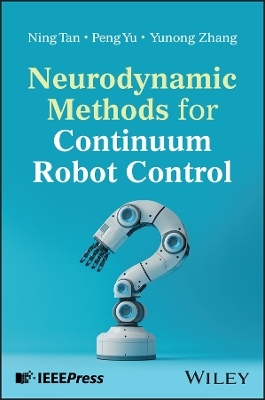
Neurodynamic Methods for Continuum Robot Control
Seiten
2026
Wiley-IEEE Press (Verlag)
978-1-394-40273-1 (ISBN)
Wiley-IEEE Press (Verlag)
978-1-394-40273-1 (ISBN)
- Noch nicht erschienen (ca. Juni 2027)
- Versandkostenfrei
- Auch auf Rechnung
- Artikel merken
Exploration on how neurodynamic methods can be effectively applied to control complex, flexible robotic systems in research and real-world settings
Neurodynamic Methods for Continuum Robot Control presents a comprehensive exploration of neurodynamic control methods for continuum robots—a new generation of soft, flexible robotic systems inspired by nature. The book is organized into seven thematic parts and eleven chapters, progressing from fundamental analytical techniques to advanced hybrid and adaptive control systems. After the introduction chapter, each chapter includes detailed theoretical derivations, algorithm design, and extensive validation through simulations and physical experiments.
This book explores how continuum robots are controlled effectively and robustly in real time, without requiring complex modeling or extensive data training. The solution explored throughout this book is a suite of neurodynamic control algorithms, which offer a powerful alternative to traditional model-based and learning-based approaches. These neurodynamic methods—particularly gradient neurodynamics (GND) and zeroing neurodynamics (ZND)—allow for fast, adaptive, and model-free solutions to inverse kinematics and trajectory tracking problems.
Written by a team of highly qualified authors with extensive experience in the field, this book includes information on:
Inherent challenges in modeling and controlling continuum robots, including model uncertainty, high dimensionality, and elastic deformation
Mathematical foundations of GND and ZND and the derivation and application of Jacobian-based and model-free kinematic control methods
Advanced neurodynamic models including predefined-time convergent, time-synchronized, and varying-parameter schemes
Hybrid intelligent methods such as fuzzy logic-enhanced neurodynamics and cerebellum-inspired architectures
Benefits of neurodynamic control, including real-time performance, robustness, adaptability, and simplicity in deployment
Discussing theory, design, and applications to deliver state-of-the-art research, Neurodynamic Methods for Continuum Robot Control is an essential resource on the subject for researchers, graduate students, and advanced practitioners—not only a technical reference, but also a visionary guide to the future of intelligent robotics.
Neurodynamic Methods for Continuum Robot Control presents a comprehensive exploration of neurodynamic control methods for continuum robots—a new generation of soft, flexible robotic systems inspired by nature. The book is organized into seven thematic parts and eleven chapters, progressing from fundamental analytical techniques to advanced hybrid and adaptive control systems. After the introduction chapter, each chapter includes detailed theoretical derivations, algorithm design, and extensive validation through simulations and physical experiments.
This book explores how continuum robots are controlled effectively and robustly in real time, without requiring complex modeling or extensive data training. The solution explored throughout this book is a suite of neurodynamic control algorithms, which offer a powerful alternative to traditional model-based and learning-based approaches. These neurodynamic methods—particularly gradient neurodynamics (GND) and zeroing neurodynamics (ZND)—allow for fast, adaptive, and model-free solutions to inverse kinematics and trajectory tracking problems.
Written by a team of highly qualified authors with extensive experience in the field, this book includes information on:
Inherent challenges in modeling and controlling continuum robots, including model uncertainty, high dimensionality, and elastic deformation
Mathematical foundations of GND and ZND and the derivation and application of Jacobian-based and model-free kinematic control methods
Advanced neurodynamic models including predefined-time convergent, time-synchronized, and varying-parameter schemes
Hybrid intelligent methods such as fuzzy logic-enhanced neurodynamics and cerebellum-inspired architectures
Benefits of neurodynamic control, including real-time performance, robustness, adaptability, and simplicity in deployment
Discussing theory, design, and applications to deliver state-of-the-art research, Neurodynamic Methods for Continuum Robot Control is an essential resource on the subject for researchers, graduate students, and advanced practitioners—not only a technical reference, but also a visionary guide to the future of intelligent robotics.
Ning Tan is an Associate Professor at Sun Yat-sen University, China. He is a Senior Member of IEEE. His research interests include continuum robotics, bioinspired design, and intelligent control. Peng Yu is a PhD Candidate at Sun Yat-sen University. He is a graduate student member of IEEE. Yunong Zhang is a Professor at Sun Yat-sen University. He is a Senior Member of IEEE, and his research interests lie in automation, robotics, neurodynamics, computation, and optimization.
| Erscheint lt. Verlag | 15.6.2027 |
|---|---|
| Sprache | englisch |
| Themenwelt | Technik ► Elektrotechnik / Energietechnik |
| ISBN-10 | 1-394-40273-2 / 1394402732 |
| ISBN-13 | 978-1-394-40273-1 / 9781394402731 |
| Zustand | Neuware |
| Informationen gemäß Produktsicherheitsverordnung (GPSR) | |
| Haben Sie eine Frage zum Produkt? |
Mehr entdecken
aus dem Bereich

aus dem Bereich
Wegweiser für Elektrofachkräfte
Buch | Hardcover (2024)
VDE VERLAG
CHF 67,20
Planungsfehler vermeiden – Probleme analysieren – Arbeitszahlen …
Buch | Softcover (2024)
VDE VERLAG
CHF 61,60


