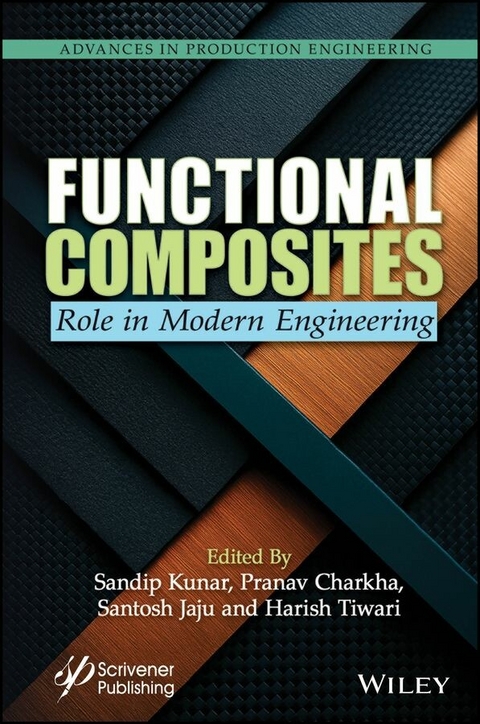
Functional Composites (eBook)
374 Seiten
Wiley-Scrivener (Verlag)
978-1-394-24201-6 (ISBN)
The book is essential for anyone looking to deepen their understanding of advanced composite materials and their intricate behaviors, offering comprehensive insights into the mechanics, design, and innovative applications of functional composites in today's engineering landscape.
Understanding the complicated vibration behavior of composite beams, plates, shells, curved membranes, rings, and other complex structures is crucial for modern-day engineering. Functional Composites: Role in Modern Engineering addresses current progress in the mechanics and design of functional composites and structures. It covers the characterization of properties, analyses, and design of various advanced composite material systems with an emphasis on coupled mechanical and non-mechanical behaviors. The book comprehensively covers analyses of functional materials related to piezoelectric and magnetostrictive nanocomposites, as well as the design of active fiber composites. Techniques and challenges in producing functional composites and identifying their coupled properties are also discussed. The book culminates in a discussion on more advanced uses of functional composites and how these smart structures can be analyzed on a larger scale. The book's comprehensive coverage of the innovative potential of these composites makes it an essential resource for industry professionals and students alike.
Readers will find that the book:
- Explores technologies for improvement in advanced processes and the application of functional composites;
- Introduces both recently developed and emerging functional composites;
- Provides comprehensive insight into concepts such as the successful fabrication of multipurpose functional composites, sustainability of functional composites, and future scopes and challenges of functional composites;
- Serves as a valuable reference for students and researchers working with functional composites.
Audience
Materials scientists, mechanical, manufacturing, biomedical, and industrial engineers in industry and academia, as well as students, who are working with functional composites.
Sandip Kunar, PhD is an associate professor in the Department of Mechanical Engineering at Aditya University. He has published over 60 research papers in national and international journals and conferences, 53 book chapters, and 16 books. His research interests include non-conventional machining processes, micromachining processes, advanced manufacturing technology, and industrial engineering.
Pranav Charkha is the Deputy Director and Academic Dean at the G.H. Raisoni Institute of Engineering and Business Management. He has published over 40 papers in international journals and conferences, four books, and five chapters. He has also been granted five copyrights and two patents and has submitted an additional four for consideration. His research focuses on supply chain management, additive manufacturing, and world-class manufacturing for Industry 4.0.
Santosh Jaju, PhD is a professor in the Department of Mechanical Engineering at the G.H. Raisoni College of Engineering with over 22 years of teaching experience. He has published over 100 research papers in national and international journals and conferences, six book chapters, and one book, in addition to filing six patents. His research interests include quality cost, service quality, lean manufacturing, productivity improvement techniques, and industrial engineering.
Harish Tiwari, PhD Head of the Institute at the Pimpri Chinchwad College of Engineering and Research. He has been awarded numerous government-funded grants and holds the Indian record for filing the highest number of patents in a day. His teaching and research interests include heat and thermal engineering.
The book is essential for anyone looking to deepen their understanding of advanced composite materials and their intricate behaviors, offering comprehensive insights into the mechanics, design, and innovative applications of functional composites in today s engineering landscape. Understanding the complicated vibration behavior of composite beams, plates, shells, curved membranes, rings, and other complex structures is crucial for modern-day engineering. Functional Composites: Role in Modern Engineering addresses current progress in the mechanics and design of functional composites and structures. It covers the characterization of properties, analyses, and design of various advanced composite material systems with an emphasis on coupled mechanical and non-mechanical behaviors. The book comprehensively covers analyses of functional materials related to piezoelectric and magnetostrictive nanocomposites, as well as the design of active fiber composites. Techniques and challenges in producing functional composites and identifying their coupled properties are also discussed. The book culminates in a discussion on more advanced uses of functional composites and how these smart structures can be analyzed on a larger scale. The book s comprehensive coverage of the innovative potential of these composites makes it an essential resource for industry professionals and students alike. Readers will find that the book: Explores technologies for improvement in advanced processes and the application of functional composites; Introduces both recently developed and emerging functional composites; Provides comprehensive insight into concepts such as the successful fabrication of multipurpose functional composites, sustainability of functional composites, and future scopes and challenges of functional composites; Serves as a valuable reference for students and researchers working with functional composites. Audience Materials scientists, mechanical, manufacturing, biomedical, and industrial engineers in industry and academia, as well as students, who are working with functional composites.
1
Introduction to Functional Composite Materials
Sandip Kunar1*, Gurudas Mandal2, Jagadeesha T.3 and Pranav Charkha4
1Department of Mechanical Engineering, Aditya University, Surampalem, Andhra Pradesh, India
2Department of Metallurgical Engineering, Kazi Nazrul University, Asansol, India
3Department of Mechanical Engineering, National Institute of Technology, Calicut, India
4School of Engineering & Technology, Pimpri Chinchwad University, Pune, India
Abstract
Composite materials are vital for everything, from supporting modern nations to facilitating new inventions. The main benefits are their strength, durability, light weight, flexibility in design, and resistance to corrosion. These materials are utilized in modern industries including building, medicine, oil and gas, sports, transportation, and aerospace. This chapter covers an overview of composite materials, including the properties of polymer matrix, reinforcements, a basic approach to material selection, composite production procedures, composite properties, and applications.
Keywords: Natural fiber, biopolymer, thermoset, thermoplastic, fiber, matrix, composite
1.1 Introduction
Nature contains composites. The long cellulose fibers that make up wood are joined by lignin to form a composite substance. It is formed by joining two or more materials that do not dissolve concurrently and have quite discrete qualities. The composite’s distinctive qualities are a result of the interaction of its various constituent components. These materials have been applied by people in various contexts from a long time ago. To construct sturdy and long-lasting structures, early Mesopotamian and Egyptians settlers exploited the blending of straw and mud at around 1500 BC, which is when these materials were first applied. A block of brick has a strong confrontation to bending, ripping, and squeezing because of the mixture of straw and mud. The ancient composite materials such as ceramics and boats were reinforced by straw [1]. In 1200 AD, the first composite bow was produced by combining wood, bone, and animal glue during the Mongols period. Birch bark was used to wrap and press the bows. These bows were accurate and strong. The supremacy of Genghis Khan’s military was ensured in part by composite Mongolian bows. Many of the biggest developments were brought about by wartime requirements because of their advantages, which include strength and light load. Various materials were created during World War II and transitioned from research and development to real manufacturing [2].
The fiber-reinforced polymers (FRP) are a direct result of the advancement and demand for composite materials. Over 7.5 million pounds of glass fibers had been utilized in 1945 for a variety of goods, mostly for military uses. The composite materials gained popularity and expanded quickly into the 1950s. The pioneers of composites made a bold attempt to expand the use of composites into other industries, including transportation, construction, and aircraft. The public sectors acquired the idea about the benefits of FRP composites, particularly no corrosion of composite materials. In 1946, the first composite boat hull was issued for commercial use. In 1947, an entire car body was made of composite and put through testing. As a result, Chevrolet Corvette was created in 1953. Several innovative molding techniques, including compression molding and sheet molding, emerged with the onset of the automotive age. The two methods became the most widely used molding procedures in the automotive and other sectors. Manufacturing techniques like vacuum bag molding, pultrusion, and large-scale filament winding were created in the early 1950s. The greatest market for composite materials in the 1960s was the marine industry. The first carbon fiber was patented in 1961 and frequently accessible after a few years. The industry commenced to manufacture the composites in the 1970s. During this time, numerous new resins and reinforcing fibers were created for use in composite applications. The automobile industry overtook the maritime industry as the largest market in the 1970s, and it still retains that position presently. Composites were initially employed in infrastructure applications in Asia and Europe in the late 1970s and early 1980s. In the 1990s, Aberfeldy, Scotland, saw the installation of the first pedestrian bridge made entirely of composite materials. During this time, the first all-composite vehicle bridge deck was built in Russell and Kansas, while the first FRP-reinforced concrete bridge deck was built in McKinleyville, West Virginia. Applications for composites are still being found today. New composites are created by combining nanomaterials with enhanced fibers and resins. In the early 2000s, nanotechnology started to appear in business goods. To enhance the electrical and mechanical characteristics of polymers, bulk carbon nanotube is utilized as composite reinforcement [3].
This material sector is advancing continuously with a large portion. For instance, engineers can modify the design of composite components based on the performance requirements, where more strength is required in the component. Wind turbine blades are always modifying the design of blade size and demand smart composite materials. By choosing the proper matrix material, the engineers can also decide the attributes like corrosion resistance, resistance to chemicals, etc. The use of natural fibers as reinforcements in composites to surrogate the synthetic fibers has acquired popularity recently owing to more environmental awareness and the requirement for sustainable development [4–7]. An overview of composite material, characteristics of polymer matrix, reinforcements, the fundamental method for choosing materials, techniques for producing composites, composite properties, and application are covered in this chapter.
1.2 Overview
As the most used word, composite materials are made up of two or more components, each of which exhibits a wide range of physical and/or chemical properties. A new material having features distinct from the individual component is fabricated by combining two or more fundamental materials. Blending two or more elementary materials produces a new substance with different properties from the constituent parts. Because the principal components remain discrete and the formation of structure is separate, composites must be appropriately separated from the solutions of solids and material mixtures [8].
Individual basic components, sometimes known as constituent materials, make up composite materials. The matrix, often known as the “binder,” and the reinforcement are the two elementary types of basic materials that are identified. To make a composite, at least one substance from each category is needed. By maintaining the relative positions of the reinforcements, the matrix phase surrounds, envelops, and supports them. By adding their unique mechanical and physical resources, the reinforcements improve the matrix’s qualities. While the infinite variety of reinforcements and binders allows the designer to create the best possible combinations, resulting in custom-made composites, the synergism between the two phases produces the quality materials [9].
The following are familiar instances of composite materials:
- Wood (cellulose fibers encased in lignin and hemicellulose)
- Bones (apatite, a hard mineral, collagen, and a soft protein)
- Pearlite is a mixture of cementite and ferrite [10, 11]
The following composite materials are categorized as follows:
- The matrix (binder) component serves as the basis for the first classification criterion. Ceramic matrix composites (CMCs), organic matrix composites (OMCs), and metal matrix composites (MMCs) are the three primary composite groups. In general, OMC refers to polymer matrix composites (PMCs) and carbon–carbon composites.
- Fiber-reinforced composites (FRCs), laminar composites, and particle composites are differentiated based on the second categorization criterion, which relates to the reinforcing phases. FRC can be further divided into types with reinforcements that are continuous or discontinuous fibers, respectively.
- FRC is made up of fibers encased in matrix materials. If the composite’s characteristics rely on the fiber length, it is referred to as a discontinuous fiber composite or a short fiber composite. However, the composite is contemplated “continuous fiber reinforced” when the fiber length expansion does not cause the elastic modulus of the composite to grow further. Despite often having good tensile qualities, fibers are typically tiny in diameter and readily twist when compressed axially. The fibers must be reinforced for resisting the buckling.
- The particulate composites are made of particles, which can be powdered or flakes, that are dispersed in a binding matrix. Particle boards are fabricated of wood and concrete is good example of this form [12].
There are numerous further categories of composite materials, including the following:
(a) Grouping based on the kind of matrix materials:
- Composites made of metal (MMCs)
Despite having a relatively high specific mass, metal fibers are typically inexpensive. They are used for metal matrix reinforcement. This material has not more requirement because of their high density. The excellent fiber-matrix compatibility allows for the primary...
| Erscheint lt. Verlag | 1.8.2025 |
|---|---|
| Reihe/Serie | Advances in Production Engineering |
| Sprache | englisch |
| Themenwelt | Naturwissenschaften ► Chemie |
| Technik ► Maschinenbau | |
| ISBN-10 | 1-394-24201-8 / 1394242018 |
| ISBN-13 | 978-1-394-24201-6 / 9781394242016 |
| Informationen gemäß Produktsicherheitsverordnung (GPSR) | |
| Haben Sie eine Frage zum Produkt? |
 EPUB (Adobe DRM)
Kopierschutz: Adobe-DRM
Adobe-DRM ist ein Kopierschutz, der das eBook vor Mißbrauch schützen soll. Dabei wird das eBook bereits beim Download auf Ihre persönliche Adobe-ID autorisiert. Lesen können Sie das eBook dann nur auf den Geräten, welche ebenfalls auf Ihre Adobe-ID registriert sind.
Details zum Adobe-DRM
Dateiformat: EPUB (Electronic Publication)
EPUB ist ein offener Standard für eBooks und eignet sich besonders zur Darstellung von Belletristik und Sachbüchern. Der Fließtext wird dynamisch an die Display- und Schriftgröße angepasst. Auch für mobile Lesegeräte ist EPUB daher gut geeignet.
Systemvoraussetzungen:
PC/Mac: Mit einem PC oder Mac können Sie dieses eBook lesen. Sie benötigen eine
eReader: Dieses eBook kann mit (fast) allen eBook-Readern gelesen werden. Mit dem amazon-Kindle ist es aber nicht kompatibel.
Smartphone/Tablet: Egal ob Apple oder Android, dieses eBook können Sie lesen. Sie benötigen eine
Geräteliste und zusätzliche Hinweise
Buying eBooks from abroad
For tax law reasons we can sell eBooks just within Germany and Switzerland. Regrettably we cannot fulfill eBook-orders from other countries.
aus dem Bereich