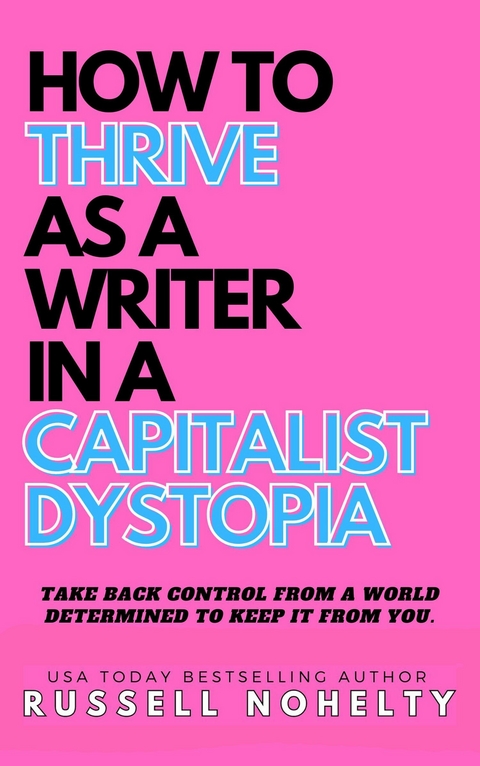
How to Thrive as a Writer in a Capitalist Dystopia (eBook)
343 Seiten
Wannabe Press (Verlag)
978-0-00-066687-1 (ISBN)
Are the ills of capitalism dragging down your creativity?
Are you stuck between needing to exchange money for food and hating monetizing your creative output?
Do you scratch your head wondering how you could possibly exist and thrive in today's world?
Then this book is for you.
How to Thrive as a Writer in a Capitalist Dystopia is your essential guide to navigating and succeeding as a creative human in the challenging world of modern capitalism. This book offers practical, actionable advice to help writers not just survive but thrive in these 'interesting' times.
You'll discover strategies to overcome the systemic challenges imposed by capitalism, learn the rules of the game and how to manipulate them to your advantage, and build a roadmap for a sustainable creative business that brings you joy even in a world tailor-made to steal every ounce of happiness from you.
Whether you're struggling with burnout or seeking to elevate your writing career, How to Thrive as a Writer in a Capitalist Dystopia equips you with invaluable tools to navigate our current capitalist landscape, ensuring your success and fulfillment as a writer from today until this whole house of cards collapses down upon itself and we rebuild something (hopefully) better in its place.
I have a secret. It is a deep-seated shame in my life.
I desperately want to be one of the cool kids. I want be okay with my status in the world, but I can’t stop myself from looking at every cool writer and saying, “I wonder if they would like me.”
No matter the space, whenever I enter somewhere new, I desperately seek the validation of the cool kids.
This is even more shameful because I have spent a big part of my life telling people to go their own way and follow the beat of their own drum.
I try to follow my own advice, but no matter how much I tamp down my imposter syndrome, I can’t stop that 16-year-old “mean girl” in my head telling me Becky doesn’t like me and Georgie thinks I’m fat.
I am a rebel, dang it. It’s right there in our mission statement at Wannabe Press. The first line is, We write for the rebels, yet every act of rebellion I make is followed by a deep-seated hope that the cool kids will validate my existence.
I don’t even care if they like me. I want them to say that I was useful. Even if they used me and spit me out, it would probably be okay. I want to sit at the end of their table, even if they don’t talk to me.
It is deeply toxic.
So, when Monica took my work and incorporated it into her Book Sales Supercharged series, I found myself saying, “Wait, the cool kids want to sit with me? Have I finally made it?”
Even before we became business partners, I knew Monica as one of the foremost thinkers in the publishing industry, and nearly everyone I talk to agrees with that sentiment. I always get people who say, “You work with Monica? I love her!”
Well, that’s not true. Usually, when I say she’s my partner, the reaction I get is, “You’re married to Monica Leonelle? I love her!”
And no, we are not married. Monica has a very lovely family. I have a wonderful wife whom I love very much. We live thousands of miles apart from each other. We work together, though, trying to build Writer MBA into a juggernaut in the indie publishing space.
I can’t lie, though. A lot of that drive to lead the space fulfills that deep-seated need to be a cool kid myself. That desire is so bad that my first instinct is to do work for free if I think somebody is cool so they’ll like me.
I’m 40 years old, and I constantly have to keep my 12-year-old fat kid outcast self in check.
Meeting with the top executives in the publishing space and having high-level meetings about how we can work together to move the industry into the future is wild to me after a career spent on the outside desperately seeking enough validation from my peers to be taken seriously.
I feel like I am, for the first time in my life, at the “cool kids” table. I thought it would somehow validate my existence when I was finally taken seriously, but I’ve learned, above anything else, that the people I was sitting across from in those meetings were as interested in having their ideas validated as I was in having mine taken seriously.
It turns out that almost everybody is looking to be validated by somebody, no matter how successful they look from the outside. Realizing that destroyed any notions I ever had that some people naturally have it together.
I watch many teen movies because I’m perpetually trapped in 1998, trying desperately to understand my high school self. One of the most interesting shifts in the past 20+ years is watching how the “cool kids” have moved from being portrayed almost exclusively as perfect villains and unsympathetic bullies to often being seen as victims in their own right, forced to put on armor to protect themselves from the same worries that everyone else has in their school.
All they want, at the end of the movie, is for somebody to let them take off the heavy armor and exist in the world as a “good” person...but they don’t know how to shed the constant need for their twisted form of validation.
That is a cold truth for the rest of us, too. I don’t think people would give a flying fart about whether the “cool kids” thought their ideas were good if they had some other way to get objective validation that they were, somehow, intrinsically and without question, a good person that deserved to exist.
And that is bonkers because, if you ignore everything else I ever write, please internalize this: you deserve to exist as much as any single human on this planet simply by being born.
Our modern society tries hard to strip you of that simple fact, but that doesn’t make it any less true. You have as much right to take up space and live without fear as any human who has or will ever exist.
Unfortunately, the capitalist nightmare we currently find ourselves caught up in works every moment to convince us that that isn’t true. It equates being “good” with having money. So, to prove we are “good”, society tells us that not only do we need to have a good idea and convince people our ideas are good enough to earn their attention, but that we can’t truly be a morally good person unless people spend money on what we have to offer.
Without that commodification of attention, you are judged as lacking true moral worth or, worse in the eyes of society, wasting your time. There is no greater sin in the eyes of today’s society than failing to operate at peak productivity. After all, time is money, right?
If you can sell your idea to people, you are good...at least for as long as people keep buying that thing. If not, you are discarded as irrelevant until you can develop something that commodifies attention properly.
The problem is that almost no idea is ever “good” for long, and even if it were an unquestionable truth of the universe, a good idea has no bearing on whether you are a good person or deserve to exist (because you do).
That was a crushing thing for me to learn. I always thought that if I just thought about a solution with enough rigor for long enough and could prove my ideas were objectively helpful to people, then maybe I would finally be a good person. When that bubble popped for me, it sent me into a dark place.
It turns out that even if an idea is “good” because it is objectively and momentarily correct (which, how could you judge whether something is correct when advice needs to be individualized for each person?), it probably won’t be correct very long.
It may be a week, a month, a year, or even longer, but eventually, market conditions will change as people evolve their habits to incorporate your ideas into their workflow, and your idea’s worth will erode to virtually nothing in the eyes of society at large...
...which forces you back into the grind to create a new idea that people will think is good enough so that society will pay to adopt it and validate that you are still a good person...
...until they deem it worthless and spit you back out into the trauma cycle once again. It’s planned obsolescence on a societal scale.
Still, this is the society we were given, which begs the question of whether it is even possible to put something creative into a world as messed up as the one we’ve built without constantly succumbing to a crippling degree of depression, anxiety, and despair every waking minute of the day? To that, I answer with a resounding maybe.
I started Wannabe Press after my first Kickstarter campaign, which raised over $5,000. I was not successful as a creative human at the time. That money was the most I had ever made on any creative project I had launched. Before then, the only money I ever made as a creative came from working on somebody else’s vision.
It didn’t fundamentally change my money situation then, but it changed my relationship with it for the rest of my career. That one glimmer of hope that I might not be wasting my life and our money on a fevered dream was everything to me. It showed me I wasn’t an abject failure.
After sending money to the printer and settling all the bills from the campaign, I had just enough seed money to start a new company.
Wannabe Press wasn’t my first company, mind you. I had launched three failed companies before that moment: [Insert Name Here] Productions, RPN Photography, and BNS Media Group.
All miserable failures, every one of them, for different reasons.
[Insert Name Here] Productions failed because my partner and I were at different stages of our lives and could not see eye to eye. RPN Photography failed because I got into a bad car accident and could no longer handle the long, grueling hours on set shooting photos for clients. BNS Media Group failed because I moved across the country, and again, my business partners were all on different pages about how much we could devote to the company.
So, this was my fourth creative business venture, and I needed it to stick. I had already started working in B2B sales and was getting pretty good at slinging phones to corporate clients, but I didn’t want it to be the rest of my...
| Erscheint lt. Verlag | 4.8.2025 |
|---|---|
| Sprache | englisch |
| Themenwelt | Technik |
| ISBN-10 | 0-00-066687-4 / 0000666874 |
| ISBN-13 | 978-0-00-066687-1 / 9780000666871 |
| Informationen gemäß Produktsicherheitsverordnung (GPSR) | |
| Haben Sie eine Frage zum Produkt? |
 EPUB (Adobe DRM)
Größe: 348 KB
Kopierschutz: Adobe-DRM
Adobe-DRM ist ein Kopierschutz, der das eBook vor Mißbrauch schützen soll. Dabei wird das eBook bereits beim Download auf Ihre persönliche Adobe-ID autorisiert. Lesen können Sie das eBook dann nur auf den Geräten, welche ebenfalls auf Ihre Adobe-ID registriert sind.
Details zum Adobe-DRM
Dateiformat: EPUB (Electronic Publication)
EPUB ist ein offener Standard für eBooks und eignet sich besonders zur Darstellung von Belletristik und Sachbüchern. Der Fließtext wird dynamisch an die Display- und Schriftgröße angepasst. Auch für mobile Lesegeräte ist EPUB daher gut geeignet.
Systemvoraussetzungen:
PC/Mac: Mit einem PC oder Mac können Sie dieses eBook lesen. Sie benötigen eine
eReader: Dieses eBook kann mit (fast) allen eBook-Readern gelesen werden. Mit dem amazon-Kindle ist es aber nicht kompatibel.
Smartphone/Tablet: Egal ob Apple oder Android, dieses eBook können Sie lesen. Sie benötigen eine
Geräteliste und zusätzliche Hinweise
Buying eBooks from abroad
For tax law reasons we can sell eBooks just within Germany and Switzerland. Regrettably we cannot fulfill eBook-orders from other countries.
aus dem Bereich