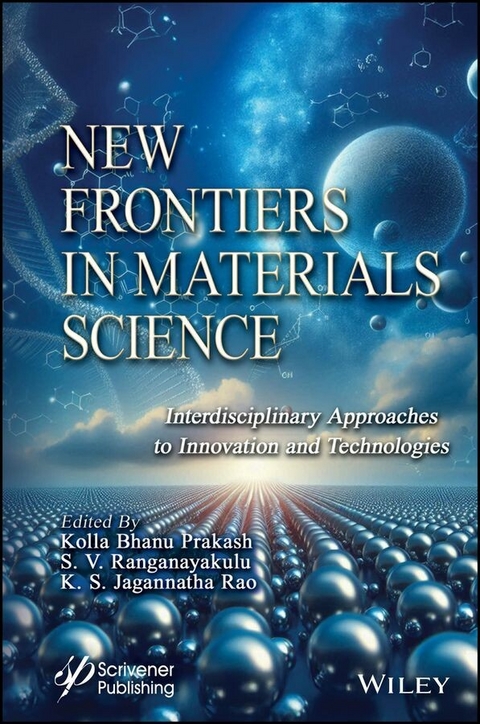
New Frontiers in Materials Science (eBook)
410 Seiten
Wiley-Scrivener (Verlag)
978-1-394-31490-4 (ISBN)
The book is essential for anyone eager to stay at the forefront of materials science, as it offers invaluable insights from leading experts into the latest advancements and applications shaping the future of technology.
New Frontiers in Materials Science: Interdisciplinary Approaches to Innovation and Technologies is an essential guide to the rapidly evolving field of materials science, presenting a thorough exploration of the latest advancements, challenges, and applications that define the discipline today. This book delves into cutting-edge research and emerging trends, from nanomaterials and biomaterials to smart materials and sustainable solutions, providing a detailed overview that is both accessible to newcomers and enriching for experienced professionals. Each chapter is crafted by leading experts, offering readers a balanced combination of theoretical knowledge and practical insights relevant to both academia and industry.
Designed for a diverse audience, this book addresses the needs of students, researchers, and professionals by bridging foundational concepts with state-of-the-art research. Topics such as materials for renewable energy, advances in nanotechnology, and applications in medical and electronic fields highlight how materials science is shaping the future. The book not only serves as a reference for technical knowledge but also inspires innovative thinking, making it a must-have resource for anyone committed to understanding and advancing the materials that will drive tomorrow's technologies.
Readers of the book will find it:
- Covers the latest developments and breakthroughs in materials science, keeping readers informed about emerging trends;
- Written by leading researchers and experts, providing in-depth knowledge and practical perspectives on innovative materials;
- Showcases how advancements in materials science impact industries such as electronics, healthcare, energy, and manufacturing;
- Examines the potential of new materials in sustainable technologies, nanotechnology, and smart materials for tomorrow's challenges;
- Encompasses topics from nanomaterials to biomaterials, making it a vital resource for students, researchers, and industry professionals.
Audience
Engineers, chemists, physicists, and materials scientists across academia and industry in sectors such as nanotechnology, biotechnology, electronics, and renewable energy.
Kolla Bhanu Prakash, PhD is a professor and associate dean of Research and Development at Koneru Lakshmaiah University, India and an adjunct professor at Taylor's University, Malaysia. He has published 15 patents, one copyright, over 150 research papers in national and international journals and conferences, edited 15 books, and authored three books. He has served as a reviewer and keynote speaker for several international conferences. His research interests include deep learning, data science, and quantum computing.
S. V. Ranganayakulu, PhD is the Dean of Research and Development at the Guru Nanak Institution's Technical Campus, India with over 30 years of teaching and administrative experience. He has to his credit 58 research papers in national and international journals, as well as 53 research papers in national and international conferences. His research interests include ultrasonics and liquid crystal displays.
K. S. Jagannatha Rao, PhD is a Pro-Chancellor at Koneru Lakshmaiah University, India. He is on the advisory board for a number of universities, both in India and abroad, and has made outstanding contributions to building innovation in higher education and research. He also played a key role in building PRISM (Panamanian Research Institutes of Science and Medicine). His research interests include neurosciences, biomarkers in brain disorders, and MRI studies on depression and Alzheimer's patients.
The book is essential for anyone eager to stay at the forefront of materials science, as it offers invaluable insights from leading experts into the latest advancements and applications shaping the future of technology. New Frontiers in Materials Science: Interdisciplinary Approaches to Innovation and Technologies is an essential guide to the rapidly evolving field of materials science, presenting a thorough exploration of the latest advancements, challenges, and applications that define the discipline today. This book delves into cutting-edge research and emerging trends, from nanomaterials and biomaterials to smart materials and sustainable solutions, providing a detailed overview that is both accessible to newcomers and enriching for experienced professionals. Each chapter is crafted by leading experts, offering readers a balanced combination of theoretical knowledge and practical insights relevant to both academia and industry. Designed for a diverse audience, this book addresses the needs of students, researchers, and professionals by bridging foundational concepts with state-of-the-art research. Topics such as materials for renewable energy, advances in nanotechnology, and applications in medical and electronic fields highlight how materials science is shaping the future. The book not only serves as a reference for technical knowledge but also inspires innovative thinking, making it a must-have resource for anyone committed to understanding and advancing the materials that will drive tomorrow s technologies. Readers of the book will find it: Covers the latest developments and breakthroughs in materials science, keeping readers informed about emerging trends; Written by leading researchers and experts, providing in-depth knowledge and practical perspectives on innovative materials; Showcases how advancements in materials science impact industries such as electronics, healthcare, energy, and manufacturing; Examines the potential of new materials in sustainable technologies, nanotechnology, and smart materials for tomorrow s challenges; Encompasses topics from nanomaterials to biomaterials, making it a vital resource for students, researchers, and industry professionals. Audience Engineers, chemists, physicists, and materials scientists across academia and industry in sectors such as nanotechnology, biotechnology, electronics, and renewable energy.
1
Nanomaterial Synthesis and Its Applications
A. Kalaiyarasan*1, K. Sankar2, S. Sundaram1 and K. Gunasekaran1
1Department of Mechanical Engineering, Muthayammal Engineering College, Rasipuram, Tamil Nadu, India
2Department of Civil Engineering, Muthayammal Engineering College, Rasipuram, Tamil Nadu, India
Abstract
Pyrolysis is a process by which a solid undergoes a heating process to make gas, char, and oil at 400ºC. This happens in the absence of oxygen. The disposal of plastics creates environmental problems. Plastic waste can be modified into other products. Carbon nanotubes (CNTs) are produced from paticles sizes ranging from 10 to 50 nanometers. A quartz tube with an inner diameter of 30 mm and a length of 500 mm constitutes the spray pyrolysis apparatus. The nozzle, with an inner diameter of approximately 0.5 mm, was connected to a precursor solution supply. A water bubbler was used to secure the quartz tube’s exterior section. Prior to use, the substrate was thoroughly cleaned in acetone utilizing ultrasonication and deionized water, and an argon blower to dry it finely. At the center of the quartz tube was a quartz boat holding the substrate. In an ordinary experiment, the quartz tube was heated to a reaction temperature and flushed with the gas to remove any air. Using an Ar atmosphere, the precursor solution—plastic pyrolytic oil and ferrocrete mixtures—was sprayed into the quartz tube. In the polystyrene pyrolytic oil, ferrocrete was present at a quantity of approximately 25 mg/ml. The homogenous mixture was created by sonicating the solution for 5 minutes, and Ar moved at a speed of 200 sccm/min. The studies were carried out using a reaction period of 45 minutes for each deposition, at 850–1050°C and 1 atmospheric pressure. Following deposition, the furnace was turned off and Ar gas flow was allowed to cool until it reached room temperature. A homogeneous black buildup was seen on the quartz substrate in the reaction zone. Ultimately, the quartz tub’s substrate containing CNTs was taken out. The yield and shape of Multiwall Carbon Nanotubes (MWNTs) were synthesized using ferrocene-mixed carbon precursor and polystyrene pyrolytic oil at a flow rate of 20 mL/h was examined. The mature materials for polystyrene-based Multiwall Carbon Nanotubes (PS-MWNTs) were examined using a scanning electron microscope (Hitachi-3000 H). For the Transmission Electron Microscope (TEM), JEOL-JEM-2010F was utilized. The usual tests were used to evaluate the mechanical, thermal, water absorption, and chemical resistance qualities. Effect of three different temperatures (855°C, 952°C, and 1150°C).
Keywords: Nanotubes, nanomaterials, fiber, composite, chemical reaction
1.1 Introduction
The field of nanotechnology has grown significantly during the past century. Additionally, a wide range of academic topics are now directly or indirectly linked to nanotechnology. Nanotechnology is the synthesis, mixing, categorization, and use of materials and devices through nanoscale shape and size changes. The prefix “nano” appears as a keyword in all streams, even those that promote products. The name “nano” comes from the Latin word “nanus” or the Greek word “nanos,” meaning “dwarf.” It combines the fields of solid-state physics, chemistry, biosciences, and material science. To fully understand a single subject, one must possess an amalgamation of knowledge from the fields of physics, chemistry, material science, solid-state physics, and biosciences. Almost all fields of research and technology are using nanotechnology more and more. The distinction between nanoscience and nanotechnology is that the former uses technology to control matter at the atomic level to create novel nanomaterials with distinctive properties, while the latter provides information about atom configurations and fundamental properties at the nanoscale [1].
Although the general public may not be aware of nanotechnology’s continued presence in daily life, nearly all technical fields are keeping an eye on it. Its broad range of use in the fields of electronics, medicine, engineering, environmental science, military, and security is only expanding (Figure 1.1). Even though this technology has seen a great deal of development, more work remains to be done to produce innovative, creative nanomaterials for a variety of applications that will benefit humanity. Despite their size, experience, and expense, researchers are dedicated to their topic and have a strong desire to further their knowledge. Consequently, the disciplines of electronics and medicine are primarily focused on low-cost device downsizing. In the future, nanotechnology will control every aspect of human existence, including working, residing, and communicating. As a result, this generates curiosity about the subject and encourages debate on the fundamental concepts of nanotechnology. “Nanomaterials” are the basic building blocks of nanotechnology. Nanomaterials are defined as materials that are, at least in one dimension, smaller than 100 nm. They are considerably smaller than microscale based on this definition. Usually, nanomaterials are one billionth of a meter, or 10-9 m, in size. The fundamental physicochemical characteristics of nanoparticles differ from those of the bulk material depending on their size and form. At the nanoscale level, nanomaterials impressively change in size and shape to acquire new properties and functions. Nanomaterials can be grouped according to their dimensionality and can take on a variety of shapes, including nanorods, nanoparticles, and nanosheets. Nanoparticles are zero-dimensional nanomaterials; nanorods and nanotubes are one-dimensional nanomaterials; and type I films and layers are typically two-dimensional nanomaterials. Most of them are separated into several categories for individual nanomaterials. Particles undergo physical changes when they come into touch with one another. These fragments of various components are referred to as bulk or 3D nanomaterials. The review highlights the importance of Nano-QSAR in influencing the direction of nano-enabled agriculture going forward, culminating in a synthesis of important observations. It offers tactical direction to guide future research projects in this exciting area.
Figure 1.1 Nanotechnology and nanoscience.
1.1.1 Nanomaterials Based in Metals
Divalent and trivalent metal ions serve as the foundation for metal nanostructures. Metal nanoparticles may be produced by a variety of techniques, such as chemical and photochemical procedures. Metal ions are reduced to metal nanoparticles using reducing agents. These nanoparticles are very porous and have strong small molecule adsorption capacity. They are extensively employed in many fields of study, including bioimaging and environmental investigations. It is possible to combine two or more nanoparticles while maintaining size control, in addition to achieving a single nanoparticle. Even earth metals can change the properties of the main element through doping. Their characteristics also change when various elements are doped in different constitutions [3–6].
1.1.2 Nanomaterials for Metal and Nonmetals on Semiconductor
Both metallic and non-metallic metal characteristics can be found in semiconductor nanoparticles. By altering them, they display broad band gaps and different characteristics. These are extensively employed in electronic devices and photocatalysis. Examples of semiconductor materials belonging to groups II–VI. Groups III–V include GaN [12], GaP [13], InP [14], and InAs [14]. Recently, researchers have become interested in semiconductor graphene nanocomposites. The semiconductor’s chemical and physical characteristics can be enhanced by graphene. The piezoelectric properties of graphene composite materials [18, 19] can be utilized for gas sensing applications [15–17]. Greenhouse gas (GHS) emissions, which are on the rise and have contributed to climate change and global warming [20–23], as well as the depletion of fossil fuel resources, have brought renewable energy sources and energy-saving methods to the attention of scientists and governments worldwide [24–26]. Among the energy sources, transportation accounts for around two-thirds of the world’s total energy use [27–29]. For a sustainable future, it is thus imperative to create alternative low-carbon transportation options, such as fuel cell vehicles (FCV) [31], electric vehicles (EV), and hybrid electric vehicles (HEV) [30, 31].
1.1.3 Micro and Nanocomposite Materials
One, two, or three of the phases of the nanocomposite polyphone solid substance have diameters of less than 105 nm. Unlike ordinary composites, nanocomposites have a high surface-to-volume ratio. The following variations in physicochemical qualities may occur depending on size and shape (Table 1.1) [2].
1.2 Nanomaterials and Preparation of Metal Matrix Composite
Nanomaterials are extremely tiny and cannot be observed without a microscope. They range between 1 and 100 nanometers (nm) in diameter. These days, nanoparticles are employed in the production of ceramic coatings, transparent sunscreens, self-cleaning windows, scratch-resistant eyewear, and paints that resist cracking. They are also utilized to make nanocomposites.
Nanoparticles are employed in a...
| Erscheint lt. Verlag | 31.7.2025 |
|---|---|
| Sprache | englisch |
| Themenwelt | Naturwissenschaften ► Chemie |
| Technik ► Maschinenbau | |
| Schlagworte | biomaterials • Ceramics • Composites • crystallography • materials characterization • mechanical properties • Metallurgy • nanomaterials • phase transitions • Polymers • Quantum materials • semiconductor materials • Smart Materials • Surface Science • Thin Films |
| ISBN-10 | 1-394-31490-6 / 1394314906 |
| ISBN-13 | 978-1-394-31490-4 / 9781394314904 |
| Informationen gemäß Produktsicherheitsverordnung (GPSR) | |
| Haben Sie eine Frage zum Produkt? |
 EPUB (Adobe DRM)
Kopierschutz: Adobe-DRM
Adobe-DRM ist ein Kopierschutz, der das eBook vor Mißbrauch schützen soll. Dabei wird das eBook bereits beim Download auf Ihre persönliche Adobe-ID autorisiert. Lesen können Sie das eBook dann nur auf den Geräten, welche ebenfalls auf Ihre Adobe-ID registriert sind.
Details zum Adobe-DRM
Dateiformat: EPUB (Electronic Publication)
EPUB ist ein offener Standard für eBooks und eignet sich besonders zur Darstellung von Belletristik und Sachbüchern. Der Fließtext wird dynamisch an die Display- und Schriftgröße angepasst. Auch für mobile Lesegeräte ist EPUB daher gut geeignet.
Systemvoraussetzungen:
PC/Mac: Mit einem PC oder Mac können Sie dieses eBook lesen. Sie benötigen eine
eReader: Dieses eBook kann mit (fast) allen eBook-Readern gelesen werden. Mit dem amazon-Kindle ist es aber nicht kompatibel.
Smartphone/Tablet: Egal ob Apple oder Android, dieses eBook können Sie lesen. Sie benötigen eine
Geräteliste und zusätzliche Hinweise
Buying eBooks from abroad
For tax law reasons we can sell eBooks just within Germany and Switzerland. Regrettably we cannot fulfill eBook-orders from other countries.
aus dem Bereich