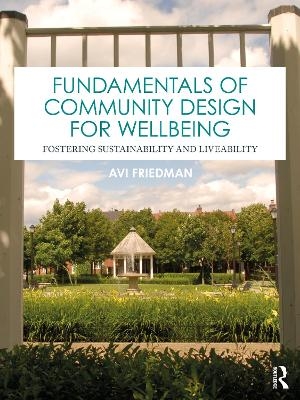
Fundamentals of Community Design for Wellbeing
Routledge (Verlag)
978-1-032-96053-1 (ISBN)
- Noch nicht erschienen (ca. Februar 2026)
- Versandkostenfrei
- Auch auf Rechnung
- Artikel merken
Fundamentals of Community Design for Wellbeing addresses the need to rethink the philosophy and form of residential environments due to recent social, economic, environmental, and cultural shifts, including depletion of non-renewable resources, elevated levels of greenhouse gas emissions, and climate change. This book highlights innovative planning strategies for livability and wellbeing of communities supported by lessons from notable international case studies, addressing varied issues including accommodating elderly populations, designing walkable communities, and closing the affordability gap. Authored by an architecture professor who is also a practicing architect and urban planner, this book navigates the residential design process from site planning to individual home design, emphasizing principles of sustainability. Each of its 20 illustrated chapters focuses on a distinct aspect of residential design that highlights effective solutions for today’s pressing challenges. This book is essential for students of urban planning, architecture, and sustainability, as well as professionals and policy makers.
Avi Friedman received his bachelor’s degree in Architecture and Town Planning from the Israel Institute of Technology, his master’s degree from McGill University, and his doctorate from the University of Montréal. He is the Director of the Affordable Homes Research Group at the McGill School of Architecture where he teaches. He also holds a Visiting Professor position in Lancaster University in the UK. Avi is known for his housing innovation and for several demonstration projects. He is the author of 30 books and the principal of Avi Friedman Consultants Inc. He is the recipient of numerous awards including the Manning Innovation Award, Lifetime Achievement Award from Sustainable Buildings Canada, and the World Habitat Award.
Preface
Acknowledgments
1. A Call for Sustainable and Livable Communities
2. Fitting in with the Context
3. Smart Growth in Urban Evolution
4. Grid Based Community Planning
5. Mobility for Wellbeing
6. Building Blocks for Wellbeing
7. Minimizing Ecological Footprints
8. Considering Environmental Elements in Planning
9. Density for Sustainable Development
10. Human-Centric Spaces in Built Environments
11. Planning Walkable Environments
12. Public Outdoor Spaces as Generators of Wellbeing
13. Designing Playful Communities
14. Cultivating Sustainability Through Edible Landscapes
15. Adaptable Living
16. Designing Communities for Aging Populations
17. Solar Design for Sustainability
18. Designing with Circularity of Materials in Mind
19. Water Management Strategies for Sustainability
20. Cultivating Social Relations for Wellbeing
Bibliography
Illustration Credits
| Erscheint lt. Verlag | 1.2.2026 |
|---|---|
| Zusatzinfo | 55 Line drawings, color; 145 Halftones, color; 200 Illustrations, color |
| Verlagsort | London |
| Sprache | englisch |
| Maße | 210 x 280 mm |
| Themenwelt | Medizin / Pharmazie ► Medizinische Fachgebiete ► Arbeits- / Sozial- / Umweltmedizin |
| Naturwissenschaften ► Geowissenschaften ► Geografie / Kartografie | |
| Technik ► Bauwesen | |
| ISBN-10 | 1-032-96053-1 / 1032960531 |
| ISBN-13 | 978-1-032-96053-1 / 9781032960531 |
| Zustand | Neuware |
| Informationen gemäß Produktsicherheitsverordnung (GPSR) | |
| Haben Sie eine Frage zum Produkt? |
aus dem Bereich