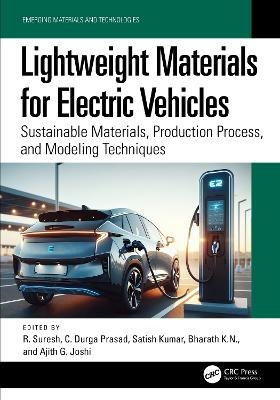
Lightweight Materials for Electric Vehicles
CRC Press (Verlag)
978-1-032-97505-4 (ISBN)
- Noch nicht erschienen (ca. Februar 2026)
- Versandkostenfrei
- Auch auf Rechnung
- Artikel merken
Lightweight Materials for Electric Vehicles serves as a comprehensive guide to the seamless integration of sustainable materials, advanced manufacturing techniques, and innovative solutions to tackle industry challenges. It underscores the pivotal role of academia in equipping the next generation of engineers with expertise in electric vehicle (EV) technologies. The book provides an in-depth exploration of the latest advancements in lightweight materials for EVs, focusing on their properties,
applications, processing methods, and the challenges they present.
Furthermore, it examines emerging trends such as AI- driven design, additive manufacturing, and the adoption of circular economy principles in automotive materials engineering. By addressing the evolving complexities of material selection and manufacturing, the book offers valuable insights into the future of EV innovation, extending its relevance to sectors beyond automotive, including aeronautics and aerospace.
Through case studies and research findings, the book also provides practical implementation strategies and actionable recommendations, while reinforcing the critical role of academia in driving progress and innovation in this transformative field.
Features:
• Discusses contemporary issues and challenges in the selection criteria of materials for electric vehicles.
• Explores various materials employed for electric vehicle batteries, such as lithium- ion, nickelmetal ydride, and solid- state batteries.
• Overviews the use of lightweight materials, such as aluminum, carbon fiber-reinforced olymers, and magnesium alloys, in electric vehicle bodies.
• Reviews different types of materials, their sustainability, feasibility of usage, and challenges.
• Presents case studies on the application of different materials in electric vehicles.
This book is an essential resource for practitioners, research scholars, academicians, and students involved in the study and development of materials for electric vehicles.
R. Suresh is a Full-time Professor in Department of Mechanical Engineering at M. S. Ramaiah University of Applied Sciences (RUAS), Bengaluru, India. With 28 years of experience spanning academia, research, and industry, his expertise lies in Hard and Refractory materials, Composites, Traditional and Non-traditional Machining process, Surface engineering, Solid-state Joining of metals, and Additive Manufacturing. C. Durga Prasad is an Assistant Professor in the Department of Mechanical Engineering at RVITM, Bengaluru, since 2019. He has extensive research experience, specializing in thermal spray coatings, microwave processing of materials, wear, tribo-corrosion, bio-composites, and biofuels. Satish Kumar is an Associate Professor in the Department of Robotic Engineering Symbiosis Institute of Technology at Symbiosis International (Deemed University), Pune, India. He has his expertise in application of Artificial Intelligence into a variety of crucial manufacturing processes, including quality enhancement, process improvement, and optimization. Bharath K. N. is a Professor and Dean (Research and Innovation) at GM University, Davangere. With 16 years of teaching and five years of R&D experience, his expertise includes composite materials, bioplastics, and machine design. Ajith G. Joshi is an Assistant Professor in Mechanical Engineering at Madanapalle Institute of Technology and Science, India. With extensive teaching experience, his research focuses on composite materials, tribology, and machining of difficult-to-cut alloys.
Chapter 1. Lightweight Materials used in Battery Vehicles: Revolutionizing Mobility. Chapter 2. Thermal and Mechanical Advancements in Epoxy-Enhanced Bamboo Nanocomposites: A Comprehensive Review on Synthesis, Structure, and Emerging Applications. Chapter 3. Recent Developments in Battery Materials and their Management System for Electric Vehicle Applications: A Perspective. Chapter 4. Advanced Nanomaterials for Battery Application. Chapter 5. Lightweight Materials Contribution for the Development of Battery Management Systems in Electric Vehicles. Chapter 6. Role of Additive Manufacturing and Thermal Spray Processed Materials in Electric Vehicles (EVs) and Hybrid Electric Vehicles (HEVs) Applications. Chapter 7. Polymer Hollow Fibre Heat Exchanger: Novel Approach to Battery Cooling. Chapter 8. Advanced Composites and Sustainable Materials for Lightweight Electric Vehicle Component. Chapter 9. Effect of Sustainable Materials to Combat Friction and Wear Behaviour in EVs and HEVs Components using Advanced Surface Processing Techniques. Chapter 10. A U-net based Deep Learning Approach for Electric Vehicle Battery Capacity Degradation and Health Early Prediction of Battery Remaining Useful Life. Chapter 11. Natural Fibre Composites – A Sustainable Lightweight Material for Electric Vehicles. Chapter 12. Synergetic Effect of Surface-Functionalized 2D Carbon-Based Polymer Nanocomposite to Enhance the Mechanical and Thermal Properties of Lightweight Materials for Electric Vehicles. Chapter 13. Emerging Materials for Battery Management System. Chapter 14. Perovskites for Next-Generation Energy Storage Applications: Innovations and Challenges. Chapter 15. Advanced Artificial Intelligence and Machine Learning Strategies for Optimizing Lightweight Materials Processing for Electric Vehicles. Chapter 16. Adaptive Vibration Isolation in Electric Vehicles Using Magnetorheological Elastomers: Characterizations and Applications. Chapter 17. Elevating Electric Vehicle Battery Management with Emerging Technologies. Chapter 18. Polymers and Composites in EVs and HEVs
| Erscheint lt. Verlag | 17.2.2026 |
|---|---|
| Reihe/Serie | Emerging Materials and Technologies |
| Zusatzinfo | 30 Tables, black and white; 95 Line drawings, black and white; 3 Halftones, black and white; 99 Illustrations, black and white |
| Verlagsort | London |
| Sprache | englisch |
| Maße | 178 x 254 mm |
| Themenwelt | Technik ► Elektrotechnik / Energietechnik |
| Technik ► Fahrzeugbau / Schiffbau | |
| Technik ► Maschinenbau | |
| ISBN-10 | 1-032-97505-9 / 1032975059 |
| ISBN-13 | 978-1-032-97505-4 / 9781032975054 |
| Zustand | Neuware |
| Informationen gemäß Produktsicherheitsverordnung (GPSR) | |
| Haben Sie eine Frage zum Produkt? |
aus dem Bereich