


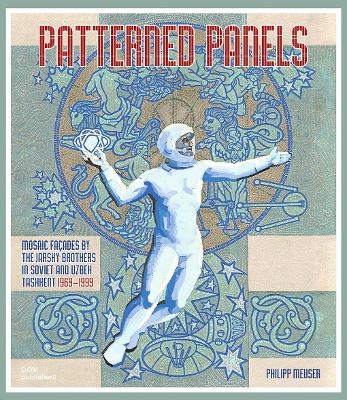
Patterned Panels. Mosaic Façades by the Jarsky Brothers in Soviet and Uzbek Tashkent
1969–1999
Seiten
In the wake of Soviet Modernism’s belated renaissance, the monumental façade mosaics of Pyotr, Nikolai, and Alexander Jarsky stand as defiant expressions of individuality within an architecture of mass production. Created for serially manufactured housing blocks in post-earthquake Tashkent, these artworks challenge the conventional narrative of Soviet prefabricated construction as soulless, anonymous, and oppressive. Their vivid ornamentation – geometric, floral, figurative – gives voice to a Soviet-Uzbek style that emerged not through ideology but through artistic resistance embedded in concrete.
This book documents for the first time the life and work of the Jarsky brothers, whose mosaic murals now number among Uzbekistan’s officially protected cultural assets. Based on two decades of research and rare personal encounters with the Jarsky family, it presents an architectural history written not by ministries but by hands shaping tiles – and identities – into lasting form.
More than an homage, this monograph is a call to action. It interrogates the politics of heritage, the historiography of standardised architecture, and the role of art in contested urban space. As Uzbekistan cautiously begins to valorise its Soviet-era past, the question lingers: will these Modernist surfaces, born of a utopian impulse, find their place on the global stage of architectural heritage?
This book documents for the first time the life and work of the Jarsky brothers, whose mosaic murals now number among Uzbekistan’s officially protected cultural assets. Based on two decades of research and rare personal encounters with the Jarsky family, it presents an architectural history written not by ministries but by hands shaping tiles – and identities – into lasting form.
More than an homage, this monograph is a call to action. It interrogates the politics of heritage, the historiography of standardised architecture, and the role of art in contested urban space. As Uzbekistan cautiously begins to valorise its Soviet-era past, the question lingers: will these Modernist surfaces, born of a utopian impulse, find their place on the global stage of architectural heritage?
Dr. Philipp Meuser (born 1969) is a Berlin-based architect and professor specialising in modular construction and industrial housing construction. As an internationally recognised expert, he advises politicians and authorities on issues relating to serial construction. With over 20 years of practical experience in this field, he has been involved in numerous projects both in Germany and abroad. Meuser’s architectural history research and handbooks make a significant contribution to the study and evaluation of the heritage value of prefabricated residential buildings.
| Erscheinungsdatum | 30.11.2025 |
|---|---|
| Verlagsort | Berlin |
| Sprache | englisch |
| Maße | 248 x 280 mm |
| Themenwelt | Technik ► Architektur |
| Schlagworte | Architektur • Kunst • Mosaikkunst • Sowjetmoderne • Taschkent • Usbekistan • Wohnungsbau |
| ISBN-13 | 9783869225760 / 9783869225760 |
| Zustand | Neuware |
| Informationen gemäß Produktsicherheitsverordnung (GPSR) | |
| Haben Sie eine Frage zum Produkt? |
Mehr entdecken
aus dem Bereich

aus dem Bereich
Grundlagen, Normen, Vorschriften
Buch | Hardcover (2024)
Springer Vieweg (Verlag)
CHF 219,95
Tragkonstruktion und Schichtaufbau
Buch | Hardcover (2024)
Birkhäuser (Verlag)
CHF 119,95
Arbeitsschritte - Fallbeispiele - Detailzeichnungen - Dokumente - …
Buch | Hardcover (2024)
DIN Media (Verlag)
CHF 92,40


