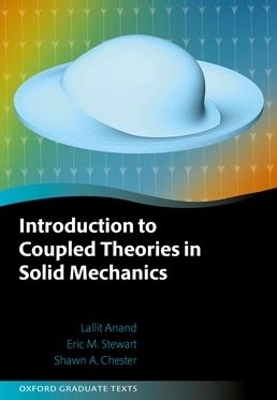
Introduction to Coupled Theories in Solid Mechanics
Oxford University Press (Verlag)
978-0-19-898621-8 (ISBN)
This textbook introduces some foundational coupled theories in solid mechanics by starting from fundamental principles of mechanics, thermodynamics, and electrodynamics, and specializing to model particular 'smart materials'. Numerous representative simulations are provided, demonstrating key coupled behaviours and engineering applications for each theory.
The large deformation coupled theories discussed in this book have been numerically implemented in the open-source finite element program FEniCS, and representative simulations which illustrate key coupled behaviors are presented for each theory. The FEniCS codes for the representative simulations shown in this book are available online on the book's companion website: .
Ideal for graduate students, researchers, and practicing engineers, Introduction to Coupled Theories in Solid Mechanics serves as both an introduction to the field and a foundational resource for building the coupled theories and simulation tools of the future.
Lallit Anand received his undergraduate degree from IIT Kharagpur and his doctorate from Brown University. After a few years in industry at U.S. Steel's Fundamental Research Laboratory, he joined the MIT faculty, where he is currently the Rohsenow Professor of Mechanical Engineering. The honors he has received include: ICES Eric Reissner Medal, 1992; ASME Fellow, 2003; Khan International Plasticity Medal, 2007; IIT Kharagpur Distinguished Alumnus Award, 2011; ASME Drucker Medal, 2014; MIT Den Hartog Distinguished Educator Award, 2017; Brown University Engineering Alumni Medal, 2018; SES Prager Medal, 2018; and SES Fellow, 2024. He was elected to the U.S. National Academy of Engineering in 2018. Eric M. Stewart obtained a B.S in Aerospace Engineering from Georgia Tech in 2018. He then obtained M.S. and Ph.D. degrees in Mechanical Engineering from MIT in 2021 and 2025, where he was a recipient of the National Defense Science and Engineering Graduate (NDSEG) Fellowship. He joined the faculty of the University of Cincinnati in 2025, where he is currently an Assistant Professor in the Department of Mechanical and Materials Engineering. Shawn A. Chester obtained his BS and MS in Mechanical Engineering from NJIT, and his PhD from MIT. After a postdoc at Lawrence Livermore National Laboratory, he joined the faculty at NJIT. He is the recipient of several honors and awards, including an NSF CAREER award, the ASME Thomas J.R. Hughes Young Investigator Award, the Newark College of Engineering Rising Star Research Award, and the NJIT Excellence in Research Award.
Part I - Finite Elasticity of Elastomeric Materials
1: Finite elasticity of elastomeric materials
2: Numerical implementation of finite elasticity
3: Representative simulations
Part II - Viscoelasticity of Elastomeric Materials
4: Viscoelasticity of elastomeric materials
5: Numerical implementation of the viscoelasticity theory
6: Representative simulations
Part III - Thermoelasticity of Elastomeric Materials
7: Thermoelasticity of elastomeric materials
8: Numerical implementation of thermoelasticity of elastomeric materials
9: Representative simulations
Part IV - Poroelasticity of Elastomeric Gels
10: Poroelasticity of elastomeric gels
11: Numerical implementation of poroelasticity of elastomeric gels
12: Representative simulations
Part V - Thermally-Responsive Elastomeric Gels
13: Thermally responsive elastomeric gels
14: Numerical implementation of theory for thermally responsive gels
15: Representative simulations
Part VI - Cahn-Hilliard Theory for Species Diffusion Coupled with Elastic Deformations
16: Cahn-Hilliard theory for species diffusion and phase segregation
17: Coupled chemo-mechanical theory for species diffusion and phase segregation
18: Numerical implementation of the coupled chemo-mechanical theory
19: Representative simulations
Part VII - Electro-Elasticity of Dielectric Elastomers
20: Electroelasticity of dielectric elastomers
21: Numerical implementation of the theory for dielectric elastomers
22: Representative simulations
Part VIII - Electro-Viscoelasticity of Dielectric Elastomers
23: Electro-viscoelasticity of dielectric elastomers
24: Numerical implementation of the electro-viscoelasticity theory
25: Representative simulations for dielectric viscoelastomers
Part IX - Electro-Chemo-Elasticity of Ionic Polymers
26: Electro-chemo-elasticity of ionic polymers
27: Numerical implementation of theory for ionic polymers
28: Representative simulations
Part X - Magneto-Elasticity of Hard-Magnetic Soft-Elastomers
29: Magneto-viscoelasticity of hard-magnetic soft-elastomers
30: Numerical implementation of the theory
31: Representative simulations
Part XI - Magneto-Elasticity of Soft-Magnetic Soft-Elastomers
32: Magneto-viscoelasticity of soft-magnetic soft-elastomers
33: Numerical implementation of the theory for s-MREs
34: Representative simulations
Appendices
| Erscheinungsdatum | 19.12.2025 |
|---|---|
| Reihe/Serie | Oxford Graduate Texts |
| Zusatzinfo | 172 figures |
| Verlagsort | Oxford |
| Sprache | englisch |
| Maße | 194 x 253 mm |
| Gewicht | 1484 g |
| Themenwelt | Naturwissenschaften ► Physik / Astronomie ► Festkörperphysik |
| Naturwissenschaften ► Physik / Astronomie ► Mechanik | |
| Technik ► Maschinenbau | |
| ISBN-10 | 0-19-898621-1 / 0198986211 |
| ISBN-13 | 978-0-19-898621-8 / 9780198986218 |
| Zustand | Neuware |
| Informationen gemäß Produktsicherheitsverordnung (GPSR) | |
| Haben Sie eine Frage zum Produkt? |
aus dem Bereich