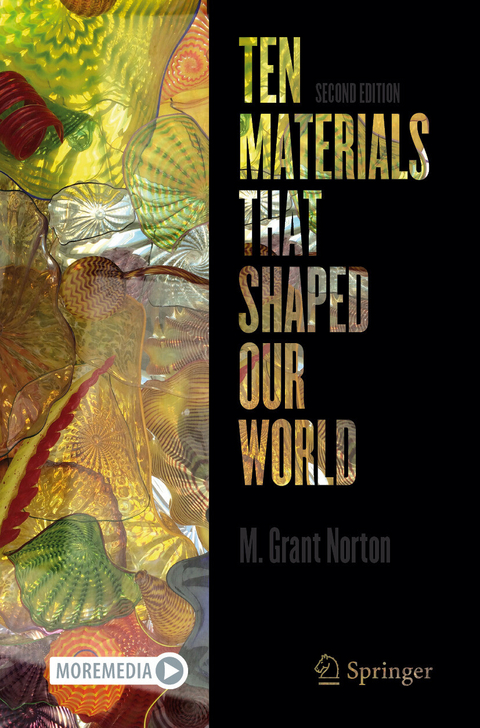
Ten Materials That Shaped Our World (eBook)
217 Seiten
Springer (Verlag)
978-3-031-91647-2 (ISBN)

This Premium Edition of Ten Materials That Shaped Our World is part of a small audiobook pilot program at Springer Nature. It includes audio files accessible online via the Springer Nature MoreMedia App.
This book examines ten materials—flint, clay, iron, gold, glass, cement, rubber, polyethylene, aluminum, and silicon—explaining how they formed, how we discovered them, why they have the properties they do, and how they have transformed our lives. Since the dawn of the Stone Age, we have shaped materials to meet our needs and, in turn, those materials have shaped us.
The fracturing of flint created sharp, curved surfaces that gave our ancestors an evolutionary edge. Molding clay and then baking it in the sun produced a means of recording the written word and exemplified human artistic imagination. As our ability to control heat improved, earthenware became stoneware and eventually porcelain, the most prized ceramic of all. Iron cast at high temperatures formed the components needed for steam engines, locomotives, and power looms—the tools of the Industrial Revolution. Gold has captivated humans for thousands of years and has recently found important uses in biology, medicine, and nanotechnology. Glass shaped into early and imperfect lenses not only revealed the microscopic world of cells and crystals, but also allowed us to discover stars and planets beyond those visible with the naked eye. Silicon revolutionized the computer, propelling us into the Information Age and with it our interconnected social networks, the Internet of Things, and artificial intelligence.
Written by a materials scientist, this book explores not just why, but also how certain materials came to be so fundamental to human society. This enlightening study captivates anyone interested in learning more about the history of humankind, our ingenuity, and the materials that have shaped our world.
| Erscheint lt. Verlag | 17.7.2025 |
|---|---|
| Reihe/Serie | Copernicus Books |
| Zusatzinfo | VIII, 217 p. 18 illus., 11 illus. in color. |
| Sprache | englisch |
| Themenwelt | Geisteswissenschaften ► Geschichte |
| Naturwissenschaften ► Physik / Astronomie | |
| Technik ► Elektrotechnik / Energietechnik | |
| Technik ► Maschinenbau | |
| Schlagworte | Evolution of Materials • History of Gold • History of Materials • History of Materials Audiobook • History of polymers • History of Silicon • Materials and Society • materials discovery • Societal Impact of Materials |
| ISBN-10 | 3-031-91647-6 / 3031916476 |
| ISBN-13 | 978-3-031-91647-2 / 9783031916472 |
| Informationen gemäß Produktsicherheitsverordnung (GPSR) | |
| Haben Sie eine Frage zum Produkt? |
 PDF (Wasserzeichen)
DRM: Digitales Wasserzeichen
Dieses eBook enthält ein digitales Wasserzeichen und ist damit für Sie personalisiert. Bei einer missbräuchlichen Weitergabe des eBooks an Dritte ist eine Rückverfolgung an die Quelle möglich.
Dateiformat: PDF (Portable Document Format)
Mit einem festen Seitenlayout eignet sich die PDF besonders für Fachbücher mit Spalten, Tabellen und Abbildungen. Eine PDF kann auf fast allen Geräten angezeigt werden, ist aber für kleine Displays (Smartphone, eReader) nur eingeschränkt geeignet.
Systemvoraussetzungen:
PC/Mac: Mit einem PC oder Mac können Sie dieses eBook lesen. Sie benötigen dafür einen PDF-Viewer - z.B. den Adobe Reader oder Adobe Digital Editions.
eReader: Dieses eBook kann mit (fast) allen eBook-Readern gelesen werden. Mit dem amazon-Kindle ist es aber nicht kompatibel.
Smartphone/Tablet: Egal ob Apple oder Android, dieses eBook können Sie lesen. Sie benötigen dafür einen PDF-Viewer - z.B. die kostenlose Adobe Digital Editions-App.
Buying eBooks from abroad
For tax law reasons we can sell eBooks just within Germany and Switzerland. Regrettably we cannot fulfill eBook-orders from other countries.
aus dem Bereich