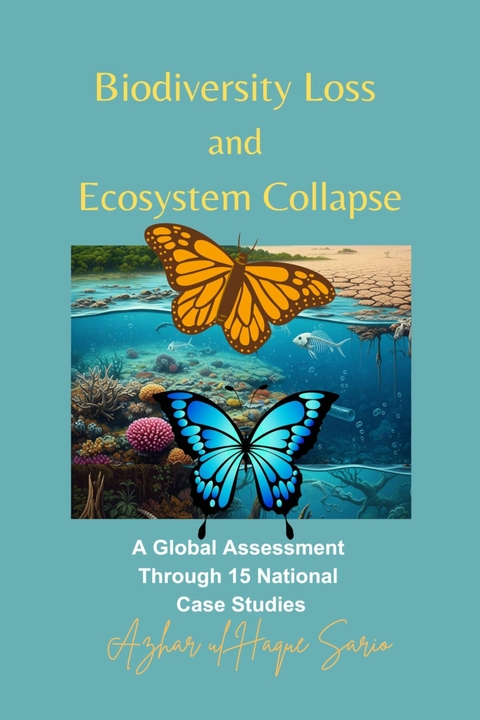
Biodiversity Loss and Ecosystem Collapse (eBook)
194 Seiten
Azhar Sario Hungary (Verlag)
978-3-384-66012-1 (ISBN)
Our planet's life support systems are failing, and this book provides the receipts. The world faces a biodiversity crisis. Wildlife populations have plummeted by an average of 73% since 1970. One million species are nearing extinction. This isn't just an environmental issue; it's an economic time bomb. This book takes you beyond the headlines. We explore the crisis through 15 in-depth national case studies. We travel to Brazil, where the Amazon is at a tipping point. We see how conflict drives deforestation in Colombia and the Democratic Republic of Congo. We also understand the impact of industrial agriculture in the United States. Each chapter breaks down the state of the local ecosystem. It identifies the key economic drivers of destruction. We analyze government policies and financial responses. Finally, we look at future pathways and solutions, all benchmarked against the crucial '30x30' global conservation target.
While many reports describe the biodiversity crisis, this book shows you the crisis. It avoids vague generalizations by focusing on specific, real-world examples. Other books might tell you palm oil is a problem; we take you inside the supply chains in Indonesia and Malaysia to see the direct link between commodity booms and forest loss. The book's unique, consistent structure for each country allows for powerful comparisons, revealing global patterns in a way no other single volume does. It's not just an assessment of loss; it's a practical guide to the complex interplay of economics, governance, and conservation. We unpack innovative solutions, from Ecuador's historic debt-for-nature swap to Colombia's pioneering biodiversity bonds, offering a clear-eyed view of what works, what doesn't, and what's next in the fight to save nature.
Disclaimer: This book is an independently produced work of analysis and commentary. The author has no affiliation with, is not sponsored by, and is not endorsed by the World Wildlife Fund (WWF), the Intergovernmental Science-Policy Platform on Biodiversity and Ecosystem Services (IPBES), the World Bank, the Convention on Biological Diversity (CBD), or any other organization mentioned herein. The use of organizational names is for identification purposes only under the principle of nominative fair use.
Part I: The Americas - Deforestation, Extraction, and Policy Frontiers
Brazil - Deforestation in the Amazon: The Tipping Point of a Global Ecosystem
A Ghost in the Green
Listen. Can you hear it? Beneath the chainsaw’s whine and the crackle of distant fires, there is a new sound rising from the Amazon. It is the sound of a great lung struggling for breath. It is the sound of a living god beginning to forget its own name.
We in Brazil live inside a waking contradiction. We are a people born of the forest, our culture a reflection of its impossible green, our very identity tangled in its roots. Yet, we are the ones holding the blade. The Amazon is not just a collection of trees; it is the planet’s memory, a biological epic written over millennia. Its health dictates the rhythm of rain for a continent and steadies the climate for us all. And we are tearing out its pages for profit. We are caught in a fever dream of an economy that pays us to dismantle our own life-support system, trading a cathedral of life for a cattle ranch, a symphony of species for a sterile field of soy. This is more than a paradox; it is a kind of madness.
The Shape of the Wound
To talk about the damage is to speak in a language of ghosts. Forget the statistics; they are just numbers that help us sleep at night. Instead, picture a wound in the Earth so vast it has changed the color of the world map. Imagine a shadow the size of France spreading across the green, a creeping emptiness where life once thrived. This is not a slow decline. It is a hemorrhage.
Scientists say we have erased nearly a fifth of this world. Another fifth is so broken, so scarred and fragmented, it has become a zombie forest—standing, but no longer truly alive. This is not just the felling of timber. It is the silencing of a billion conversations. The Amazon holds, in its living embrace, one in ten of every life form we have ever known. Every acre that falls is a library of unread stories, of potential cures for our diseases, of creatures of impossible beauty, burned before we even gave them a name.
This unraveling is pushing the entire system toward a precipice. A point of no return. The scientists call it the tipping point, a clinical term for a planetary catastrophe. They warn us this edge is near—somewhere between 20% and 25% of total loss. We are standing on the brink, peering into an abyss of our own making.
To cross that line is to trigger a final, irreversible cascade. The Amazon, a system so powerful it creates its own weather, will lose its ability to make rain. The great canopy, which exhales rivers into the sky, will thin and tear. The air will parch. The rainy seasons will stutter and shrink, while the dry seasons will grow into long, fire-choked sieges. The world’s greatest rainforest will begin its inexorable transformation into a dry, brittle savanna. It will be a slow-motion death that will unleash a death-rattle of carbon into the atmosphere, convulsing the global climate and executing a mass extinction event of biblical proportions.
A Pink Omen in the Water
If you want to understand this loss, do not look at a chart. Look at the boto, the pink river dolphin. This creature is a myth made flesh, an intelligent, gentle soul that has navigated the Amazon’s dark waters since time began. Its health is the river’s health. Its fate is our warning.
In the Mamirauá Reserve, a place designed to be a heaven on Earth, the dolphin’s world collapsed. Their numbers cratered, a 65% freefall in two short decades. It was a silent scream we failed to hear. Then, in the suffocating heat of late 2023, the scream became visible. The world watched as Lake Tefé, a tributary of the great river, became a tomb. The water, superheated by an unprecedented drought and our warming world, literally boiled the life from them.
Over 330 of their bodies were pulled from the shallows. Their beautiful pink forms, a ghastly and heartbreaking sight, were a message from the dying heart of the ecosystem. They didn’t die of old age or disease. They died of heat. They died because their world had been rendered uninhabitable. Their bodies were an omen, a visceral portrait of a system pushed past its breaking point.
The Heart Attack of a Continent
The Amazon is the heart that pumps water to an entire continent. This is not poetry; it is physics. Every day, billions of trees act as colossal biological straws, pulling moisture from the earth and breathing it into the atmosphere in a process called evapotranspiration. This creates an invisible, sky-borne ocean—the “flying rivers.”
This great river in the sky, carrying more water than the Amazon River itself, flows west, hits the wall of the Andes, and is forced south. It delivers the rain that sustains the agricultural heartlands of southern Brazil, Paraguay, Uruguay, and Argentina. The food on 300 million plates depends on this celestial pump.
Every tree that falls, every hectare that burns, weakens the pump. It slows the heart. The flying rivers are thinning, faltering. The ever-more-frequent and punishing droughts that plague South America are the symptoms of this weakening pulse. The fate of a farmer in the Argentine Pampas, staring at his cracked and barren soil, is being written by the sound of a chainsaw a thousand miles away in Brazil. To kill the Amazon is to knowingly engineer a future of thirst and hunger for ourselves.
A Desperate Hope on a Knife's Edge
As we stand here in the middle of 2025, the story is one of terrifying suspense. For the first time in what feels like an eternity, a fragile shoot of hope has pushed through the scorched earth. Early this year, data showed that the rate of destruction had plummeted by over 30%, a nine-year low. This was not a miracle. It was the result of will. A new government drew a line in the sand, empowering those who protect the forest and hunting those who burn it.
But this progress is a house of cards. The machinery of destruction—the powerful agribusiness lobby, the political forces that profit from ruin—has not been dismantled. It has only been paused. It waits, patiently, for our will to falter. While our gaze was fixed on the Amazon, the Pantanal wetlands, a paradise of jaguars and giant otters, suffered the worst fires in its history in 2024. The sickness is not in one organ; it is in the body of the nation.
And now, a storm gathers. A bill, a simple plan to pave a road, threatens to be the final, deliberate plunge of the knife. The BR-319 is an old, forgotten scar of a highway, a muddy track that cuts through the untouched heart of the central Amazon. To pave it would be to create a main artery for destruction.
A paved road in the jungle is a catalyst. From it, a “fishbone” pattern of illegal roads will spread like a cancer, opening up millions of acres of pristine forest to a chaotic and unstoppable flood of loggers, miners, and land thieves. Scientists have modeled it. Their conclusion is a death sentence. Paving the BR-319, a single project, could unleash enough destruction to shove the entire Amazon ecosystem over its tipping point. One road could be the act that kills a god.
So this is where we are. In a moment of profound tension, caught in a desperate tug-of-war between a fragile, resurgent hope and the cold, hard logic of the bulldozer. The recent progress proves that the Amazon’s eulogy is not yet written. But the shadow of the BR-319 reminds us just how quickly, and how easily, it could be. The fate of the world’s living heart, and the stability of our own future, hangs right now between a glimmer of green and the paved road to ruin.
Listen.
If you stand at the edge of the world’s greatest forest, you can hear it breathing. It’s a quiet, constant hum of life—a billion creatures, a trillion leaves, all inhaling the sun and exhaling the very air we need to survive. But listen closer, and you’ll hear another sound. A dissonant, mechanical shriek that tears through the harmony. It’s the sound of a chainsaw. And after it comes a more terrifying sound: silence.
The story of the Amazon’s demise isn't a natural disaster; it's a human story. It's a tale of a slow, deliberate amputation, driven by a series of choices that mistake a quick profit for lasting prosperity. This is not an abstract environmental issue. It’s a crisis of imagination, a failure to see the living, breathing cathedral for the timber.
The Tyranny of the Hamburger
At the heart of the fire and the fallen trees is a simple, voracious appetite. The single greatest force erasing the Amazon from the map is cattle ranching. The numbers are so staggering they feel unreal: for every four ancient trees felled in the Brazilian Amazon, three are sacrificed to create pasture for cows. This isn't a footnote in the story of deforestation; it is the headline.
This hunger has global reach. The demand for beef has made cattle ranching the leading cause of tropical deforestation worldwide. It’s a planetary fever. The process is often cloaked in a clever deception known as "cattle laundering." Imagine a shell game played with lives and landscapes: cattle are raised on illegally razed land, fattened in the ashes of irreplaceable forest. Then, just before sale, they are moved to a legitimate, "clean" ranch. Their criminal origin story is washed away, and they enter the global market with a clean bill of...
| Erscheint lt. Verlag | 20.7.2025 |
|---|---|
| Sprache | englisch |
| Themenwelt | Naturwissenschaften |
| Technik | |
| Schlagworte | Biodiversity conservation • conservation case studies • deforestation causes and solutions • ecosystem services economics • Environmental Policy • Global Biodiversity Framework • natural resource management |
| ISBN-10 | 3-384-66012-9 / 3384660129 |
| ISBN-13 | 978-3-384-66012-1 / 9783384660121 |
| Informationen gemäß Produktsicherheitsverordnung (GPSR) | |
| Haben Sie eine Frage zum Produkt? |
 EPUB (Ohne DRM)
Digital Rights Management: ohne DRM
Dieses eBook enthält kein DRM oder Kopierschutz. Eine Weitergabe an Dritte ist jedoch rechtlich nicht zulässig, weil Sie beim Kauf nur die Rechte an der persönlichen Nutzung erwerben.
Dateiformat: EPUB (Electronic Publication)
EPUB ist ein offener Standard für eBooks und eignet sich besonders zur Darstellung von Belletristik und Sachbüchern. Der Fließtext wird dynamisch an die Display- und Schriftgröße angepasst. Auch für mobile Lesegeräte ist EPUB daher gut geeignet.
Systemvoraussetzungen:
PC/Mac: Mit einem PC oder Mac können Sie dieses eBook lesen. Sie benötigen dafür die kostenlose Software Adobe Digital Editions.
eReader: Dieses eBook kann mit (fast) allen eBook-Readern gelesen werden. Mit dem amazon-Kindle ist es aber nicht kompatibel.
Smartphone/Tablet: Egal ob Apple oder Android, dieses eBook können Sie lesen. Sie benötigen dafür eine kostenlose App.
Geräteliste und zusätzliche Hinweise
Buying eBooks from abroad
For tax law reasons we can sell eBooks just within Germany and Switzerland. Regrettably we cannot fulfill eBook-orders from other countries.
aus dem Bereich