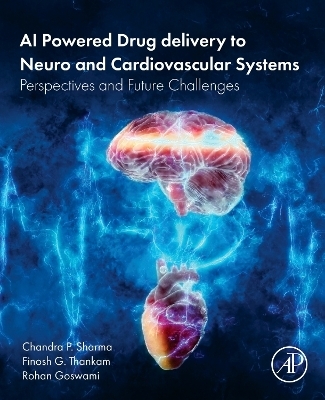
AI Powered Drug delivery to Neuro and Cardiovascular Systems
Academic Press Inc (Verlag)
978-0-443-40441-2 (ISBN)
- Noch nicht erschienen (ca. März 2026)
- Versandkostenfrei
- Auch auf Rechnung
- Artikel merken
The book delves into AI-driven drug design and testing for cardiovascular diseases and explores the application of AI in cardiac drug delivery vehicles. It discusses bioengineered heart and vessel therapeutics, redox homeostasis, and targeted drug replenishment in cardiac matrix remodeling. Additionally, it addresses mitochondrial drug retention, AI-assisted gene therapy for neurodegenerative disorders, and the role of AI in optimizing heart health. The text highlights smart systems for managing cerebrovascular accidents and neuromodulation with pharmacotherapy. Finally, it covers translational challenges, future directions, and the significance of AI-driven prediction models and robotic delivery mechanisms.
Dr. Chandra P. Sharma is Adjunct Professor, Department of Pharmaceutical Biotechnology, Manipal College of Pharmaceutical Sciences, Manipal University, and Hon. Emeritus Professor, College of Biomedical Engineering & Applied Sciences, Purbanchal University, Kathmandu, Nepal. Dr. Sharma is a Solid-State Physicist from IIT Delhi and received his training in Biomaterials area in the University of Utah with Prof. D.J. Lyman as a graduate student and in the University of Liverpool, England with Prof. D.F. Williams as a Post-Doctoral Research Associate. Dr. Sharma has been awarded FBSE (Fellow Biomaterials Science & Engineering) by The International Union of Societies for Biomaterials Science & Engineering (IUS-BSE) in 2008 and FBAO (Fellow Biomaterials and Artificial Organs) by Society for Biomaterials & Artificial Organs (India) (SBAOI) in 2011 and shares Whitaker and National Science Foundation Award – International Society for Artificial Organs (ISAO) USA, invited member ACS (2015-2018). Dr. Finosh Thankam is an assistant professor and researcher in Tissue Engineering and Regenerative Medicine, in the Department of Translational Research, at the Western University of Health Sciences, in Pomona, CA. His undergraduate studies were in Biochemistry, before completing his post-graduate degree in Medical Biochemistry from Mahatma Gandhi University, in India. As a research fellow he was exposed to the new world of tissue engineering and regenerative medicine and published many original articles on various aspects of cardiac tissue engineering. His current research interests include investigating the pathogenesis of various musculoskeletal disorders, and cardiovascular diseases, and applying the knowledge and principles of tissue engineering to develop artificial tissue constructs to improve the care for the sufferers. Rohan Goswami, M.D. is an advanced heart failure and transplant cardiologist in the Transplant Center at Mayo Clinic hospital in Jacksonville, Florida. Dr. Goswami received his medical degree from the American University of the Caribbean School of Medicine, Sint Maarten, Netherlands Antilles, and went on to complete an internal medicine residency at The Stamford Hospital/Columbia University College of Physicians and Surgeons in Stamford, Connecticut, where he was Chief Resident. During his time at Stamford Hospital, he developed and implemented a resident education system to help improve resident knowledge, patient care and patient outcomes. He then completed a fellowship in cardiovascular diseases at the University of Tennessee Health Science Center in Memphis, Tennessee, and his advanced heart failure and transplant cardiology fellowship at Mayo Clinic College of Medicine in Jacksonville. Dr. Goswami has a background in information technology and is focused on innovation and clinical research. He also is an avid mountaineer and climbed Mount Kilimanjaro with his father in 2016.
1. Introduction
Section I: Fundamentals and concepts
2. AI and ML in translational drug delivery.
3. Current AI practices in the management of cardiovascular and neurological diseases.
4. AI-enhanced drug design and testing for cardiovascular diseases.
Section II: AI-supported drug delivery
5. Artificial intelligence in cardiac drug delivery vehicles
6. Bioengineered heart and vessels: Insights on AI-based drug release approaches.
7. AI-inspired redox homeostasis of cardiovascular system: Next-gen drug therapy
8. AI-targeted drug replenishment in cardiac matrix remodeling and regeneration.
9. Mitochondrial drug retention: Novel avenues in AI
10. AI-assisted pharmaco and gene therapy for neurodegenerative diseases
11. Neuromodulation with pharmacotherapy: An AI perspective
Section III: Management and future
12. AI in Heart Health
13. Augmented optimization of medical side effects – avoiding the crisis of complication.
14. Smart systems for the management of cerebrovascular accidents.
15. Translational challenges and future.
| Erscheint lt. Verlag | 1.3.2026 |
|---|---|
| Verlagsort | San Diego |
| Sprache | englisch |
| Maße | 191 x 235 mm |
| Gewicht | 450 g |
| Themenwelt | Medizin / Pharmazie ► Medizinische Fachgebiete ► Pharmakologie / Pharmakotherapie |
| Medizin / Pharmazie ► Pharmazie | |
| Technik | |
| ISBN-10 | 0-443-40441-0 / 0443404410 |
| ISBN-13 | 978-0-443-40441-2 / 9780443404412 |
| Zustand | Neuware |
| Informationen gemäß Produktsicherheitsverordnung (GPSR) | |
| Haben Sie eine Frage zum Produkt? |
aus dem Bereich