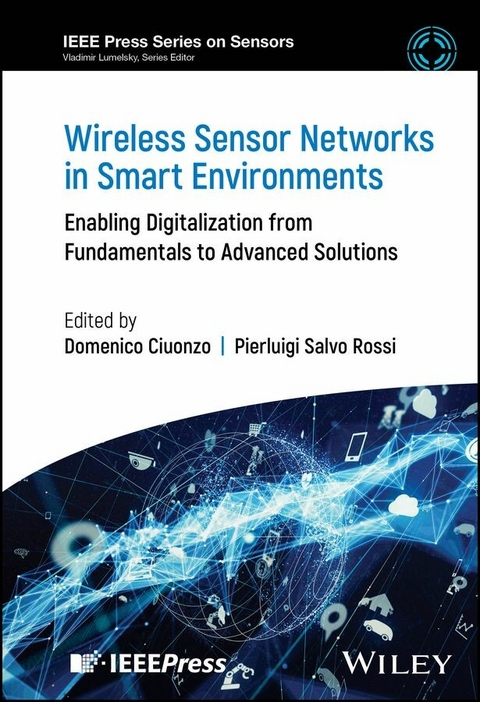
Wireless Sensor Networks in Smart Environments (eBook)
641 Seiten
Wiley-IEEE Press (Verlag)
978-1-394-24984-8 (ISBN)

Understand the fundamental building blocks of the Internet of Things
The Internet of Things is the term for an ever-growing body of physical devices, vehicles, rooms, and other objects that can collect and exchange data using embedded capacities for network connectivity. Wireless Sensor Networks (WSNs) represent the 'sensing arm' of this network of objects, providing the mechanism for collecting and transmitting data from these objects. Wireless Sensor Networks in Smart Environments offers a timely and comprehensive overview of these networks and their broader impacts. Adopting both methodology- and application-oriented perspectives, the book covers both the foundational principles of WSNs and the most recent technological developments.
Readers will also find:
- Concrete real-world examples of recent applications
- Detailed discussion of WSNs from the perspectives of signal processing, data communication, and security
- Coverage of inference, learning, control, and decision-making processes
Wireless Sensor Networks in Smart Environments is ideal for researchers and graduate students working in signal processing, communications, and machine learning.
Domenico Ciuonzo, PhD, MSc, is a Tenure-Track Professor at the Department of Electrical Engineering and Information Technologies, University of Naples, Federico II, Italy. He obtained his MSc and PhD in Computer Engineering from the University of Campania 'L. Vanvitelli', Italy, in 2009 and 2013, respectively. He was the recipient of two Best Paper awards (IEEE ICCCS 2019 and Elsevier Computer Networks 2020), the 2019 Exceptional Service Award from IEEE AESS, 2020 Early-Career Technical Achievement Award from IEEE SENSORS COUNCIL for sensor networks/systems and the 2021 Early-Career Award from IEEE AESS for contributions to decentralized inference and sensor fusion in networked sensor systems.
Pierluigi Salvo Rossi, PhD, is a Full Professor and the Deputy Head with the Department of Electronic Systems, Norwegian University of Science and Technology (NTNU), Trondheim, Norway. He is also a part-time Senior Research Scientist with the Department of Gas Technology, SINTEF Energy Research, Norway. Previously, he worked with Kongsberg Digital AS, Norway, with NTNU, Norway, with the Second University of Naples, Italy, and with the University of Naples 'Federico II,' Italy. He held visiting appointments with Uppsala University, Sweden, with NTNU, Norway, with Lund University, Sweden, and with Drexel University, USA. He received his MSc in Telecommunications Engineering and PhD in Computer Engineering from the University of Naples 'Federico II' in 2002 and 2005, respectively.
Introduction
The Internet-of-Things (IoT) revolution is no longer a distant dream. Today, billions of connected devices are seamlessly and pervasively integrated into our daily lives, driving innovation in industries including surveillance, healthcare, urban planning, and environmental and industrial monitoring. These devices, primarily sensors and actuators, form the backbone of Wireless Sensor Networks (WSNs), however, unique opportunities and challenges exist in the adoption of WSNs for any specific vertical area. For the mentioned reason, the global WSN market is projected to grow exponentially, with estimates valuing it at over USD 148.67 billion by 2026 (Source: Fortune Business Insights), while IoT-related investments are expected to exceed USD 1 trillion globally in the same projected timeframe (Source: International Data Corporation). WSNs usually consists of a number of small, inexpensive, heterogeneous, and geographically dispersed nodes, which reflects in limited computational and storage capabilities, and limited energy availability. Based on these premises, WSNs are in charge of (i) monitoring a physical asset and gathering vast amounts of data, (ii) disseminating (to other nodes) or report (to a collective unit) such data over the wireless medium, (iii) elaborating high-level analytics for the scenario at hand, (iv) (possibly) controlling the environment, and (v) preserving the security of the whole monitored/controlled physical asset while implementing all these functionalities.
Accordingly, this edited book deals with the design and deployment of WSNs, offering a comprehensive journey from fundamental to advanced solutions. The text is organized into four parts, each addressing a critical aspect of WSN technology. Part I (Chapters 1–3) delves into the core of signal processing techniques crucial for efficient data handling in WSNs. Part II (Chapters 4–6) shifts the focus to the communication technologies allowing these networks to operate reliably and efficiently, even under demanding conditions (e.g. low-energy budget). Part III (Chapters 7–9) tackles cybersecurity, an essential area given the vulnerabilities these networks face in a hyper-connected world. Finally, Part IV (Chapters 10–15) showcases practical applications of WSNs, highlighting their transformative potential in smart environments, from urban monitoring to industrial automation.
This structure provides a cohesive understanding of the evolving role that WSNs play in enabling IoT, ensuring readers are well-equipped to harness the full potential of this rapidly expanding technological landscape.
Part I – Signal Processing in Wireless Sensor Networks
WSNs gather complex, high-dimensional data, representing a serious challenge for efficient processing. Signal processing, specifically adapted, is crucial to manage effectively WSN data. The first part of this book focuses on signal processing for WSNs, offering strategies to handle and analyze the data they generate. It includes three chapters, each addressing different but connected aspects. It will make readers gain both theoretical and practical tools to master WSN-data processing and maximize WSN potential.
In Chapter 1 (by Morgenstern, Dabush, Huleihel, Routtenberg, and Poor) introduces the foundational concepts of graph signal processing (GSP), a cutting-edge approach tailored to handle signals over irregular domains such as those encountered in WSNs. GSP provides a robust framework for analyzing the intricate structures inherent in WSN data. Essential GSP tools are explored, including the graph Fourier transform and Laplacian-based regularization. Additionally, recent advancements in GSP methodologies are covered, such as smoothness validation, signal recovery, anomaly detection, and topology identification, all within the context of WSN applications. This chapter sets the basis for understanding how GSP can enhance the interpretation and utility of WSN data.
In Chapter 2 (by Qureshi, Rikos, Charalambous, and Khan) shifts focus to distributed learning methods, essential for harnessing the full potential of WSNs in real-world applications. Here, the significance of distributed learning is discussed with related practical challenges and with limitations of current methodologies. The chapter aims to equip the readers with the knowledge to develop innovative approaches building on existing work. Practical applications, such as fine-tuning vision transformers in WSN environments, illustrate how distributed learning can be applied to enhance performance and efficiency in diverse scenarios.
In Chapter 3 (by Cuthbert and Dey) addresses the critical task of decentralized and distributed non-Bayesian quickest change detection in energy-harvesting WSNs. This chapter delves into the mechanisms of how sensors operate within energy constraints, periodically sampling and computing log-likelihood ratios (LLRs) to detect changes. Both decentralized and distributed scenarios are examined, highlighting the balance between quantization rates and energy consumption for accurate decision-making. Additionally, an optimal sensing and quantization rate allocation problem is presented, providing analytical solutions and asymptotic expressions for detection delays and false alarm times at the fusion center.
Part II – Communications Technologies in Wireless Sensor Networks
In the fast-paced world of WSNs, efficient communication technologies are key to their success, which should be adaptable to diversified application scenarios. Part II of this book explores the latest innovations that boost WSN performance, reliability, and efficiency. It includes three chapters, each tackling unique challenges and presenting cutting-edge solutions. From integrating reconfigurable intelligent surfaces (RIS) for better decision fusion to developing low-complexity rules for massive multi-input multi-output (MIMO) systems and real-time WiFi protocols, these chapters offer insights into advanced communication methods that enhance WSNs across diverse applications.
In Chapter 4 (by Ciuonzo, Zappone, Salvo Rossi, and Di Renzo) focuses on the distributed detection of phenomena of interest (POI) through decision fusion techniques in WSNs. It examines how decisions from multiple sensors, collected by a fusion center over a shared flat-fading channel with multiple antennas, can be integrated to make more accurate global decisions. The chapter introduces channel-aware fusion techniques supported by smart wireless environments, emphasizing the role of RIS. RIS aids in conveying the state of the POI to the fusion center efficiently, promoting energy-efficient data analytics aligned with the IoT paradigm. The chapter progresses from presenting an optimal decision fusion rule to deriving a suboptimal joint fusion rule and RIS design. This approach balances performance with reduced complexity and system knowledge requirements. Simulation-based evaluations underscore the benefits of incorporating RIS, even with suboptimal designs.
In Chapter 5 (by Chawla, Ciuonzo, Jagannatham, and Salvo Rossi), the focus shifts to the development of low-complexity fusion rules for detecting unknown parameters in millimeter-wave (mmWave) massive MIMO WSNs. The chapter explores both centralized and distributed MIMO antenna topologies, evaluating system performance based on false alarm and detection probabilities. It delves into the optimization of sensor gains to enhance detection performance and examines power scaling laws for extended sensor battery life without sacrificing performance. Additionally, this chapter addresses the challenges of channel state information uncertainty, leveraging sparse Bayesian learning for mmWave massive MIMO channel estimation. Extensive simulations validate the effectiveness of the proposed detectors, highlighting their practical applicability and performance under various conditions.
In Chapter 6 (by Yun, Lin, Zhou, and Han) reviews three innovative 802.11-based WiFi solutions tailored to meet the urgent need for real-time, high-speed wireless communication protocols in time- and mission-critical wireless sensing and control systems. The first solution, an RT-WiFi protocol, employs a time division multiple access (TDMA)-based data link layer scheduler to guarantee deterministic packet delivery timings using commercial off-the-shelf (COTS) devices. The second solution, SRT-WiFi, is a software-defined radio (SDR)-based implementation on an FPGA platform, offering full-stack configurability in line with evolving IEEE 801.11 standards. Lastly, the chapter explores the implementation of 802.11a/g/n/ac physical layers on GNU Radio-based SDR platforms, supporting both single-user and multiuser MIMO transmissions. The efficacy of these solutions is demonstrated through real-world testbed deployments and extensive simulations, confirming their suitability for high-speed, reliable communication in WSNs.
Part III – Cyber Security in Wireless Sensor Networks
Despite WSNs have transformed how we engage with our environment, the distributed and resource-limited nature of WSNs makes them highly susceptible to cyberthreats. This part explores the key challenges and related innovative solutions for securing these networks. The three chapters offer a deep dive into WSN security, covering topics from enhancing privacy in distributed filters to...
| Erscheint lt. Verlag | 16.7.2025 |
|---|---|
| Reihe/Serie | IEEE Press Series on Sensors |
| Sprache | englisch |
| Themenwelt | Technik ► Elektrotechnik / Energietechnik |
| Schlagworte | Byzantine attack • cyber security • data fusion • Distributed Detection • distributed Kalman filtering • distributed sensor • energy harvesting sensor • Graph Signal Processing • Internet-of-ISAC • LoRaWAN network • real-time WLAN • wireless sensor network |
| ISBN-10 | 1-394-24984-5 / 1394249845 |
| ISBN-13 | 978-1-394-24984-8 / 9781394249848 |
| Informationen gemäß Produktsicherheitsverordnung (GPSR) | |
| Haben Sie eine Frage zum Produkt? |
 EPUB (Adobe DRM)
Kopierschutz: Adobe-DRM
Adobe-DRM ist ein Kopierschutz, der das eBook vor Mißbrauch schützen soll. Dabei wird das eBook bereits beim Download auf Ihre persönliche Adobe-ID autorisiert. Lesen können Sie das eBook dann nur auf den Geräten, welche ebenfalls auf Ihre Adobe-ID registriert sind.
Details zum Adobe-DRM
Dateiformat: EPUB (Electronic Publication)
EPUB ist ein offener Standard für eBooks und eignet sich besonders zur Darstellung von Belletristik und Sachbüchern. Der Fließtext wird dynamisch an die Display- und Schriftgröße angepasst. Auch für mobile Lesegeräte ist EPUB daher gut geeignet.
Systemvoraussetzungen:
PC/Mac: Mit einem PC oder Mac können Sie dieses eBook lesen. Sie benötigen eine
eReader: Dieses eBook kann mit (fast) allen eBook-Readern gelesen werden. Mit dem amazon-Kindle ist es aber nicht kompatibel.
Smartphone/Tablet: Egal ob Apple oder Android, dieses eBook können Sie lesen. Sie benötigen eine
Geräteliste und zusätzliche Hinweise
Buying eBooks from abroad
For tax law reasons we can sell eBooks just within Germany and Switzerland. Regrettably we cannot fulfill eBook-orders from other countries.
aus dem Bereich