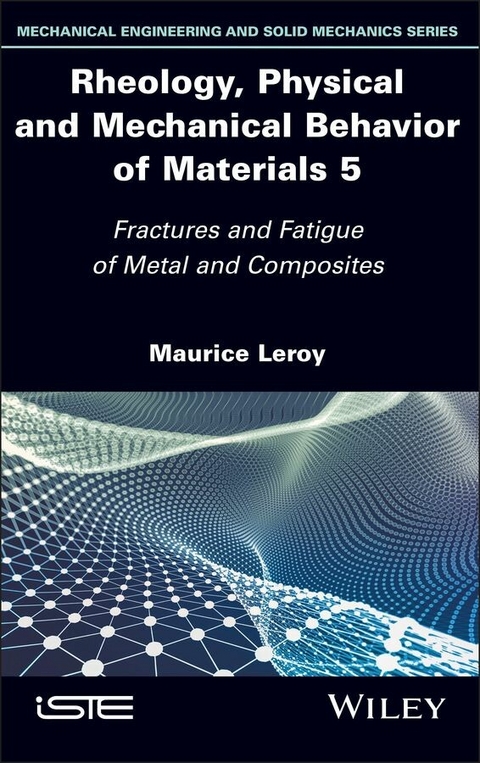
Rheology, Physical and Mechanical Behavior of Materials, Volume 5 (eBook)
517 Seiten
Wiley-Iste (Verlag)
978-1-394-39362-6 (ISBN)

This book covers the formation of cracks around inclusions or precipitates, ductile and cup fracture facies, abrupt or intergranular fractures, cleavage and the influence of strain rates in striction and fracture. It also looks at the formability limit curves of metals under dynamic actions and techniques used.
Regarding metals, the book studies the types of tests, cracking mechanisms, and laws relating to uncracked and cracked parts, as well as endurance limits. As for composites, fracture mechanisms for unidirectional and laminate materials, successive layer fractures, maximum and quadratic stress and/or strain criteria, and fracture envelopes are analyzed.
Maurice Leroy is a doctor in physics and solid mechanics, and a lecturer and professor at the University of Nantes, France, as well as Director of the Composite and Metallic Formations research laboratory at the IUT. He was instrumental in the creation of France's first Materials Science and Engineering department.
Rheology, Physical and Mechanical Behavior of Materials 5 studies fractures and fatigue in metallic materials and composites. It analyzes the mechanisms at work according to the types of damage and fractures observed. This book covers the formation of cracks around inclusions or precipitates, ductile and cup fracture facies, abrupt or intergranular fractures, cleavage and the influence of strain rates in striction and fracture. It also looks at the formability limit curves of metals under dynamic actions and techniques used. Regarding metals, the book studies the types of tests, cracking mechanisms, and laws relating to uncracked and cracked parts, as well as endurance limits. As for composites, fracture mechanisms for unidirectional and laminate materials, successive layer fractures, maximum and quadratic stress and/or strain criteria, and fracture envelopes are analyzed.
1
Damage
1.1. Definition
A material is considered to be free of damage if it lacks any microscopic scale cracks and cavities. The theory of damage describes the progressive phenomena that occur between a material in a virgin state and the initial formation of a macroscopic crack. This progression is due to several different mechanisms, such as (Lemaitre and Chaboche 2020):
- ductile plastic damage, which occurs in conjunction with the large plastic strains experienced by metals at ambient and low temperatures;
- fragile viscoplastic damage (or “creep”), which occurs over time and which, for metals at medium and high temperatures, consists of the intergranular de-cohesions that occur together with viscoplastic strain;
- fatigue damage (or microplasticity) occurring due to the repetition of the stresses, and which are identified according to the number of cycles;
- macrofragile damage, which can be caused by mechanical stresses without appreciable irreversible strains.
Additional types of damage include oxidation, corrosion and irradiation.
The theory of damage applies to all materials and for all temperatures and types of stresses; these different phenomena can accumulate and interact with one another.
The progression of the damage is determined over the time up to the initial formation of macroscopic cracks at the most stressed points of the objects and structures. This is the case for processes such as forming carried out via plastic strain.
1.2. Damage variables
Let us examine a damaged solid, isolating an element of finite volume with a large size relative to the defects in the medium (Figure 1.1).
Figure 1.1. Damage
Let S be the area of a section of the element whose volume is given by its normal . In this section, the cracks and cavities that constitute the damage leave traces in various forms. Let be the effective resistant area ( < S), taking into account the area of these works, the stress concentrations in the vicinity of the geometric discontinuities and the interactions between neighboring defects, and let SD be the difference.
By definition:
is the mechanical measurement of the local damage in relation to the direction .
From a physical point of view, the visible damage Dn is therefore the relative (corrected) area of the cracks and cavities cut by the plane that is normal to the direction . From a mathematical point of view, if S tends toward 0, the variable Dn is the (corrected) surface density of the discontinuities of the material in the plane normal to .
- Dn = 0 represents an undamaged or “virgin” state.
- Dn = 1 represents a volume element broken into two parts at a normal plane .
- D ≤ Dn < 1 characterizes the state of damage.
In a general case of anisotropic damage consisting of cracks and cavities with correlated orientations, the value of the scalar variable Dn depends on the orientation of the normal plane. We will see that the corresponding intrinsic variable can be represented by a second- or fourth-order tensor.
NOTE.– The case of isotropy: isotropic damage is due to cracks and cavities whose orientation is distributed uniformly along all directions of the material.
The value of Dn does not depend on the orientation of , and the value of the scalar D fully characterizes the state of the damage:
1.3. Effective stress
DEFINITION 1.1– The effective stress is the stress of the section that actually resists the forces or . For a unidirectional case, if F is the force applied to a section S of a volume element σ = F/S and for isotropic damage of value D, according to equations [1.1] and [1.2], the resisting section is:
We obtain:
By definition, the effective stress is set as:
given that and for undamaged material , for a fracture .
In the case of isotropic damage, where the ratio is not dependent on the orientation of the normal plane , we will write for the effective stress tensor :
The damage is a tensor that connects the stress [σ] on the undamaged material to effective stress tensor [] by:
Therefore, when the material is damaged, we replace [σ] with [], and for an isotropic material, the damage tensor is reduced to a scalar equal to:
For an undamaged elastic material, its law of behavior is:
and for a damaged material that is still elastic, [1.6] remains valid, provided that either the stress or the components of the stiffness are replaced Cijkℓ and, according to [1.3]:
which gives:
The damage modifies the stiffness that, taken with σij and εkl, becomes:
Under tension, the stiffness E = C1111 for the damaged material, according to [1.8], is written as:
For damage that is due not only to elasticity but to plasticity, despite exhibiting “more complex” behavior, it is generally sufficient to replace the stress with the effective stress .
NOTE.– The damage may be related to the movement ui or to the speeds . For the speeds at time t, we establish:
where ui,t is the speed of movement away from the defects, and and fuif,t are speeds in the vicinity of the defects, with the first term corresponding to cavities that do not change shape and the second to cavities with a change in shape but not in size.
In the case of a non-workable elastoplastic material subjected to triaxial stresses and for defects without shape change (f = 0), the damage has the speed :
with:
- σm : average value in triaxial stresses;
- εp,eq : equivalent plastic strain speed;
- σe : elastic limit.
1.4. Principle of strain equivalence
STATEMENT.– We consider that the behavior under strain of the material is only affected by the damage occurring in the form of effective stress ; we replace the usual stress σ with the effective stress for the same strain value ε of the material (Figure 1.2).
The one-dimensional linear elasticity law is written with the effective stress and the isotropy of D, according to [1.3]:
E is the Young’s modulus or stiffness of the undamaged material and (1 − D) E = Ẽ is interpreted as the elastic modulus or stiffness of the damaged material:
Equation [1.9] gives Ẽ = E – D E and thus:
NOTE.– The measurements of elastic stiffness Ẽ make it possible to obtain D using methods such as small-sized extensometry gauges on specimens with a weakened central section in order to correctly locate the damage by displacement sensor for temperatures > 200 °C and by ultrasound.
Figure 1.2. Strain equivalence
If σu is the typical final breaking stress and is that of the fracture by interatomic decohesion, the critical value is defined as Dc, which corresponds to the application of this phenomenon by:
or:
1.5. Experimental characterization of the damage
1.5.1. Changes in mechanical characteristics
The state of a material at a given moment is sometimes characterized by its mechanical properties, such as Young’s modulus E. If the material is damaged, its mechanical properties will change. We also observe that these changes often correspond to structural modifications of the material.
This change will be related to the notion of effective stress used in damage mechanics (Kachanov’s model).
1.5.2. Modifications of the material
The presence of cavities created by damage can be detected by density measurement, non-destructive testing or micrographic observations of samples. For non-destructive methods, these mainly involve ultrasonic or X-ray tests, implementing interpretations with varying levels of sophistication. Micrographic observations then make it possible to determine the dimensions of the cavities, their number per unit volume and their shape, given that they can be more spherical (volumetric) or flatter (surface area).
1.5.3. Wear rate
When the stress imposed on a solid is stationary – that is, constant – or it fluctuates between two constant values, the size of the cavities created increases over time. The damage can then be defined by a (dimensionless) number that depends on the “age” of the material being used. This number is called the wear rate D.
If the load is applied for a time t and the fracture must occur after a time tr, the wear rate is equal to:
If the stress is made up of n successive loading cycles fluctuating between two constant extreme values, the wear rate is equal to:
where N is the number of cycles leading to fracture.
EXAMPLE 1.1.– Damage and change in elastic stiffness, useful life.
The change in the...
| Erscheint lt. Verlag | 24.7.2025 |
|---|---|
| Reihe/Serie | ISTE Invoiced |
| Sprache | englisch |
| Themenwelt | Naturwissenschaften ► Chemie |
| Technik ► Maschinenbau | |
| Schlagworte | Cleavage • deformations • endurance limits • fiber composites • flexibility matrices • formability limit curves • fracture envelopes • fracture facies • intergranular fractures • Materials Science • maximum stresses • rheology |
| ISBN-10 | 1-394-39362-8 / 1394393628 |
| ISBN-13 | 978-1-394-39362-6 / 9781394393626 |
| Informationen gemäß Produktsicherheitsverordnung (GPSR) | |
| Haben Sie eine Frage zum Produkt? |
 EPUB (Adobe DRM)
Kopierschutz: Adobe-DRM
Adobe-DRM ist ein Kopierschutz, der das eBook vor Mißbrauch schützen soll. Dabei wird das eBook bereits beim Download auf Ihre persönliche Adobe-ID autorisiert. Lesen können Sie das eBook dann nur auf den Geräten, welche ebenfalls auf Ihre Adobe-ID registriert sind.
Details zum Adobe-DRM
Dateiformat: EPUB (Electronic Publication)
EPUB ist ein offener Standard für eBooks und eignet sich besonders zur Darstellung von Belletristik und Sachbüchern. Der Fließtext wird dynamisch an die Display- und Schriftgröße angepasst. Auch für mobile Lesegeräte ist EPUB daher gut geeignet.
Systemvoraussetzungen:
PC/Mac: Mit einem PC oder Mac können Sie dieses eBook lesen. Sie benötigen eine
eReader: Dieses eBook kann mit (fast) allen eBook-Readern gelesen werden. Mit dem amazon-Kindle ist es aber nicht kompatibel.
Smartphone/Tablet: Egal ob Apple oder Android, dieses eBook können Sie lesen. Sie benötigen eine
Geräteliste und zusätzliche Hinweise
Buying eBooks from abroad
For tax law reasons we can sell eBooks just within Germany and Switzerland. Regrettably we cannot fulfill eBook-orders from other countries.
aus dem Bereich