The Smart and Resilient City (eBook)
424 Seiten
Wiley-Iste (Verlag)
978-1-394-39353-4 (ISBN)
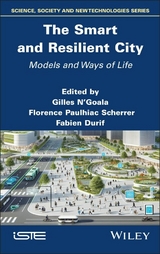
This book explores the constituent dimensions of the so-called smart city from two singular angles: the new uses stimulated by innovations and the needs that these innovations fill (mobility, food, culture, tourism, housing, etc.).
Based on research carried out by the CitUs International Chair in collaboration with the cities of Montpellier and Montreal, The Smart and Resilient City explores the impact of digital, ecological and social transformations on urban management and the lives of city dwellers. It provides essential and engaging reading for the academic community in cities in transition, helping public and private decision-makers to develop new territorial projects that combine innovation with individual and collective well-being.
Gilles N'Goala is Professor of Management and Marketing at the University of Montpellier, France, and Co-holder of the CitUs International Chair on the uses and practices of the intelligent city.
Florence Paulhiac Scherrer is Professor of Urban Studies at ESG UQAM, Canada, and Co-holder of the CitUs International Chair on the uses and practices of the intelligent city.
Fabien Durif is Full Professor at ESG UQAM, Canada, and Director of the Observatoire de la consommation responsable and the FCI - GreenUXlab laboratory.
While advanced technologies such as the Internet of Things (IoT), artificial intelligence (AI) and data infrastructures offer solutions for improving urban management and quality of life a priori, they also raise major challenges and risks. This book explores the constituent dimensions of the so-called smart city from two singular angles: the new uses stimulated by innovations and the needs that these innovations fill (mobility, food, culture, tourism, housing, etc.). Based on research carried out by the CitUs International Chair in collaboration with the cities of Montpellier and Montreal, The Smart and Resilient City explores the impact of digital, ecological and social transformations on urban management and the lives of city dwellers. It provides essential and engaging reading for the academic community in cities in transition, helping public and private decision-makers to develop new territorial projects that combine innovation with individual and collective well-being.
Introduction
Smart City: Lives in Transition
I.1. Introduction
The smart city is intimately linked to the development of digital infrastructures that aim, as in the case of the metropolitan area of Angers, to better manage water resources (based on atmospheric conditions), connectivity (access to public Wi-Fi), public lighting (illumination, extension, regulation), waste management (collection and preventing dumping), mobility (urban traffic and parking) or safety and tranquility in public spaces.
Many cities have particularly invested in the development of hypervisors for better centralization of all monitoring tools, applications, reference points and data. For example, since April 2019, the OnDijon control center has been collecting data from the whole set of urban services, as well as from the metropolitan area’s 300 video surveillance cameras and the city’s sensors1. The city of Marseille collects data on its wooded areas using satellite images and feedback from its agents. Since 2019, the Nantes metropolitan area has focused on overall improvements for the population including issues around pollution, noise, heat peaks, food supply, physical and mental health, culture and sport. It therefore developed the Synopse project (Système numérique d’observation populationnelle santé environnement (digital system for population health and environment observation)) to aggregate these data.
Driven by digital giants (IBM, Cisco, Google, etc.), smart city digital devices have developed in silence and spread unevenly, mainly affecting metropolises and leaving out peri-urban and rural areas (Ait-Yahia et al. 2019). The aim was first to save on resources (water, lighting and energy) and to provide better services to make life easier for the local population: 24/7 access, geolocation, real-time information, public Wi-Fi, open access to information, etc. The service city has taken shape through numerous technological applications. For example, the Internet of Things (IoT) and other sensors make people’s lives easier through connecting everyday objects with the Internet (personal assistants, for example). Algorithms and artificial intelligence (AI) enable greater personalization of services, content and experiences for citizens. Open Data, which refers to data that everyone can access, use or share, allows multiple actors (large and small businesses, researchers, etc.) to have a better understanding of practices and uses within public space. Facial recognition, based on very private data (facial features), authenticates people and could help to guarantee greater security and tranquility in cities. But the servicization of the city through ever more advanced technologies is no longer the only objective. The climate emergency and sustainability issues have redirected priorities toward environmental preservation (water management, zero waste, etc.) and the fight against global warming (renaturation of cities, net zero artificialization, low-emissions zones, etc.).
Two visions of the city, technology and society are sometimes diametrically opposed, with:
- on the one hand, that in favor of a “detechnologization” of the world, believing that a decrease in technology in our lives is the only solution to respond to the climate emergency and to safeguard democracy;
- on the other hand, that in favor of technologies that may be useful for dealing with major contemporary problems, whether they are economic, ecological, social or democratic, provided that they are designed with this in mind (smart green tech, tech for good, responsible AI, etc.) (N’Goala and Collin-Lachaud 2023).
The concept of the “smart city” is often vilified, debased, scorned or denounced. Techno-centric or techno-solutionist approaches have had their day and people who can, consciously or unconsciously, still defend them are rare. Technology is much less important than people’s lives and cannot claim to make them happy. Many people prefer epithets such as the inclusive and sustainable city, the citizen and participatory city, the smart city with positive impact, the learning city (UNESCO Global Network of Learning Cities), the service city, the innovative and connected city, the resilient and adaptive city, the sustainable and responsible city, or even the open and collaborative city. The city thus conveys an imagination, a vision, representations and values which sometimes oppose and often complement each other. The smart city is a realizable utopia that takes shape in territories and requires the establishment of digital infrastructures. Public and private decision-makers then assign multiple objectives and responsibilities to it (sustainability, social inclusion, user services, etc.). We will therefore use the original term “smart city”, as it serves as a point of attention and reference in professional and academic circles.
The history of innovation is punctuated by periods of acceleration that mark both major technical and scientific advances and profound transformations in lifestyles. The intrusion of technology, particularly digital technology, into public spaces is in fact causing ruptures in traditions, whose scope is still difficult to measure. Let us imagine for a moment a total blackout of digital infrastructure – similar to what was imagined in 2023 in the Netflix disaster movie, Leave the World Behind – our lives would be dramatically turned upside down. This dependence on technology justifies not only questioning and criticizing this headlong rush, but also considering the upheavals it is causing in our lives.
Going hand in hand with globalization, the growing urbanization and metropolization of the world appear as inevitable phenomena that are sure to produce many negative externalities (air and water pollution, city congestion, social inequalities, etc.). While in 2019, more than 4 billion people lived in cities (55% of the world population), this number is expected to grow to 6.5 billion by 2050. In such a context, how can we maintain the individual and collective well-being of the inhabitants? How can we avoid a deterioration in the quality of life of billions of people? The well-being of populations is based, from a hedonic perspective, on the obtaining of pleasures, positive affects and the achievement of personal happiness and satisfaction in life, or from a eudaimonic perspective, on self-realization, in accordance with their true nature and the deep goals they pursue. Following this second perspective, Deci and Ryan (1985) consider that people are self-realized when their fundamental needs for autonomy, competence and relationships with others (interpersonal affiliation) are met. These needs motivate and drive human activities and practices and give meaning to them.
Is the smart city synonymous with happiness and self-realization for urban populations? It certainly offers them what they want: services, convenience (real-time information, 24/7 accessibility, time saving, less effort, etc.), more leisure activities and pleasures. And yet, will their individual and collective well-being be greater? How and to what extent will the cities of the future meet the fundamental needs of autonomy, competence and relationships with others? Does the expansion of technologies not further endanger the autonomy of local populations, their competences and their relationships with others?
Technologies do not guarantee that everyone will be self-realized and flourish in the cities of the future. First, the digital world evokes fears of a loss of control by residents over their living environment and poses a risk of personal alienation (powerlessness) or surveillance and social control by states, public authorities or digital giants (Google, Apple, etc.). Unlike a world where everyone can decide on their activities and choices in complete autonomy, the smart city entails standards, rules and values, a morality that imposes itself and constrains behavior, even if it is supposed to be for “the common good”. Second, digital technology confronts people with their incompetence, making massive use of digital channels (mobile applications, sites, connected objects) and advanced data exploitation technologies (AI), while a large part of the population is marked by digital illiteracy (digital exclusion) and vulnerability in matters of privacy (intrusion, dissemination and theft of personal data). Finally, robotization and automation may lead to a reduction in social contact in favor of contact mediated by machines (bots, etc.) and increase social isolation among the population. For economic reasons, humans are increasingly being replaced by machines in managing social and commercial interactions. Things as mundane as discussions with the postman, the store clerk or the municipal employee are becoming rarer in everyday life. Relationships with others could thus diminish and loneliness could increase further, as well as the feeling of unease.
This book proposes to explore the constitutive dimensions of the so-called smart city, from one angle in particular – that of uses – and more broadly of the practices in which these innovations engage and the needs that they satisfy. City life is multi-faceted and the smart city intervenes in the daily lives of urban populations, from their homes to public spaces, but also in the institutions they frequent, whether cultural or health-related, for example, or in the media or transport. What are the impacts of these innovations on the quality of urban life, and how to account for the societal transformations they generate? These...
| Erscheint lt. Verlag | 18.7.2025 |
|---|---|
| Reihe/Serie | ISTE Invoiced |
| Sprache | englisch |
| Themenwelt | Technik ► Architektur |
| Technik ► Elektrotechnik / Energietechnik | |
| Schlagworte | Artificial Intelligence (AI) • data infrastructures • Internet of Things (IoT) • Smart City • urban management |
| ISBN-10 | 1-394-39353-9 / 1394393539 |
| ISBN-13 | 978-1-394-39353-4 / 9781394393534 |
| Informationen gemäß Produktsicherheitsverordnung (GPSR) | |
| Haben Sie eine Frage zum Produkt? |
 EPUB (Adobe DRM)
Kopierschutz: Adobe-DRM
Adobe-DRM ist ein Kopierschutz, der das eBook vor Mißbrauch schützen soll. Dabei wird das eBook bereits beim Download auf Ihre persönliche Adobe-ID autorisiert. Lesen können Sie das eBook dann nur auf den Geräten, welche ebenfalls auf Ihre Adobe-ID registriert sind.
Details zum Adobe-DRM
Dateiformat: EPUB (Electronic Publication)
EPUB ist ein offener Standard für eBooks und eignet sich besonders zur Darstellung von Belletristik und Sachbüchern. Der Fließtext wird dynamisch an die Display- und Schriftgröße angepasst. Auch für mobile Lesegeräte ist EPUB daher gut geeignet.
Systemvoraussetzungen:
PC/Mac: Mit einem PC oder Mac können Sie dieses eBook lesen. Sie benötigen eine
eReader: Dieses eBook kann mit (fast) allen eBook-Readern gelesen werden. Mit dem amazon-Kindle ist es aber nicht kompatibel.
Smartphone/Tablet: Egal ob Apple oder Android, dieses eBook können Sie lesen. Sie benötigen eine
Geräteliste und zusätzliche Hinweise
Buying eBooks from abroad
For tax law reasons we can sell eBooks just within Germany and Switzerland. Regrettably we cannot fulfill eBook-orders from other countries.
aus dem Bereich