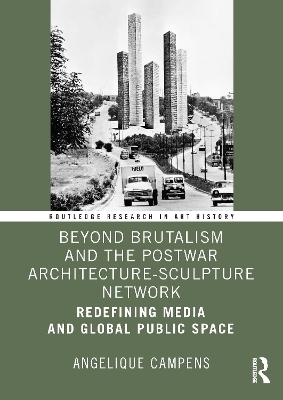
Beyond Brutalism and the Postwar Architecture-Sculpture Network
Routledge (Verlag)
978-1-041-10332-5 (ISBN)
This study focuses on the moment in the history of modern art, during the 1950s, when sculptors and architects began to use concrete to create a previously impossible fusion of their respective art forms and the mutual influences between sculpture and architecture.
The book pays particular attention to those works that left the concrete "brut"—that is, "raw" or unfinished—and thus produced a rough aesthetic that has become an icon of postwar art. The author shines a spotlight on the work of André Bloc and the international networks, publications, and initiatives that he facilitated, demonstrating the pivotal role he played in the exchange between architecture and sculpture and the expansion of public art practice. Placing Bloc among a roster of artists and architects working in concrete that also included Picasso and Le Corbusier, the book follows the movement from Brut’s conceptual and material roots in the 1930s into the height of its influence from the mid-1950s to early 1970s. It ends by tracing the legacy into the present. In so doing, it shows how fundamental the use of concrete was to the development of a new architectural-sculptural form and, in turn, how their interdisciplinary and socially focused practices form an overlooked genealogy of the arts in the present.
This book is ideal for researchers and students in 20th-century Art, Architecture, Design, and Urban Studies.
Angelique Campens is an independent art historian, writer, educator, and curator, teaching at KASK & Conservatorium/School of Arts Ghent, Belgium.
Introduction Part 1: The (postwar) historical context of the Architecture-Sculpture Network and Béton Brut 1. SYNTHESIS: Forging the Architecture-Sculpture Network: Synthèse des Arts and André Bloc’s Legacy 2. TEXTURE: Exploring concrete in the Architecture -Sculpture network: Brutalism vs Béton brut PART 2: Sculpting the Urban Landscape: The Rise of Concrete Sculptures in Public Spaces 3. COLLABORATION: Picasso’s Encounter with Concrete: Carl Nesjar and Betograve 4 MOVEMENT: Concrete Landmarks: The International Sculpture Symposium and Highway Sculptures Part 3: Sculpture in Architecture and the Built Environment: Living and Exhibiting in Béton Brut 5. DWELLING: The Sculptural House 6. DOMESTICITY: Living in a Béton Brut Sculpture 7. DISPLAY: A Sculptural Environment for Art Epilogue: Concrete Synthesis, Then and Now
| Erscheinungsdatum | 11.12.2025 |
|---|---|
| Reihe/Serie | Routledge Research in Art History |
| Zusatzinfo | 69 Halftones, black and white; 69 Illustrations, black and white |
| Verlagsort | London |
| Sprache | englisch |
| Maße | 174 x 246 mm |
| Gewicht | 560 g |
| Themenwelt | Kunst / Musik / Theater ► Kunstgeschichte / Kunststile |
| Kunst / Musik / Theater ► Malerei / Plastik | |
| Technik ► Architektur | |
| ISBN-10 | 1-041-10332-8 / 1041103328 |
| ISBN-13 | 978-1-041-10332-5 / 9781041103325 |
| Zustand | Neuware |
| Informationen gemäß Produktsicherheitsverordnung (GPSR) | |
| Haben Sie eine Frage zum Produkt? |
aus dem Bereich