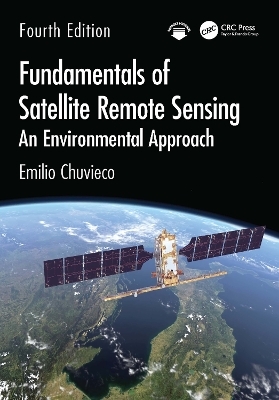
Fundamentals of Satellite Remote Sensing
CRC Press (Verlag)
978-1-032-85020-7 (ISBN)
- Lieferbar (Termin unbekannt)
- Versandkostenfrei
- Auch auf Rechnung
- Artikel merken
The fourth edition of this core textbook in advanced remote sensing continues to be the best guide on satellite-based remote sensing tools and methods for space-based Earth observation, and the use of remote sensing satellite data for studying and monitoring the planet. It is thoroughly updated with information related to new satellite missions from different agencies with particular attention to the new constellations of high-resolution sensors and new field observations for model calibration and validation, including field sensors and drones. The commercialization of remote sensing data with open cloud services and new classifications by AI algorithms and cloud computing services are also discussed.
New in the Fourth Edition:
Thoroughly revised to include updates in all chapters due to the technological advances in space exploration.
Covers new constellations of high-resolution sensors such as Planet, Maxar, Geo-Airbus etc
Explains field sensors such as spectro-radiometers, ground lidars and drones
Discusses image services including Earthengine and CreoDIAS, as well as public repositories: Copernicus, Earthexplorer, Glovis
Provides an introduction to AI algorithms
Discusses cloud computing approaches
This textbook is for upper-level undergraduate and graduate students taking advanced courses in Remote Sensing and GIS in physical geography, geophysics, engineering, soil and plant sciences, urban planning, etc. It is also an excellent text for researchers and scientists interested in learning techniques and technologies for collecting, analyzing, managing, processing, and visualizing geospatial datasets.
Emilio Chuvieco is a Professor of Geography and director of the Environmental Ethics chair at the University of Alcalá, Spain, where he leads the Environmental Remote Sensing Research Group. Among his many accomplishments, he has written 33 books and 430 scientific papers and book chapters and was Editor of Remote Sensing of Environment (2015-20). He is a member of the Spanish Academy of Sciences, science leader of the Fire Disturbance project within the European Space Agency’s Climate Change Initiative Program. He received the Spanish Rei Jaume I award for Environmental Protection in 2022.
1. Introduction. 2. Physical Principles of Remote Sensing. 3. Sensors and Remote Sensing Satellites. 4. Basis for Analyzing EO Satellite Images. 5. Visual Interpretation. 6. Digital Image Processing (I): From Raw to Corrected Data. 7. Digital Image Processing (II): Generation of Derived Variables. 8. Validation and Intercomparison. 9. Earth Observation and Geographic Information Systems.
| Erscheinungsdatum | 02.12.2025 |
|---|---|
| Zusatzinfo | 37 Tables, black and white; 80 Line drawings, color; 24 Line drawings, black and white; 175 Halftones, color; 25 Halftones, black and white; 255 Illustrations, color; 49 Illustrations, black and white |
| Verlagsort | London |
| Sprache | englisch |
| Maße | 178 x 254 mm |
| Gewicht | 1043 g |
| Themenwelt | Naturwissenschaften ► Biologie ► Ökologie / Naturschutz |
| Naturwissenschaften ► Geowissenschaften ► Geografie / Kartografie | |
| Naturwissenschaften ► Geowissenschaften ► Geologie | |
| Technik ► Nachrichtentechnik | |
| ISBN-10 | 1-032-85020-5 / 1032850205 |
| ISBN-13 | 978-1-032-85020-7 / 9781032850207 |
| Zustand | Neuware |
| Informationen gemäß Produktsicherheitsverordnung (GPSR) | |
| Haben Sie eine Frage zum Produkt? |
aus dem Bereich