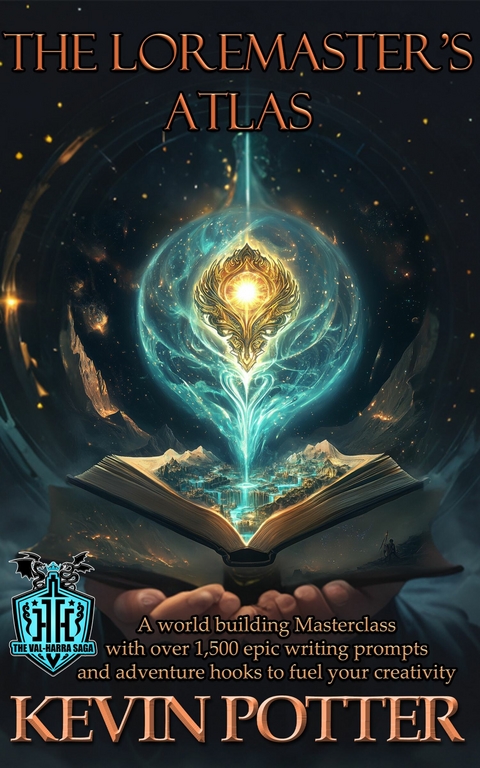
The Loremaster's Atlas (eBook)
929 Seiten
Kevin Potter (Verlag)
978-0-00-096420-5 (ISBN)
Your Next Epic Saga Starts Here.
Do you long for rich, detailed fantasy worlds you can fall into?
Are you feeling frustrated by writer's block?
Do you dream of crafting realms so deep and believable that your readers will feel the grit of the road and the magic in the air?
Every fantasy creator knows the struggle: the terror of the blank page, the frustration of a world that feels hollow, the search for that one, unique spark to ignite a universe.
The Loremaster's Atlas is the spark you've been searching for. This is not just another list of writing prompts; it is a masterfully crafted toolkit for forging deeply immersive, unforgettable fantasy worlds, designed by a fantasy author for fellow creators.
Inside, you will discover:
-Over 1,500 Unique, High-Concept Prompts: Forget 'a mysterious stranger walks into a tavern.' These are potent seeds of conflict, culture, and cosmic mystery, meticulously designed to be non-repetitive and bursting with story potential. Prompts like 'A city built inside the petrified eye of a dead god' or 'A curse that makes metaphors literal' are just the beginning.
-Go Beyond the Cliché: Venture into entire chapters dedicated to twisting classic fantasy tropes on their heads and building unique societies from the ground up. Explore cultures shaped by alien biomes, impossible geographies, and bizarre magical phenomena that will set your world apart.
-A Complete World-Building Masterclass: This atlas is also a grimoire of creation. Journey through a comprehensive 12-chapter guide that takes you from foundational principles to mastering the intricate details of magic systems, politics, economics, history, and more. It's the world-building seminar you've always wanted, teaching you how to think like a true loremaster.
Are you are a novelist sketching out an epic?
A screenwriter crafting your next masterpiece?
Or perhaps storyteller looking to spin a legendary yarn.
All paths lead here, to The Loremaster's Atlas. Let it be your compass, your map, and your muse.
Stop staring at the blank page. Download your copy of The Loremaster's Atlas today to find the tools you need to build your legend. Pick up your quill and begin.
CHAPTER ONE: Foundation Principles
Building Your World's DNA
"A world is not a backdrop for a story—it is a character in its own right, with its own personality, needs, and capacity to surprise both creator and audience."
Welcome to the art and science of world building. Whether you're crafting a novel that will transport readers to impossible realms or designing a campaign setting where players will live out heroic adventures, you're about to embark on perhaps the most rewarding creative endeavor imaginable: building entire worlds from nothing but imagination and intent.
But here's the thing about world building that many creators learn the hard way—it's not about creating everything. It's about creating the right things, in the right order, with the right level of detail. It's about building a foundation so solid that everything else feels inevitable, so organic that your audience never questions the reality you've presented to them.
This chapter will give you the fundamental principles that separate amateur world building from masterful creation. These aren't just guidelines—they're the DNA of every great fantasy world ever created, from Middle-earth to Westeros, from the Forgotten Realms to your own imagination made manifest.
The Three Pillars: Your World's Foundation
Every successful fantasy world, regardless of scope or complexity, rests on three essential pillars. Get these right, and your world will feel real to your audience. Get them wrong, and no amount of detail or creativity will save you from creating something that feels hollow and unconvincing.
The First Pillar: Internal Logic
Internal logic is the principle that your world must make sense according to its own rules, even when those rules are impossible by real-world standards. A dragon breathing fire is perfectly logical if your world has established that dragons can breathe fire. A dragon breathing fire when your world has previously established that dragons are peaceful vegetarians who communicate through interpretive dance is a violation of internal logic.
But internal logic goes deeper than just consistency. It's about cause and effect. It's about understanding that every element in your world affects every other element, creating a web of interconnected relationships that feel natural and inevitable.
Consider this example: In your world, magic requires the caster to physically touch a natural gemstone. This single rule has cascading effects:
- Economic implications: Gemstones become valuable not just as decorations but as essential tools, creating entire industries around mining, cutting, and trading them.
- Social implications: Wealthy mages can afford better gems and thus cast more powerful magic, creating a class system based on magical ability and economic status.
- Political implications: Nations with gem mines become powerful, while those without must trade, conquer, or find alternatives.
- Cultural implications: Societies develop different relationships with magic based on their access to gems—some might see magic as a divine right of the wealthy, others might develop communal gem-sharing rituals.
- Personal implications: Mages must constantly worry about losing or damaging their gems, creating vulnerability and tension.
This is internal logic in action. One rule creates a hundred consequences, and those consequences feel natural because they follow logically from the initial premise.
The Internal Logic Test: For every major element you add to your world, ask yourself: "If this were real, what would it actually mean for the people living with it every day?" Then follow those implications wherever they lead.
The Second Pillar: Emotional Resonance
Internal logic makes your world believable, but emotional resonance makes your audience care about it. This is the principle that your world must connect with fundamental human experiences and emotions, even when the setting is fantastical.
Emotional resonance doesn't mean your world has to be realistic—it means it has to be emotionally real. The struggles, relationships, and conflicts in your world should reflect struggles, relationships, and conflicts that your audience can understand and feel, even if the specific circumstances are impossible.
Think about Tolkien's Middle-earth. Readers connect with it not because they've experienced orc attacks or ring quests, but because they understand the emotions underneath: the fear of corruption and loss of innocence (the Ring's influence), the pain of watching the world change (the elves' departure), the courage required to do what's right when the cost is high (Frodo's sacrifice).
Creating Emotional Resonance:
- Universal Themes: Build your conflicts around experiences everyone can understand—love, loss, betrayal, redemption, the struggle between duty and desire, the fear of change, the hope for a better future.
- Relatable Consequences: Make sure the stakes in your world are things your audience cares about. The end of the world matters because people will die. Political corruption matters because it affects innocent lives. A broken friendship matters because we've all experienced relationship pain.
- Human-Scale Moments: Even in the most epic fantasy, include small, intimate moments that remind your audience of their own lives. A character missing their hometown food, a parent worrying about their child, friends joking together despite danger.
- Moral Complexity: Avoid simple good-versus-evil conflicts. The most emotionally resonant stories involve characters making difficult choices between competing values or loyalties.
The Emotional Resonance Test: Ask yourself: "Would someone who has never read fantasy be able to understand why the characters in this situation would feel the way they do?" If the answer is no, you may need to ground your fantastic elements in more recognizable emotions.
The Third Pillar: Practical Utility
The third pillar is often overlooked by new world builders, but it's essential: your world must serve the needs of your story or game. Every element you create should either advance your narrative goals or enhance your audience's experience. Beautiful, detailed world building that doesn't serve your story is just elaborate procrastination.
This doesn't mean everything in your world must be plot-relevant. It means that the act of world building should be making your story better, not just bigger. Each element should contribute to atmosphere, character development, conflict, or the overall themes you're exploring.
For Fiction Writers: Your world building should create opportunities for character growth, conflict, and thematic exploration. A magic system that only exists to look cool isn't serving your story. A magic system that forces your protagonist to confront their fear of dependence on others is doing narrative work.
For Game Masters: Your world building should create opportunities for player choice, character development, and memorable adventures. A detailed pantheon that never affects gameplay isn't serving your game. A pantheon where the gods actively compete for followers and grant meaningful but costly powers is creating engagement.
Practical Utility Guidelines:
- Purpose-Driven Creation: Before adding any element to your world, ask: "What story purpose does this serve? What experience am I trying to create?"
- Conflict Generation: Good world building creates problems and tensions that drive stories forward. Perfect worlds are boring worlds.
- Character Opportunities: Your world should provide chances for characters to reveal their personalities, grow, and make meaningful choices.
- Thematic Reinforcement: World elements should support and enhance your story's themes, not distract from them.
The Practical Utility Test: For every major world element, ask: "If I removed this, would my story or game be less engaging?" If the answer is no, consider whether that element needs to exist at all.
The World Building Triangle: Magic, Technology, and Society
Once you understand the three pillars, you need a framework for organizing your world's elements. The World Building Triangle provides this structure by focusing on the three most influential forces in any fantasy setting: Magic, Technology, and Society.
These three forces are in constant interaction, each one influencing and being influenced by the others. Understanding these relationships is crucial because they determine almost everything else about your world.
Magic: The Rules of the Impossible
Magic is what separates fantasy from other genres, but paradoxically, it's also what requires the most careful rule-making. Magic without limitations is indistinguishable from authorial convenience. Magic with well-designed constraints becomes a source of endless story possibilities.
Key Magic Considerations:
- Who can use it? Everyone, some people, or special individuals?
- How is it learned? Study, innate talent, divine gift, or cultural practice?
- What does it cost? Energy, materials, time, or personal sacrifice?
- What are its limits? What can't magic do, and why?
- How does society view it? Feared, revered, regulated, or commodified?
Technology: The Tools of Progress
Technology in fantasy doesn't just mean "medieval with some magic." It encompasses all the tools, techniques, and knowledge...
| Erscheint lt. Verlag | 7.7.2025 |
|---|---|
| Sprache | englisch |
| Themenwelt | Technik |
| ISBN-10 | 0-00-096420-4 / 0000964204 |
| ISBN-13 | 978-0-00-096420-5 / 9780000964205 |
| Informationen gemäß Produktsicherheitsverordnung (GPSR) | |
| Haben Sie eine Frage zum Produkt? |
 EPUB (Adobe DRM)
Größe: 3,1 MB
Kopierschutz: Adobe-DRM
Adobe-DRM ist ein Kopierschutz, der das eBook vor Mißbrauch schützen soll. Dabei wird das eBook bereits beim Download auf Ihre persönliche Adobe-ID autorisiert. Lesen können Sie das eBook dann nur auf den Geräten, welche ebenfalls auf Ihre Adobe-ID registriert sind.
Details zum Adobe-DRM
Dateiformat: EPUB (Electronic Publication)
EPUB ist ein offener Standard für eBooks und eignet sich besonders zur Darstellung von Belletristik und Sachbüchern. Der Fließtext wird dynamisch an die Display- und Schriftgröße angepasst. Auch für mobile Lesegeräte ist EPUB daher gut geeignet.
Systemvoraussetzungen:
PC/Mac: Mit einem PC oder Mac können Sie dieses eBook lesen. Sie benötigen eine
eReader: Dieses eBook kann mit (fast) allen eBook-Readern gelesen werden. Mit dem amazon-Kindle ist es aber nicht kompatibel.
Smartphone/Tablet: Egal ob Apple oder Android, dieses eBook können Sie lesen. Sie benötigen eine
Geräteliste und zusätzliche Hinweise
Buying eBooks from abroad
For tax law reasons we can sell eBooks just within Germany and Switzerland. Regrettably we cannot fulfill eBook-orders from other countries.
aus dem Bereich