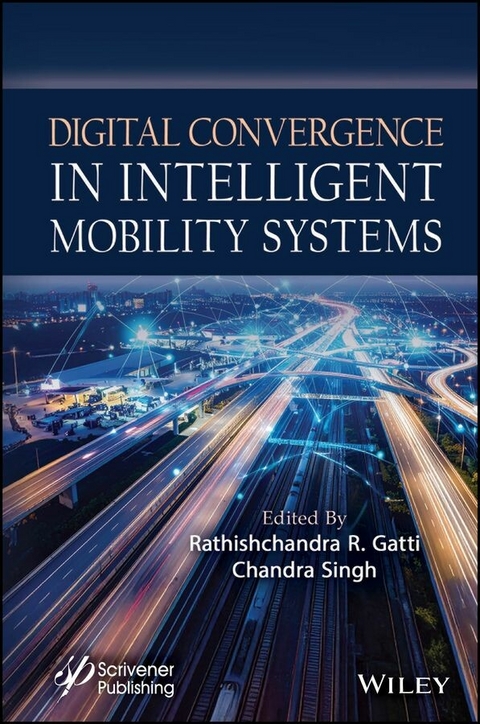
Digital Convergence in Intelligent Mobility Systems (eBook)
600 Seiten
Wiley-Scrivener (Verlag)
978-1-394-27525-0 (ISBN)

Digital Convergence in Intelligent Mobility Systems gives a comprehensive understanding of how digital technologies are revolutionizing transportation, equipping you with the insights needed to navigate the future of intelligent mobility systems.
The rapid evolution of digital technologies has transformed the landscape of intelligent mobility systems, ushering in a new era of innovation and convergence. The integration of digital technologies into various aspects of mobility systems, such as autonomous vehicles, smart transportation networks, and advanced traffic management systems, has the potential to revolutionize how we move people and goods.
Digital Convergence in Intelligent Mobility Systems is a comprehensive guide that explores the intersection of digital convergence and intelligent mobility systems. This book aims to provide an in-depth understanding of the state-of-the-art technologies, methodologies, and applications that are reshaping the future of transportation. It will serve as a valuable resource for researchers, engineers, policymakers, and students interested in the field of intelligent mobility.
Rathishchandra R. Gatti, PhD is a professor and Head of the Department of Mechanical and Robotics Engineering at Sahyadri College of Engineering and Management with over 23 years of experience. He has published over seven books, 30 papers in international journals, and 15 patents. His research interests include AI in engineering, machine data analytics, and robotics.
Chandra Singh is an assistant professor in the Department of Electronics and Communications Engineering at the Nitte Mahalinga Adyantaya Memorial Institute of Technology. He has published over eight books, 30 papers in international journals, and five patents. His research interests include optical and wireless communication, machine learning, and cyber physical systems.
Digital Convergence in Intelligent Mobility Systems gives a comprehensive understanding of how digital technologies are revolutionizing transportation, equipping you with the insights needed to navigate the future of intelligent mobility systems. The rapid evolution of digital technologies has transformed the landscape of intelligent mobility systems, ushering in a new era of innovation and convergence. The integration of digital technologies into various aspects of mobility systems, such as autonomous vehicles, smart transportation networks, and advanced traffic management systems, has the potential to revolutionize how we move people and goods. Digital Convergence in Intelligent Mobility Systems is a comprehensive guide that explores the intersection of digital convergence and intelligent mobility systems. This book aims to provide an in-depth understanding of the state-of-the-art technologies, methodologies, and applications that are reshaping the future of transportation. It will serve as a valuable resource for researchers, engineers, policymakers, and students interested in the field of intelligent mobility.
1
Arduino-Based Battery-Operated Multi-Purpose Portable Seed-Sowing Machine
K. Raju1, M. Ajay Kumar1 and Canute Sherwin2*
1Department of Mechanical Engineering, St. Joseph Engineering College, Mangaluru, India
2CoE - Energy Science and e-Mobility, Atria University, Karnataka, India
Abstract
Agriculture plays a crucial role in contributing about 17% of the gross domestic production (GDP) in India. The zest of rural population in India relies on farming and associated activities for their income. The use of traditional tools for agricultural activities like plow, spade, sickle, thresher, etc., gives less yield. Even though a lot of developments related to mechanization and automation of activities related to agriculture and farming are introduced, most of them are suitable for largescale agriculturalists and farmers. The large-scale farmers associated with mass production are equipped with machines for cropping, thereby making huge profits. There is a need to develop automated/semi-automated systems for medium- or small-scale agricultural activities which would be energy efficient, easy to use and maintain, and economical. The manufacturers of agricultural machineries introduce machines which are imported in design, expensive, and suitable for large-scale applications like tillers, tractors, etc. However, developing and utilizing machines for specific purposes have been a challenge. The seed-sowing machines assist farmers in utilizing time and money to sow seeds in the desired position. In this chapter, the design and development of an Arduino-based battery-operated seed-sowing machine is discussed. The machine uses Arduino-controlled servo motors for controlled spacing and sowing of seeds. The battery eliminates the need for electricity to power the device. The Arduino-controlled design provides farmers a great level of precision and control over the operation of the machine. The depth, speed of tiller blades, and other parameters can be adjusted for the optimal performance of different types of crops and soil. The machine was tested for sowing the different types of seeds at a speed of 75 rpm. The motor and the battery capacities are 250 W and 21 Ah, respectively, and the battery charge will last for 1.3 hours. Overall, the Arduino-controlled multi-purpose seed-sowing machine is a valuable addition to the modern agricultural sector that helps the farmers to increase productivity, efficiency, and profitability. The proposed design is simple to use; hence, even an unskilled farmer can handle it. The chapter also discusses a comprehensive analysis on semi- and fully automated seed-sowing machines for agricultural purposes. Some of the shortcomings of traditional machines and practices are also compiled in this chapter. The scope for further improvement in seed-sowing machines and features is highlighted in the chapter, which encourages researchers to carry forward this research.
Keywords: Agriculture, automation, farmers, battery, seed-sowing machine, gross domestic production, tilling, trenching
1.1 Introduction
In the Indian economy, agriculture plays a crucial role in contributing about 17% of the gross domestic production (GDP). The majority of rural population in India depends on the agriculture and associated activities for their income. The use of traditional tools for agricultural activities like plow, spade, sickle, thresher, etc., gives less yield. Even though a lot of developments related to mechanization and automation of activities related to agriculture and farming are introduced, most of them are suitable for large-scale agriculturalists and farmers. The large-scale farmers are now equipped with machines that help in mass production of crops and hence make the profits. There is a need to develop automated/semi-automated systems for medium- or small-scale agricultural activities which would be energy efficient, easy to use and maintain, and economical. The manufacturers of agricultural machineries introduce machines which are imported in design, expensive, and suitable for large-scale applications like tillers, tractors, etc. However, developing and utilizing machines for specific purposes have been a challenge. The seed-sowing machines assist farmers in utilizing time and money to sow seeds in the desired position. The basic objective of the sowing operation is to put the seed in rows at the desired depth and seed-to-seed spacing, cover the seeds with soil, and provide proper compaction over the seed [1].
The traditional seed-sowing process includes broadcasting manually, i.e., opening furrows manually by the plow and dropping the seeds through a funnel attached to the plow. Dibbling, i.e., sowing in a small area, consists of making slits or holes through a stick and dropping seeds by the hand. The multi-row seeding devices are quite popular with the traditional farmers. Some of the limitations associated with traditional farming include non-uniform distribution of seeds and high labor requirement [2]. The labor shortage is one of the major challenges faced by many agriculturalists today. The need to develop machines suitable for increasing the production rate is increasing today to meet the supply and the demand gap for food products. Sowing is an important activity in agriculture and is labor intensive. Although the seed-sowing machines are available, they are not affordable for small/medium-scale farmers [3]. The mechanization along with the automation leads to improving the efficiency of the farming processes. It helps the farmers to reduce the efforts put toward the seed-sowing functions. This study is a sincere effort to develop a low-cost, compact, and multi-crop semi-automatic seed-sowing machine. A detailed literature survey on already-available seed-sowing machines, associated technologies, and activities related to the seed sowing has been conducted in the present work to help in designing an efficient system. For automation in the field of agriculture, one needs to take care of the process and understand the behavior of the technology at the same time. Care is taken in designing a system which provides the required soil cover, maintaining moisture and PH level, etc. In this line, different automation technologies are being studied, including solar-powered systems, seed metering systems, sensors with Bluetooth modules, etc. [4].
This book chapter discusses the design, construction, and working of a semi-automatic seed-sowing machine which defines the specific needs it needs to fulfill. This provides the base for the design. After the design stage, the manufacturing stage leads to the development of a working prototype. The book chapter culminates with the testing of the prototype for real-world situations, and appropriate modifications to the design and troubleshooting are made. The design comprises of an Arduino-based battery-operated multi-purpose portable seed-sowing machine. The main components of the system are the battery, chain drive and sprocket assembly, wheel, servo motor, Arduino UNO, relay, hopper, shaft and bearing, and DC motor. The machine is powered by a rechargeable battery and controlled by an Arduino microcontroller to control servo motors and other electronic components. The main features of the machine are portability and accessibility in the regions where there is no electricity. The machine is also cost effective, making it an ideal choice for small- and medium-scale farmers and agriculturalists.
1.2 Background
This section discusses a few designs on semi-automated and fully automated seed-sowing machines designed by researchers for small- and medium-scale farmers. This literature has been surveyed to get few insights into the important specifications for the design of a semi-automated seed-sowing and tilling machine.
Ratnesh Kumar et al. (2022) developed an automatic seed-sowing machine that moves and sows seeds in the farmland in parallel rows. The machine is designed to carry different types of crop seeds, and the spacing required for different types of plant seed sowing is adjustable. The machine runs with the help of a DC motor connected to a battery [5]. Senthilnathan et al. (2018) designed an Internet of Things (IoT)-based seed-sowing machine, which helps the farmers to sow the seeds with less time and effort. The system design comprises a DC motor, seed distributor, cultivator, hopper, relays, microcontroller, and belt drives. The machine can be controlled using an Android phone or a laptop [6]. Vidya Yedave et al. (2019) proposed an automatic seed-sowing robot which performs the task of soil loosening and seed sowing at a fast rate. The robot can be controlled to move forward, backward, right, and left using a remote control and RF module. A 12V battery is used to power the system, and an Arduino UNO is used to control the motor drivers. A mechanical mechanism is used in this design for loosening of soil and seed-sowing purposes [7]. Kalash Singhal et al. (2018) proposed a solar-powered seed-sowing machine which is cost efficient and performs multiple operations associated with seed sowing like tilling, sowing, and watering. It makes use of a 40 W solar panel, 24V battery, and 24V DC motor for its functioning. The seed-sowing machine’s design, apart from being simple, cost effective, and efficient, needs to take into consideration row spacing, seed rate, speed depth, and compaction force [8]. Efforts are made to achieve multiple operations simultaneously by Smitha et al. (2018) [9]. Mohan Kumar et al. (2023) have designed and fabricated an Arduino-enabled and battery-operated seed-sowing machine....
| Erscheint lt. Verlag | 9.7.2025 |
|---|---|
| Sprache | englisch |
| Themenwelt | Technik ► Maschinenbau |
| Schlagworte | 5G communication • Autonomous Vehicles • Blockchain in Transportation • Digital Convergence • Digital Twins • edge computing • Intelligent Mobility Systems • Machine Learning in Transportation • mobility solutions • Smart Transportation Networks • Sustainability in Mobility • traffic management • Transportation Technology • Urban Transportation • vehicular communication |
| ISBN-10 | 1-394-27525-0 / 1394275250 |
| ISBN-13 | 978-1-394-27525-0 / 9781394275250 |
| Informationen gemäß Produktsicherheitsverordnung (GPSR) | |
| Haben Sie eine Frage zum Produkt? |
 EPUB (Adobe DRM)
Kopierschutz: Adobe-DRM
Adobe-DRM ist ein Kopierschutz, der das eBook vor Mißbrauch schützen soll. Dabei wird das eBook bereits beim Download auf Ihre persönliche Adobe-ID autorisiert. Lesen können Sie das eBook dann nur auf den Geräten, welche ebenfalls auf Ihre Adobe-ID registriert sind.
Details zum Adobe-DRM
Dateiformat: EPUB (Electronic Publication)
EPUB ist ein offener Standard für eBooks und eignet sich besonders zur Darstellung von Belletristik und Sachbüchern. Der Fließtext wird dynamisch an die Display- und Schriftgröße angepasst. Auch für mobile Lesegeräte ist EPUB daher gut geeignet.
Systemvoraussetzungen:
PC/Mac: Mit einem PC oder Mac können Sie dieses eBook lesen. Sie benötigen eine
eReader: Dieses eBook kann mit (fast) allen eBook-Readern gelesen werden. Mit dem amazon-Kindle ist es aber nicht kompatibel.
Smartphone/Tablet: Egal ob Apple oder Android, dieses eBook können Sie lesen. Sie benötigen eine
Geräteliste und zusätzliche Hinweise
Buying eBooks from abroad
For tax law reasons we can sell eBooks just within Germany and Switzerland. Regrettably we cannot fulfill eBook-orders from other countries.
aus dem Bereich