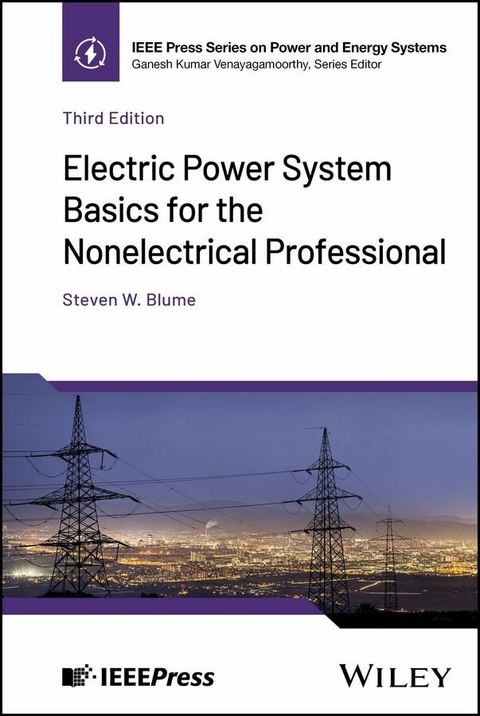
Electric Power System Basics for the Nonelectrical Professional (eBook)
536 Seiten
Wiley-IEEE Press (Verlag)
978-1-394-28199-2 (ISBN)
Understand the fundamentals of electrical power systems with this accessible guide
Few subjects are more fundamental to modern life than electrical power. The systems that generate, transport, and distribute electricity are among the most essential contributors to modern industry, development, and everyday living. As energy demand grows and, with it, the electric power industry, more and more non-electrical professionals must make important policy and administrative decisions regarding the systems that power our world.
Electric Power System Basics for the Nonelectrical Professional provides an education on the basics of this subject, including the various types of energy sources, types of transmission and distribution lines, grid modernization, and much more. From residential to industrial energy, and from metering principles to energy conservation techniques, this book provides a one-stop reference on all relevant areas of knowledge. Now fully updated to reflect the latest advances and the current state of a growing industry, it is a must-own for anyone looking to bring foundational power systems knowledge to bear on policy or industrial issues.
Readers of the third edition will also find:
- Coverage of wildfire mitigation strategies to reduce safety risk
- Detailed discussion of regulatory changes and their effects on system operations
- Updated coverage of system reliability and smart technologies
- Updated discussion of the transitioning digital power grid
Electric Power System Basics for the Nonelectrical Professional is ideal for power industry executives and state regulators.
Steven W. Blume, MSEE, PE, is the Founder of Applied Professional Training, Inc., which became an accredited college under the name of APTC.edu, and stayed in business for over 25 years. He now works as an independent consulting contractor under the business name and website www.BlumeConsulting.com. He is a registered professional engineer with a Master's degree in electrical engineering specializing in Power Systems and a Bachelor's degree specializing in Telecommunications. Blume is a NERC certified Reliability Coordinator, and his engineering and operations experience includes generation, transmission, distribution, protection, and electrical safety. He is an active lifetime Senior Member of IEEE and has published two books in power systems through Wiley-IEEE Press.
Understand the fundamentals of electrical power systems with this accessible guide Few subjects are more fundamental to modern life than electrical power. The systems that generate, transport, and distribute electricity are among the most essential contributors to modern industry, development, and everyday living. As energy demand grows and, with it, the electric power industry, more and more non-electrical professionals must make important policy and administrative decisions regarding the systems that power our world. Electric Power System Basics for the Nonelectrical Professional provides an education on the basics of this subject, including the various types of energy sources, types of transmission and distribution lines, grid modernization, and much more. From residential to industrial energy, and from metering principles to energy conservation techniques, this book provides a one-stop reference on all relevant areas of knowledge. Now fully updated to reflect the latest advances and the current state of a growing industry, it is a must-own for anyone looking to bring foundational power systems knowledge to bear on policy or industrial issues. Readers of the third edition will also find: Coverage of wildfire mitigation strategies to reduce safety riskDetailed discussion of regulatory changes and their effects on system operationsUpdated coverage of system reliability and smart technologiesUpdated discussion of the transitioning digital power grid Electric Power System Basics for the Nonelectrical Professional is ideal for power industry executives and state regulators.
Chapter Summaries
A brief overview of each chapter is presented below. Knowing how the information is organized in this book helps the reader comprehend the material. The language used in this book reflects actual industry terminology.
Chapter 1: System Overview, Terminology, and Basic Concepts
This book begins with a brief yet informative discussion of the history leading to the power systems we know today. A system overview diagram is presented with brief discussions of each major division within the power system. Basic definitions and common terminology are discussed such as voltage, current, power, and energy. To set the stage for more advanced learning, fundamental concepts such as direct and alternating current (i.e., dc and ac), frequency, single‐phase and three‐phase, types of loads, and power system efficiency are discussed.
This chapter introduces how electrical generators produce electricity. The physical laws and electrical and magnetic concepts presented in this chapter serve as the foundation for all electric power systems.
Basic electrical formulas are presented throughout this book to help explain terminology, relationships, and concepts associated with electric power systems. The reader should not be intimidated nor concerned about math; they are strictly used to illustrate, describe, and explain electrical relationships.
Chapter 2: Generation
This chapter presents basic concepts behind various traditional and non‐traditional electrical generation sources or power plants. These concepts include sub‐systems that differentiate plants, such as their natural resources, spin or non‐spinning rotors, operational characteristics, environmental effects, and overall efficiencies.
The reader becomes more knowledgeable about the various aspects of electrical generation, such as the different prime movers used to rotate generator shafts and the basic building blocks that make up the various power plants. The prime movers discussed include steam, hydro, and wind turbines.
This chapter discusses the major equipment components or sub‐systems associated with each power plant type, such as boilers, cooling towers, boiler feed pumps, and high‐ and low‐pressure systems. Also, the basic design concepts of how small and large solar and wind generators convert sustainable resources into useful electrical energy are discussed.
Finally, this chapter discusses the growing use of non‐rotating electric energy sources, primarily solar photovoltaic, wind, and battery storage. An explanation of Inverter Based Resources (IBRs) is also provided.
Chapter 3: Transmission Lines
This chapter explains the reasons for using very high‐voltage power lines compared to low‐voltage power lines and the fundamental components of transmission lines such as conductors, insulators, air gaps, and shielding. Further, this chapter compares direct current (dc) transmission to alternating current (ac) transmission lines, as well as underground transmission to overhead transmission. The reader will obtain a good understanding of transmission line design parameters and the benefits of using high‐voltage transmission for efficient transport of electrical power.
Chapter 4: Substations
This chapter covers equipment found in substations that transform very high‐voltage electrical energy transported from generation facilities into a more usable form of electrical energy for distribution and consumption. This chapter discusses the equipment itself (i.e., transformers, regulators, circuit breakers, and disconnect switches) and their relationship to system protection, maintenance operations, and system control. This chapter also includes discussions on control building equipment, static VAR compensators, preventative maintenance practices, and new digital substation equipment being used to help modernize operations and reliability.
Chapter 5: Distribution
This chapter describes how primary distribution systems, both overhead and underground, are designed, operated, and used to serve residential, commercial, and industrial consumers. The focus is on the distribution system between the substation and the consumer's demarcation point (i.e., service entrance equipment). This chapter covers overhead and underground line configurations, voltage classifications, and common equipment used in distribution systems. The reader will learn how distribution systems are designed and built to provide reliable electrical power to end users.
This chapter is based on traditional distribution systems, whereas modernization concepts, such as distribution automation, intelligent electronic devices, decentralized control, advanced distribution management systems (ADMS), distributed renewable energy resources (DERMS), distributed energy resources (DERs), and other modernizing developments are discussed in more detail in Chapter 10 (The Transitioning Digital Power Grid).
Chapter 6: Consumption
This chapter discusses equipment located between the customer service entrance demarcation point and the wiring to actual load devices. This chapter also explains the use of emergency generators and uninterruptible power supply (UPS) systems to enhance reliable electric service and power quality. This chapter also covers smart meters, service reliability indicators, common problems, and solutions associated with large power consumers, such as robust data centers.
Chapter 7: System Protection
This chapter is devoted to “system protection” and how electric power systems are protected against equipment failures, faults on power lines, lightning strikes, inadvertent operations, and other events that cause system disturbances. “Personal protection” (i.e., personal safety) is discussed later in Chapter 11.
Reliable service is dependent upon properly designed and periodically tested protective relay systems. These systems, and their associated protective relay types, are explained for transmission and distribution lines, substations, and generator units, including generator synchronization to the main power grid. The reader learns how the entire electric power protection system is designed, with overlap and backup schemes, to protect itself from unexpected faults, and to minimize the impact of major system disturbances.
This chapter discusses enhancements to protective relay systems that address wildfire ignition mitigation strategies. Enhanced protective relay schemes discussed in this chapter include accelerated fast tripping, highly sensitive fault detection, downed conductor detection, temporarily disabling automatic reclosing during fire seasons, and other protection equipment enhancements such as upgraded expulsion‐type fuses.
Chapter 8: Interconnected Power Systems
This chapter starts with a discussion of the four major power grids in North America and how these grids are territorially divided, operated, controlled, and regulated. This chapter emphasizes how individual power companies are interconnected to improve overall performance, reliability, stability, and security. Other topics discussed include generation‐load balance, resource planning, and operational limitations under normal and emergency conditions. This chapter discusses the concepts of rolling blackouts, brownouts, load shedding, and other service reliability issues and methods used to minimize outages.
Chapter 9: System Control Centers and Telecommunications
System control centers are extremely important in the day‐to‐day operation of electric power systems. This chapter explains how system control center operators remotely monitor and control equipment located in substations, on power lines, and at actual consumer locations. These tools enable transmission and generator operators to economically dispatch power, meet energy demand, control equipment during normal and emergency conditions, monitor system health, and interpret alarms from pending circumstances. This chapter includes the explanation and use of SCADA (Supervisory Control and Data Acquisition) and EMS (Energy Management Systems).
The functionality and benefits of the various types of communications systems used to connect system control centers with remote terminal units are discussed in this chapter. These telecommunications systems include optical fibers, microwave, power line carriers, radio, and copper wireline circuits. In a fundamental manner, this chapter discusses how these digital data/voice/video communications services are used in protective relaying, customer service call centers, and other critical corporate needs.
This chapter also discusses the modernization of system control center tools, such as synchrophasors and wide area monitoring systems to improve system visibility, security, and reliability.
Chapter 10: The Transitioning Digital Power Grid
This new chapter focuses on the significant changes occurring in the transitioning digital power grid system. The key areas include transmission reliability enhancements such as voltage and frequency ride through to help replace the declining spinning inertia, how the “Duck Curve” characterizes changes in load‐generation resource balance, and the growing use of large battery storage systems.
Significant changes in how the distribution system infrastructure and operations are adapting to modernizing trends are discussed, such as advanced...
| Erscheint lt. Verlag | 8.7.2025 |
|---|---|
| Reihe/Serie | IEEE Press Series on Power and Energy Systems |
| Sprache | englisch |
| Themenwelt | Technik ► Elektrotechnik / Energietechnik |
| Schlagworte | electricity • electric regulatory issue • Electric Vehicles • energy conservation • energy resources • Environment • EV • home automation • Infrastructure • power consumption • Power generation • Power Systems • power transportation • renewable energy • safety awareness |
| ISBN-10 | 1-394-28199-4 / 1394281994 |
| ISBN-13 | 978-1-394-28199-2 / 9781394281992 |
| Informationen gemäß Produktsicherheitsverordnung (GPSR) | |
| Haben Sie eine Frage zum Produkt? |
 EPUB (Adobe DRM)
Kopierschutz: Adobe-DRM
Adobe-DRM ist ein Kopierschutz, der das eBook vor Mißbrauch schützen soll. Dabei wird das eBook bereits beim Download auf Ihre persönliche Adobe-ID autorisiert. Lesen können Sie das eBook dann nur auf den Geräten, welche ebenfalls auf Ihre Adobe-ID registriert sind.
Details zum Adobe-DRM
Dateiformat: EPUB (Electronic Publication)
EPUB ist ein offener Standard für eBooks und eignet sich besonders zur Darstellung von Belletristik und Sachbüchern. Der Fließtext wird dynamisch an die Display- und Schriftgröße angepasst. Auch für mobile Lesegeräte ist EPUB daher gut geeignet.
Systemvoraussetzungen:
PC/Mac: Mit einem PC oder Mac können Sie dieses eBook lesen. Sie benötigen eine
eReader: Dieses eBook kann mit (fast) allen eBook-Readern gelesen werden. Mit dem amazon-Kindle ist es aber nicht kompatibel.
Smartphone/Tablet: Egal ob Apple oder Android, dieses eBook können Sie lesen. Sie benötigen eine
Geräteliste und zusätzliche Hinweise
Buying eBooks from abroad
For tax law reasons we can sell eBooks just within Germany and Switzerland. Regrettably we cannot fulfill eBook-orders from other countries.
aus dem Bereich