


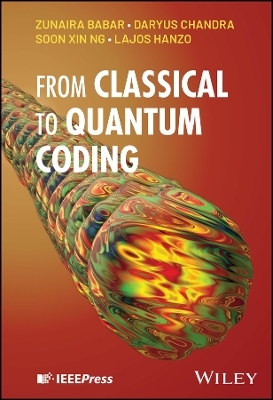
From Classical to Quantum Coding
Seiten
2026
Wiley-IEEE Press (Verlag)
978-1-394-33193-2 (ISBN)
Wiley-IEEE Press (Verlag)
978-1-394-33193-2 (ISBN)
- Noch nicht erschienen (ca. März 2026)
- Versandkostenfrei
- Auch auf Rechnung
- Artikel merken
An expert discussion of the potential evolution of quantum codes
In From Classical to Quantum Coding, a team of distinguished researchers deliver a seamless research monograph on the subject of quantum error correction codes (QECC) designed for mitigating the environment-induced decoherence imposed on quantum computing and communications. Commencing from first principles, Part I is dedicated to readers familiar with classical coding and wishing to move into quantum coding. Part II focuses on near-term quantum codes requiring a modest to moderate number of qubits. Finally, Part III of the book offers an outlook on the classical to quantum evolution of QECCs, to advanced codes that rely on numerous qubits as quantum technology matures.
The book incorporates several advanced topics, including the universal decoding of arbitrary linear codes, iterative short turbo block codes, turbo convolutional codes, and the family of low-density parity check codes. The powerful design tool of extrinsic information transfer charts plays a central role in the associated near-hashing-bound designs.
Readers will also find:
An easy-reading introduction to quantum information processing and quantum coding
An evolutionary portrayal of the classical to quantum coding paradigm
Practical discussions of near-term quantum topological error correction codes and how they protect quantum gates from decoherence
Detailed treatments of syndrome-based decoding of diverse quantum turbo codes and quantum low-density parity check codes
From Classical to Quantum Coding will benefit doctoral students, industrial and academic researchers wishing to expand their expertise from the classical to the quantum field of signal processing, computing and communications.
In From Classical to Quantum Coding, a team of distinguished researchers deliver a seamless research monograph on the subject of quantum error correction codes (QECC) designed for mitigating the environment-induced decoherence imposed on quantum computing and communications. Commencing from first principles, Part I is dedicated to readers familiar with classical coding and wishing to move into quantum coding. Part II focuses on near-term quantum codes requiring a modest to moderate number of qubits. Finally, Part III of the book offers an outlook on the classical to quantum evolution of QECCs, to advanced codes that rely on numerous qubits as quantum technology matures.
The book incorporates several advanced topics, including the universal decoding of arbitrary linear codes, iterative short turbo block codes, turbo convolutional codes, and the family of low-density parity check codes. The powerful design tool of extrinsic information transfer charts plays a central role in the associated near-hashing-bound designs.
Readers will also find:
An easy-reading introduction to quantum information processing and quantum coding
An evolutionary portrayal of the classical to quantum coding paradigm
Practical discussions of near-term quantum topological error correction codes and how they protect quantum gates from decoherence
Detailed treatments of syndrome-based decoding of diverse quantum turbo codes and quantum low-density parity check codes
From Classical to Quantum Coding will benefit doctoral students, industrial and academic researchers wishing to expand their expertise from the classical to the quantum field of signal processing, computing and communications.
Zunaira Babar is a Senior Algorithm Engineer at VIAVI Solutions Inc. Daryus Chandra is a Senior Quantum Error Correction Researcher at Photonic Inc. Soon Xin Ng, PhD, is a Full Professor of Telecommunications at the University of Southampton, UK. Lajos Hanzo is a Fellow of the Royal Academy of Engineering and a Foreign Member of the Hungarian Academy of Sciences.
| Erscheint lt. Verlag | 18.3.2026 |
|---|---|
| Sprache | englisch |
| Themenwelt | Mathematik / Informatik ► Informatik ► Theorie / Studium |
| Technik ► Elektrotechnik / Energietechnik | |
| ISBN-10 | 1-394-33193-2 / 1394331932 |
| ISBN-13 | 978-1-394-33193-2 / 9781394331932 |
| Zustand | Neuware |
| Informationen gemäß Produktsicherheitsverordnung (GPSR) | |
| Haben Sie eine Frage zum Produkt? |
Mehr entdecken
aus dem Bereich

aus dem Bereich
was jeder über Informatik wissen sollte
Buch | Softcover (2024)
Springer Vieweg (Verlag)
CHF 53,15
Grundlagen – Anwendungen – Perspektiven
Buch | Softcover (2022)
Springer Vieweg (Verlag)
CHF 53,15
Teil 2 der gestreckten Abschlussprüfung Fachinformatiker/-in …
Buch | Softcover (2025)
Europa-Lehrmittel (Verlag)
CHF 37,90


