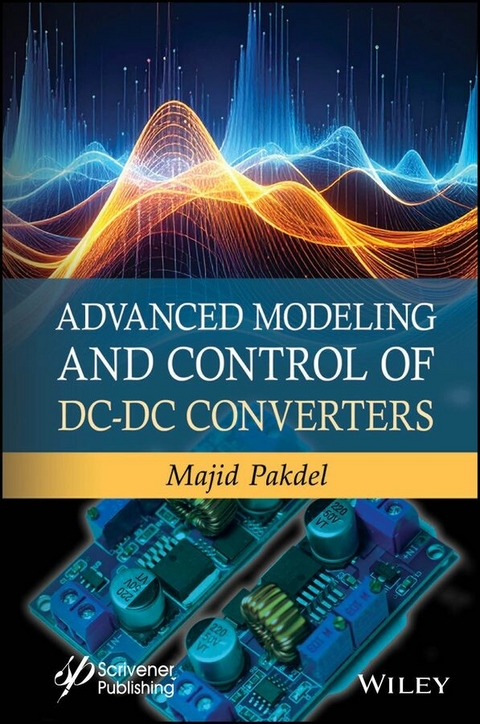
Advanced Modeling and Control of DC-DC Converters (eBook)
818 Seiten
Wiley-Scrivener (Verlag)
9781394289424 (ISBN)
Advanced Modeling and Control of DC-DC Converters is essential for anyone looking to master the intricacies of power electronics, as it offers comprehensive insights into advanced modeling techniques, control strategies, and practical applications across various high-impact industries.
Advanced Modeling and Control of DC-DC Converters delves into the intricate field of power electronics and its applications for DC-DC converters. This subject plays a crucial role in a wide range of industries, including renewable energy systems, electric vehicle technology, aerospace, telecommunications, and more. This volume focuses on the advanced modeling and control strategies of DC-DC converters, covering various converter topologies, such as buck, boost, buck-boost, and isolated converters, exploring their unique characteristics and challenges. Furthermore, it delves into the integration of advanced semiconductor devices, which offer higher efficiency and power density. One of the key features of this book is the exploration of advanced control algorithms that enhance the performance, stability, and efficiency of DC-DC converters. These algorithms encompass traditional control techniques such as proportional-integral-derivative (PID) control and contemporary approaches like sliding-mode control, adaptive control, and advanced model predictive control. Advanced Modeling and Control of DC-DC Converters provides detailed explanations, design guidelines, and simulation examples to aid readers in implementing these control strategies effectively, making it an invaluable resource for students and industry veterans alike.
Majid Pakdel, PhD is affiliated with the Department of Electrical Engineering at the University of Zanjan. He has authored five books and over 50 publications in internationally reputed journals and conferences. His research interests include power electronics, artificial intelligence, microcontroller programming, and power system protection.
Advanced Modeling and Control of DC-DC Converters is essential for anyone looking to master the intricacies of power electronics, as it offers comprehensive insights into advanced modeling techniques, control strategies, and practical applications across various high-impact industries. Advanced Modeling and Control of DC-DC Converters delves into the intricate field of power electronics and its applications for DC-DC converters. This subject plays a crucial role in a wide range of industries, including renewable energy systems, electric vehicle technology, aerospace, telecommunications, and more. This volume focuses on the advanced modeling and control strategies of DC-DC converters, covering various converter topologies, such as buck, boost, buck-boost, and isolated converters, exploring their unique characteristics and challenges. Furthermore, it delves into the integration of advanced semiconductor devices, which offer higher efficiency and power density. One of the key features of this book is the exploration of advanced control algorithms that enhance the performance, stability, and efficiency of DC-DC converters. These algorithms encompass traditional control techniques such as proportional-integral-derivative (PID) control and contemporary approaches like sliding-mode control, adaptive control, and advanced model predictive control. Advanced Modeling and Control of DC-DC Converters provides detailed explanations, design guidelines, and simulation examples to aid readers in implementing these control strategies effectively, making it an invaluable resource for students and industry veterans alike.
1
Averaged-Switch Modeling and Simulation
1.1 Introductory Example (Synchronous Buck Converter)
We are going to start off with just taking an example and working through it. So here is what we would refer to commonly as a synchronous buck converter. You can organize the buck converter structure with a single pole double throw switch, followed by an LC filter as shown in Figure 1.1 [2].
Figure 1.1 Synchronous buck converter.
How difficult can that be? You take the input voltage, vg, there. You switch the two devices repeatedly at a switching frequency, fs. You create a pulsating waveform at the switching node. The duty cycle of that pulsating waveform is the control variable that we refer to as d, and then you will pass filter that pulsating waveform to generate an output DC voltage that is directly proportional to the control variable, d, and directly proportional to the DC value of the input voltage. So that’s your buck converter. The inputs, in this case here, would be the input voltage, the load current, and the control voltage that really sets the value of the duty cycle, d. The outputs would be the output voltage. But also, we treat the input current curve as an “output” and we’ll see that as particularly important when we get to the point of designing an input filter. Then the responses from, for example, the duty cycle to input current are going to be particularly important in studying how the input filter is going to respond to that type of perturbation. The state variables in the converter can be commonly associated with the energy storage elements. So here we have two energy storage elements in the low pass filter, the inductor L and the capacitor C, and the voltage across the capacitor and the inductor current are the state variables in the converter. To make this a little bit more realistic, we are including there some of the non-idealities in the converter. We will say that these two switches have, when on, behaved as on resistances. They’re not necessarily the same. We say Ron1 and Ron2 right there. We also take into account some series resistance for the inductor, and on the output filter capacitor, we take into account the fact that it’s also not an ideal capacitor but has some equivalent series resistance. Why is that called the synchronous buck converter? Normally in a buck converter, we have the main control switch and the rectifying diode right there as depicted in Figure 1.2.
Figure 1.2 Rectifying diode in a buck converter.
You could just as well have a single controllable switch with the rectifying diode performing function of the single pole double throw switch in the buck converter. That’s perfectly fine. Then instead of diode, we can employ an active switch, in particular a MOSFET, to have the switch conducting at a time when the diode would be conducting current. So, when you turn off the main control MOSFET, then normally the rectifying diode would be conducting automatically. You will have automatic commutation between the main control MOSFET and the diode. But if in the process you actually turn on the MOSFET, right there, you will have the current actually flying through the channel of the MOSFET from source to drain. That’s actually opposite to what normally the current would flow through a controllable MOSFET and that MOSFET really serves the purpose that the rectifying diode would serve in just a regular transistor plus diode buck converter. Now, that MOSFET, let’s call it Q2, and Q1 are turned on and off in complementary manner and will never have them both on at the same time, of course, as illustrated in Figure 1.3.
Figure 1.3 Opposite current flow in MOSFET Q2 turn on.
So that MOSFET Q2 has to be synchronized to the operation of the control MOSFET Q1 and in fact, it has to be performing the rectification function in a synchronous manner, in a timed manner that corresponds to what the diode would be doing if the diode were present, which is why we have this term “synchronous” in the buck converter. Synchronous buck converter is a very common component. You probably have 10 of those in your pocket right now performing conversion from the battery down to various pieces of your smartphone. It is a very commonly applied converter circuit. One little question, since we are discussing the review of the Intro to Politics materials, why would we want to use here a synchronous rectifier and MOSFET instead of just a plane diode? The point of using the MOSFET Q2 here is that the resistance of the synchronous rectifier, Ron2, times the current that would be flowing through that synchronous rectifier from source to drain, i, would be less than the diode voltage drop, VD, i.e., we have Ron2 i << VD. So that implies reduced conduction losses and that’s particularly important in cases where you’re trying to make this converter serve as a power supply with a very low output voltage. The example that we are going to do in just a moment is going to regulate the output voltage to 1.8 volts. If you were to use a diode that has a forward voltage, drop of 0.8 volts, the efficiency of that converter would be horrendous, because that forward voltage drop would be comparable to the voltage you’re trying to regulate. Instead, you employ a MOSFET that has a very, very small resistance and has the forward voltage drop in conducting current much lower than the forward voltage drop of a diode. One last comment about the synchronous rectification right there is that whether you sketch this diode here explicitly or not, we would like to remind you that the diode, in fact, does physically exist as a body diode of the rectifying MOSFET. So the MOSFET comes in with the PN junction diode between the source and drain terminals. We don’t like that diode to conduct, because it has a large forward voltage drop. Instead, we bypass that PN junction diode that’s built into the MOSFET structure itself by turning on the MOSFET channel and conducting current through the channel of the MOSFET with a voltage drop much smaller than the forward voltage drop of what would be the drop across the body diode. All right, so this is the type of little bit of a review of the very beginning of the Intro to Politics. You learn how converters work, how they switch, and some of the details related to conduction losses, and so on. If you need to go back and review some of that some more, go ahead. What we will do, for the most part in this book, is look into the dynamic modeling and control aspects in the next steps.
1.2 Synchronous Buck Converter State Equations
Let’s see what we do with the synchronous buck converter. Typically, when we do the analysis, we can certainly write converters state equations very easily. If you notice that depending on the position of these switches, whether they are on or off, you will see we’re going to have really two main states of the converter. One when the Q1 switch is on, the other one when the Q2 switch is on, and that’s decided entirely by the control signal. The control signal here is denoted as c. That’s a logic level signal that’s produced by a controller that decides which one of the two switches should be on. Notice here that conceptually we’ve split this into a gate driver and an inverting gate driver for the two switches to make sure we understand that the switching between these two devices is complementary. A further detail on that note is that there is a certain amount of dead time between these two MOSFETs, so they should never be turned on at the same time. Logic-wise, this is what we do.
Figure 1.4 State and output equations.
Details circuit-wise, we also insert small dead times between the conduction state of the MOSFET 1 versus the MOSFET 2. So how do we write the state equations? Well, we’ll look at the two positions of the switches. Thus, when the control signal, c, is in logic 1 state, switch 1 is on, and we have the following equation as shown in Figure 1.4:
That is the voltage loop equation for the state of the switch 1, so that’s for c is equal to 1. When c is equal to 0, and MOSFET 2 is on, and MOSFET 1 is off, then you have similarly the dynamic equation for the inductor now being a different voltage path right there, and that voltage path, the voltage loop equation looks like the following equation as shown in Figure 1.4.
Now, the output equations here, well, there is a state equation for the capacitor current, which is pretty easy; it doesn’t depend on the state of the switches, so we have the following equation as depicted in Figure 1.4.
Then output equations are the input current is either equal to the inductor current when c is 1, or is equal to 0 when c is 0, and the output voltage is as follows as illustrated in Figure 1.4.
We just write down the equations for the two states of the switches and how we actually generate the control pulsating signal of how a pulse-width modulator operates in a conceptually simple manner, having just a voltage comparator that compares an analog control input that we call it vc(t) to a sort of periodic waveform. The period of that waveform is equal to the switching period, and the amplitude of that waveform is called VM. The amplitude of that waveform sets the...
| Erscheint lt. Verlag | 30.6.2025 |
|---|---|
| Sprache | englisch |
| Themenwelt | Technik ► Elektrotechnik / Energietechnik |
| Schlagworte | Averaged-Switch • Bode Diagram • Control • Current-mode control • DC-DC Converters • Design Oriented • Frequency Response • Input Filter • LTSpice • MATLAB • Modeling • Power Electronics • Psim • Python • Simulation • Transient analysis |
| ISBN-13 | 9781394289424 / 9781394289424 |
| Informationen gemäß Produktsicherheitsverordnung (GPSR) | |
| Haben Sie eine Frage zum Produkt? |
 EPUB (Adobe DRM)
Kopierschutz: Adobe-DRM
Adobe-DRM ist ein Kopierschutz, der das eBook vor Mißbrauch schützen soll. Dabei wird das eBook bereits beim Download auf Ihre persönliche Adobe-ID autorisiert. Lesen können Sie das eBook dann nur auf den Geräten, welche ebenfalls auf Ihre Adobe-ID registriert sind.
Details zum Adobe-DRM
Dateiformat: EPUB (Electronic Publication)
EPUB ist ein offener Standard für eBooks und eignet sich besonders zur Darstellung von Belletristik und Sachbüchern. Der Fließtext wird dynamisch an die Display- und Schriftgröße angepasst. Auch für mobile Lesegeräte ist EPUB daher gut geeignet.
Systemvoraussetzungen:
PC/Mac: Mit einem PC oder Mac können Sie dieses eBook lesen. Sie benötigen eine
eReader: Dieses eBook kann mit (fast) allen eBook-Readern gelesen werden. Mit dem amazon-Kindle ist es aber nicht kompatibel.
Smartphone/Tablet: Egal ob Apple oder Android, dieses eBook können Sie lesen. Sie benötigen eine
Geräteliste und zusätzliche Hinweise
Buying eBooks from abroad
For tax law reasons we can sell eBooks just within Germany and Switzerland. Regrettably we cannot fulfill eBook-orders from other countries.
aus dem Bereich