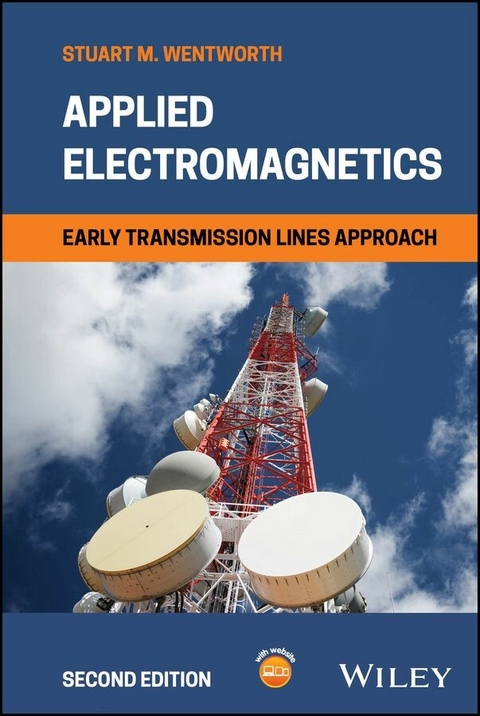
Applied Electromagnetics (eBook)
1204 Seiten
Wiley (Verlag)
978-1-394-24314-3 (ISBN)
A timely and authoritative update to a leading text on the applied electromagnetics of transmission lines
In the newly revised second edition of Applied Electromagnetics: Early Transmission Lines Approach, experienced engineer and professor Stuart Wentworth delivers an up-to-date and authoritative discussion of the electromagnetic foundations of signal transmission. The book explains practical applications for wireless systems, transmission lines, waveguides (including optical fiber), and antennas.
Wentworth provides a detailed theoretical grounding of the subject and combines it with hands-on MATLAB simulations available on the web that help students understand critical concepts.
- Brand-new end-of-chapter problems at a broad range of difficulty levels
- Many more drill and example problems
- Worked solutions provided on the companion website
- Extensively updated material as well as entirely new material on metamaterials and patch antennas
Perfect for undergraduate students of electrical engineering, Applied Electromagnetics: Early Transmission Lines Approach will also benefit researchers and educators in electrical engineering.
Stuart M. Wentworth, PhD, is Assistant Professor Alumni at Auburn University, having retired in 2023 after 33 years of service in the Electrical and Computer Engineering Department. His research focused on antennas, microwave circuit and interconnect modeling, and high frequency material characterization.
A timely and authoritative update to a leading text on the applied electromagnetics of transmission lines In the newly revised second edition of Applied Electromagnetics: Early Transmission Lines Approach, experienced engineer and professor Stuart Wentworth delivers an up-to-date and authoritative discussion of the electromagnetic foundations of signal transmission. The book explains practical applications for wireless systems, transmission lines, waveguides (including optical fiber), and antennas. Wentworth provides a detailed theoretical grounding of the subject and combines it with hands-on MATLAB simulations available on the web that help students understand critical concepts. Brand-new end-of-chapter problems at a broad range of difficulty levelsMany more drill and example problemsWorked solutions provided on the companion websiteExtensively updated material as well as entirely new material on metamaterials and patch antennas Perfect for undergraduate students of electrical engineering, Applied Electromagnetics: Early Transmission Lines Approach will also benefit researchers and educators in electrical engineering.
PREFACE
WHY IS IT IMPORTANT FOR AN ELECTRICAL ENGINEER TO UNDERSTAND ELECTROMAGNETICS?
Beyond the fact that electrical circuits can only be understood superficially without an understanding of electromagnetics, consider that as microelectronic circuits continue to get smaller and faster, simple circuit theory breaks down. Only by the application of electromagnetic principles can microelectronic circuits be understood and designed. As a second example, consider that future power needs may be partially met by beamed solar power. Orbiting solar panels would capture electromagnetic radiation from the sun and beam the power to receiving antennas on the ground. Electromagnetic theory will be applied to design these systems. Finally, consider the explosive growth of wireless communications. The circuits, antennas, and signal transmissions all depend on electromagnetic principles. The anticipated continued growth in wireless technology increases the demand for electrical engineers with a solid electromagnetics background.
WHERE TO BEGIN? STATIC FIELDS OR TRANSMISSION LINES?
Opinions vary on whether electromagnetics is best taught using a classical approach or a transmission lines first approach. The classical approach starts with static fields, moving on to dynamic fields and plane waves, and finally to the first applied electromagnetics topic of transmission lines. This is the method used in the other version of this text, Fundamentals of Electromagnetics with Engineering Applications. In the alternative approach, it is argued that students can more easily grasp the concepts of wave phenomena by beginning with transmission lines. Such a method only requires that the student understand basic circuit theory. As such, transmission lines can provide a smooth transition from circuit theory to more involved electromagnetics phenomena, such as the propagation of electromagnetic waves.
There are strong proponents of each approach. Having taught electromagnetics for over 30 years using each approach, I can honestly say that they both work. This text uses a transmission lines first approach. It begins with an introductory chapter describing the role that electromagnetics has in various aspects of a wireless communications system. There is also a review of wave fundamentals and phasors, background information that is an important prelude to coverage of transmission lines in Chapter 2. The transmission line chapter is an application of electromagnetic theory that introduces such concepts as impedance matching and signal reflection and is critical for proper understanding of the connecting wires used in high-speed microprocessors. This chapter also provides a bridge from circuit theory, well known to most electrical engineering students at this point, to some of the concepts and terminology of electromagnetic theory. After this chapter, the student is eased into electromagnetics and vector algebra, beginning with electrostatic fields. Vector concepts such as dot product and gradient are introduced where needed. Students should achieve some level of comfort working with vectors and different coordinate systems before progressing to the slightly more complicated topic of magnetostatic fields, featuring cross product and curl operations. Then, variation with time is introduced with dynamic fields, culminating in Maxwell's equations. This is followed by coverage of plane-wave propagation. At this point, students will see the linkage between generic plane waves and waves propagating on transmission lines. The last two chapters cover interesting and important applications of electromagnetics: waveguides and antennas.
FEATURES OF THE SECOND EDITION
This text is targeted for use in a one-semester (3 or 4 credits) electromagnetics course for electrical engineering students at the junior level. The students are assumed to have completed the freshman and sophomore physics and calculus courses and, therefore, are expected to be competent at integration and differentiation and at least have some familiarity with vectors.
The second edition seeks to provide clearer explanations. It uses more suitable variables: Q represents charges rather than ρ, since ρ is used in cylindrical and spherical coordinates; k represents propagation direction along a transmission line rather than z, since z is used as normalized impedance. Vector notation is simplified by, for instance, using x, y, and z instead of ax, ay, and az. It also features significantly more drill problems, worked examples, and end-of-chapter problems.
The second edition features many more examples, drills, and end-of-chapter problems than the first edition. To make room for this material, Chapter 9, Electromagnetic Compatibility, and Chapter 10, Microwave Engineering, have been removed, though microstrip and lumped element matching from Chapter 10 has been moved to Chapter 2. The first edition versions of Chapters 9 and 10 are available at the Companion Website. The lengthy derivation of fields in rectangular waveguides has mostly been removed and placed in the appendix. Some new material is the introduction of metamaterials in Chapter 6, a more thorough treatment of dielectric waveguides in Chapter 7, and the inclusion of patch antennas in Chapter 8.
Pedagogical Features
- Worked-out example problems—numerous worked-out example problems give students hands-on experience in how to solve electromagnetic problems.
- Drill problems—many relatively simple drill problems are included for reinforcement of the course material.
- End-of-chapter problems—plentiful end-of-chapter problems, including problems on MATLAB, are arranged by chapter section, and many of the odd-numbered problems have answers provided at the Companion Website.
- Practical Applications—a number of practical applications are provided that show how electromagnetic theory is put into practice.
- End-of-chapter summaries—a concise summary at the end of each chapter captures the key points.
SUGGESTED COVERAGE
While the text is designed for a one-semester course (either 3 or 4 credits), there are more topics that can reasonably be covered in that time frame. Table P1 indicates suggested coverage for a 3-credit or 4-credit one-semester course. There is a suggested core of topics (in bold) and optional topics (in italics) that provide depth or breadth at the instructor's discretion.
The entire text can also be used as the foundation for a two-semester (6-credit) course, but additional material (perhaps 15–20 additional contact hours) would be needed. The instructor may elect to use portions of the first edition's Chapter 9 on EMC and/or Chapter 10 on Microwave Engineering. These chapters are provided at the Companion Website.
TABLE P1 Suggested Coverage for One-Semester Course
| 3-Credit coursea | 4-Credit coursea,b |
|---|
| Topic | Book | Contact hours | Book | Contact hours |
|---|
| Introduction | 1.1–1.7 | 1 | 1.1–1.7 | 1 |
| Transmission lines | 2.1–2.5 2.6–2.7 | 4 4 | 2.1–2.5 2.6–2.9.1 | 4 7 |
| Electrostatics | 3.1–3.12, 3.14 | 11 | 3.1–3.12, 3.14 | 11 |
| Magnetostatics | 4.1–4.9 | 8 | 4.1–4.9 | 8 |
| Dynamic fields | 5.1–5.7 | 5 | 5.1–5.7 | 5 |
| Plane waves | 6.1–6.7 | 5 | 6.1–6.7 6.8–6.9 | 5 2 |
| Antennas | — | — | 8.1–8.8 | 8 |
| Exams/review | — | 4 | — | 5 |
| Total hours | 42 | 56 |
aCore sections are listed in bold. Italics indicate sections replaceable with other topics.
bThis 4-credit course focuses on antennas.
SUCCESS IN LEARNING ELECTROMAGNETICS (A NOTE TO THE STUDENTS)
There are some aspects of electromagnetics that many students find daunting. The use of vectors and coordinate systems other than Cartesian, along with the frequent use of derivatives and integrals, are likely to frighten a number of students. There is really no need for fear, only a need for resolve! The only way to learn electromagnetics is to study the material and to apply it to as many problems as possible. Students should certainly work through all the example and drill problems. Successful students will also read (and reread) the text, will work on more end-of-chapter problems than required of the homework assignments, and will rework the best problems.
BOOK COMPANION WEBSITE
Students and instructors can download resources from the Book Companion...
| Erscheint lt. Verlag | 2.7.2025 |
|---|---|
| Sprache | englisch |
| Themenwelt | Technik ► Elektrotechnik / Energietechnik |
| Schlagworte | antennas • Electromagnetic theory • electromagnetic transmissions • Microwave systems • signal transmission • signal transmission engineering • transmission lines book • transmission lines design • Waveguides • wireless communications • Wireless systems |
| ISBN-10 | 1-394-24314-6 / 1394243146 |
| ISBN-13 | 978-1-394-24314-3 / 9781394243143 |
| Informationen gemäß Produktsicherheitsverordnung (GPSR) | |
| Haben Sie eine Frage zum Produkt? |
 EPUB (Adobe DRM)
Kopierschutz: Adobe-DRM
Adobe-DRM ist ein Kopierschutz, der das eBook vor Mißbrauch schützen soll. Dabei wird das eBook bereits beim Download auf Ihre persönliche Adobe-ID autorisiert. Lesen können Sie das eBook dann nur auf den Geräten, welche ebenfalls auf Ihre Adobe-ID registriert sind.
Details zum Adobe-DRM
Dateiformat: EPUB (Electronic Publication)
EPUB ist ein offener Standard für eBooks und eignet sich besonders zur Darstellung von Belletristik und Sachbüchern. Der Fließtext wird dynamisch an die Display- und Schriftgröße angepasst. Auch für mobile Lesegeräte ist EPUB daher gut geeignet.
Systemvoraussetzungen:
PC/Mac: Mit einem PC oder Mac können Sie dieses eBook lesen. Sie benötigen eine
eReader: Dieses eBook kann mit (fast) allen eBook-Readern gelesen werden. Mit dem amazon-Kindle ist es aber nicht kompatibel.
Smartphone/Tablet: Egal ob Apple oder Android, dieses eBook können Sie lesen. Sie benötigen eine
Geräteliste und zusätzliche Hinweise
Buying eBooks from abroad
For tax law reasons we can sell eBooks just within Germany and Switzerland. Regrettably we cannot fulfill eBook-orders from other countries.
aus dem Bereich