Optical Fiber Sensors and AI (eBook)
196 Seiten
Springer Nature Singapore (Verlag)
978-981-96-6158-9 (ISBN)
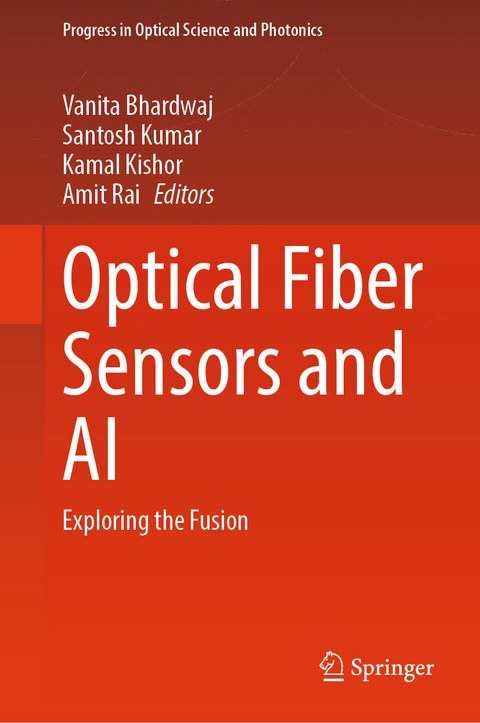
This book highlights the exciting developments in optical fiber sensors and how artificial intelligence (AI) is boosting their performance and applications. It starts with an easy-to-understand introduction to the basics of optical fiber sensors and their many uses. Then, it moves on to the latest technological advancements, showing how AI is making these sensors smarter and more efficient. The book contains chapters demonstrating how machine learning contributes to real-time data analysis and how deep learning enhances sensor systems. There is also a focus on designing better sensor networks with the help of AI. The book explains how combining AI with the Internet of Things (IoT) and optical fiber sensors can create smart infrastructure solutions. Real-world case studies illustrate how AI-enhanced fiber-optic sensors are benefiting fields like healthcare and environmental monitoring. The book wraps up with a look at future trends and challenges in the world of AI-powered optical fiber sensing. This book is perfect for researchers, engineers, and anyone interested in the powerful combination of AI and optical fiber technology. It provides valuable insights into how these technologies can work together to create innovative and practical solutions.
This book highlights the exciting developments in optical fiber sensors and how artificial intelligence (AI) is boosting their performance and applications. It starts with an easy-to-understand introduction to the basics of optical fiber sensors and their many uses. Then, it moves on to the latest technological advancements, showing how AI is making these sensors smarter and more efficient. The book contains chapters demonstrating how machine learning contributes to real-time data analysis and how deep learning enhances sensor systems. There is also a focus on designing better sensor networks with the help of AI. The book explains how combining AI with the Internet of Things (IoT) and optical fiber sensors can create smart infrastructure solutions. Real-world case studies illustrate how AI-enhanced fiber-optic sensors are benefiting fields like healthcare and environmental monitoring. The book wraps up with a look at future trends and challenges in the world of AI-powered optical fiber sensing. This book is perfect for researchers, engineers, and anyone interested in the powerful combination of AI and optical fiber technology. It provides valuable insights into how these technologies can work together to create innovative and practical solutions.
| Erscheint lt. Verlag | 2.7.2025 |
|---|---|
| Reihe/Serie | Progress in Optical Science and Photonics |
| Zusatzinfo | XIV, 196 p. 36 illus., 35 illus. in color. |
| Sprache | englisch |
| Themenwelt | Informatik ► Theorie / Studium ► Künstliche Intelligenz / Robotik |
| Mathematik / Informatik ► Mathematik ► Statistik | |
| Naturwissenschaften ► Chemie ► Analytische Chemie | |
| Naturwissenschaften ► Physik / Astronomie | |
| Technik ► Elektrotechnik / Energietechnik | |
| Schlagworte | AI-Augmented Optical Fiber Sensing • AI-enhanced Optical Fiber Sensing • Deep learning • Internet of Things (IoT) • machine learning • Optical Fiber Sensors in Environmental Monitoring • Optical Fiber Sensors in Healthcare • Real-Time Data Analysis in Fiber Optic Sensing • Sensor technology • Signal Processing in Optical Fiber Sensors |
| ISBN-10 | 981-96-6158-7 / 9819661587 |
| ISBN-13 | 978-981-96-6158-9 / 9789819661589 |
| Informationen gemäß Produktsicherheitsverordnung (GPSR) | |
| Haben Sie eine Frage zum Produkt? |
 PDF (Wasserzeichen)
Größe: 9,3 MB
DRM: Digitales Wasserzeichen
Dieses eBook enthält ein digitales Wasserzeichen und ist damit für Sie personalisiert. Bei einer missbräuchlichen Weitergabe des eBooks an Dritte ist eine Rückverfolgung an die Quelle möglich.
Dateiformat: PDF (Portable Document Format)
Mit einem festen Seitenlayout eignet sich die PDF besonders für Fachbücher mit Spalten, Tabellen und Abbildungen. Eine PDF kann auf fast allen Geräten angezeigt werden, ist aber für kleine Displays (Smartphone, eReader) nur eingeschränkt geeignet.
Systemvoraussetzungen:
PC/Mac: Mit einem PC oder Mac können Sie dieses eBook lesen. Sie benötigen dafür einen PDF-Viewer - z.B. den Adobe Reader oder Adobe Digital Editions.
eReader: Dieses eBook kann mit (fast) allen eBook-Readern gelesen werden. Mit dem amazon-Kindle ist es aber nicht kompatibel.
Smartphone/Tablet: Egal ob Apple oder Android, dieses eBook können Sie lesen. Sie benötigen dafür einen PDF-Viewer - z.B. die kostenlose Adobe Digital Editions-App.
Buying eBooks from abroad
For tax law reasons we can sell eBooks just within Germany and Switzerland. Regrettably we cannot fulfill eBook-orders from other countries.
aus dem Bereich