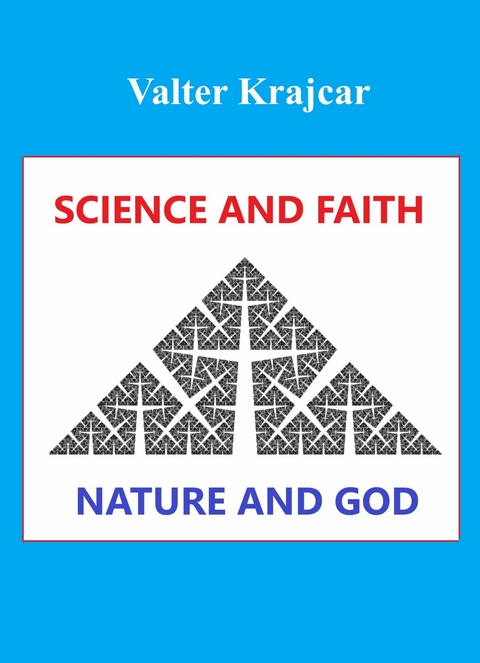
Science and Faith, Nature and God (eBook)
192 Seiten
Publishdrive (Verlag)
978-0-00-077189-6 (ISBN)
Are you struggling to reconcile your scientific understanding with your religious beliefs? Do you feel torn between the empirical world of science and the spiritual realm of faith? In this groundbreaking exploration, a physicist who has walked both paths reveals how these seemingly conflicting worldviews can coexist and enrich each other.
Drawing from his unique position as both a physicist at the prestigious Rudjer Boskovic Institute and a devout Catholic, Valter Krajcar takes readers on a profound journey through the intersection of science and faith. Through personal narrative, scientific expertise, and theological insight, he systematically dismantles the perceived barriers between these two domains. From quantum mechanics to religious doctrine, from the anthropic principle to biblical wisdom, Krajcar demonstrates how modern scientific discoveries can actually deepen our understanding of God and spirituality. His work, endorsed by both leading physicists and theologians, offers a fresh perspective on age-old questions about existence, purpose, and the nature of reality.
This isn't just another book about science and religion - it's a roadmap for anyone seeking to bridge the gap between empirical knowledge and spiritual truth. Krajcar's unique synthesis offers a path forward for both the scientifically minded believer and the spiritually inclined scientist.
Unlock the harmony between science and faith - get your copy today and begin your journey toward a more complete understanding of reality.
Courage for a contemporary synthesis
It took a lot of scientific and religious courage to write a book like this. Because this belongs to the future, and at first glance it may seem like the past. An average well-informed theologian who was educated in the second half of the 20th century, after leafing through the book, they will probably say that it is very apologetic. This, of course, is not contemporary. However, upon closer reading, any better connoisseur of modern natural sciences will discover that the author is a well-informed scientist who dares to proclaim the future of a new interpenetration of natural sciences and theology, that is, a natural and religious understanding of the entire reality. It is fortunate that as a scientist he is systematically professional, sovereignly master a multitude of state-of-the-art data, and as a believer he is firmly informed, far from superficiality and is orthodox without contempt. If he were an expert in theology, he probably would not dare to engage in it. Namely, contemporary theologians for the most part do not expect and do not seek the synthesis of natural sciences and theology, they have given up on it, believing that they have freed themselves from this naïve apologetic temptation. It could be said that a relationship like the separation of Church and State, between the natural sciences and theology was finally established. Science is a layman. This is not in conflict with religion. They are guarded against crossing each other's boundaries. Science has nothing against God, nor theology against free inquiry and scientific progress. A scientist does not need God to do science, just as a theologian does not need to know the latest results of natural research. They both pay attention to it elegantly, no one wants to be charlatan. So it happens that top theologians in terms of natural sciences are at the high school level, and top scientists in religious matters are at the level of First Communion.
It should be admitted that there are theologians who, after theological studies, also received their doctorates at natural sciences and mathematics faculties. When it comes to subjects that are more directly related to ethics, such as some areas of medicine, genetic engineering and the like, they - whether they like it or not - easily become moralistic guardians of boundaries beyond which scientific research should not cross, looking for ways “to keep the wolf full and the goat whole”, that is, to point out ways on which a conflict with undoubted ethical norms could be avoided.
While experts behave in this way, uneducated people who are neither naturalists nor theologians bypass conflicts without fully thinking about the issues that may arise on them. Only sometimes one of the journalists in this group loses his elegant caution and questions emerge from him that he thinks believers, even theologians, cannot meaningfully answer. For example, recently we could read in a Zagreb newspaper that educators in a religious kindergarten will find themselves in trouble if a child asks them: “Is it certain that God is a man?, How did Jesus perform a stunt with a fish?, Is he white?, What does it mean for those who are not?, Where is the hidden soul and do the saints watch television?...”. I suppose he assumes that adult skeptics are well-behaved so that they would not torment religious acquaintances with such questions, but with children you never know. A theologian, unless he himself is a very lively journalist who as such is eager for an opportunity, most likely does not fall for the glue because that would mean a return to the time of defensive apologetics and would not be tasty at all.
All this is mostly known and predictable, but it may be forgotten that it is a consequence of the destruction of the medieval geocentric picture of the world in which God, without denying his omnipotence, could be placed in the celestial spaces behind the last sphere of fixed stars, while angels could move all other spheres and act in general instead of the found forces of nature. In those old times, the believer could conceive scientifically and theologically the world and religious belief as a worldview (Weltanschaung) coincided with the scientific picture of the world (Weltbild). It is not surprising that the official Church has been afraid of the new results of the natural sciences for too long, putting heliocentrism and evolution on the index. If it threatened the faith of the broad classes, it might be considered injurious to human salvation, and yet man was created to save the soul first, that is, to secure his eternal life, and not to know how the universe was organized. In addition, it must be recognized that the realization that the Earth is not at the center of the universe could support the opinion that man is not as important as the Church teaches, that teaching about the animal origin of man could also compromise the awareness of human dignity, favoring those - for example, all racists - who wanted to treat some people as animals. It took time for the Church to understand that the new results of science do not diminish but even emphasize the dignity and importance of each individual human person. Then opposition to the progress of science ceased and a state of peace, or at least a truce, was reached. To avoid conflicts, the boundaries are not crossed and are generally set tacitly. In principle, the Church stopped being afraid of the results of the natural sciences, and scientists began to behave as if they were not really interested in theology, so they could not be bothered by this. But in the end, it must be admitted that a thinking man cannot be satisfied with this, that this division into two separate areas of human thought is unnatural. In the rift thus created, there was room especially for political manipulation of both religion and science. That is why there could be no place for religious education in communist countries, and believers could flare up against members of other political or national groups as “opponents of God” without much thought.
It must be admitted that even in our day there have been a few top naturalists who have dared to think about God based on their scientific knowledge. It is much more difficult to find a theologian who dealt with natural sciences, and those who dared to do so in the middle of the century in our midst, such as Marijan Blazevic and Bozo Vuca, are rarely mentioned anymore. As clear and consolidated as contemporary views on the relationship between faith and science may seem, the fact is that young scientists, even if they remain so-called practical believers, do not think of faith scientifically or science as believers, that in many of them faith fades, that is, it becomes an irrational more or less emotional attitude that does not renounce out of fidelity to family and national heritage or noble childhood memories.
Finally, it must happen that people dare to ask themselves whether this must be so, whether these two areas of thought must be so strictly separated as if they were taboo subjects for each other. Valter Krajcar dared not only to say this question, but also to dive deeply and professionally into it. His picture of the world is truly contemporary, highly professional. From the Big Bang at the beginning of time to the present day, nothing has been skipped, nothing has been bypassed, not a single problem has been eliminated. He knows everything a modern scientist can know. Those who have remained at the level of high school knowledge in these areas cannot follow it effortlessly. The average modern intellectual stops thinking as soon as he must think about multidimensional spaces that he cannot imagine, about many of the smallest particles that are known only from mathematical equations and without which the modern universe cannot be thought. He is reluctant to hear that no one really knows what matter is and what is force and the like.
Krajcar is equally confident in the field of biology, the theory of the origin and development of life on Earth. He does not need God as a scientific prerequisite to fill in the unexplored gaps, but the thought of God arises from all that thinking. A great, omnipotent and intellectual Freedom that wanted the initial Big Bang to leave particles to collide, mix and merge freely over many billions of years according to the laws of probability, and to draw out of this “deterministic chaos” a man with whom to associate and rule this wondrous world.
It should be said that in the meantime, biblical science has developed and popularized proportionately so that the average educated believer can penetrate its symbolism, distinguish literary genres and penetrate the core of its message. Krajcar, who is obviously familiar with this, most naturally transitions from natural sciences to theology, from nature to Revelation. He reveals how the Bible and modern science are mutually reinforcing. Not as if the natural sciences proved the existence of God. He simply meets, meets on this path of getting to know the whole reality. It does not serve to conceal unresolved questions, but to recognize it more and more concretely in the events of this “deterministic chaos”, of directed probability, of the original freedom from which various regularities at different levels of observation spring. As if everything from the first movement of particles could have been different, and the reason that the evolution of the universe went exactly in this direction could only have been the Will that wanted the particles, atoms and molecules, galaxies and stars in them to be born from the Big Bang, for the planet Earth to dance around one star, for everything to be chaotic over millions of years and still achieve the expected goal: man.
For many theologians and faithful of older formation in general, reading this book...
| Erscheint lt. Verlag | 2.4.2025 |
|---|---|
| Sprache | englisch |
| Themenwelt | Technik |
| ISBN-10 | 0-00-077189-9 / 0000771899 |
| ISBN-13 | 978-0-00-077189-6 / 9780000771896 |
| Informationen gemäß Produktsicherheitsverordnung (GPSR) | |
| Haben Sie eine Frage zum Produkt? |
 EPUB (Adobe DRM)
Größe: 1,8 MB
Kopierschutz: Adobe-DRM
Adobe-DRM ist ein Kopierschutz, der das eBook vor Mißbrauch schützen soll. Dabei wird das eBook bereits beim Download auf Ihre persönliche Adobe-ID autorisiert. Lesen können Sie das eBook dann nur auf den Geräten, welche ebenfalls auf Ihre Adobe-ID registriert sind.
Details zum Adobe-DRM
Dateiformat: EPUB (Electronic Publication)
EPUB ist ein offener Standard für eBooks und eignet sich besonders zur Darstellung von Belletristik und Sachbüchern. Der Fließtext wird dynamisch an die Display- und Schriftgröße angepasst. Auch für mobile Lesegeräte ist EPUB daher gut geeignet.
Systemvoraussetzungen:
PC/Mac: Mit einem PC oder Mac können Sie dieses eBook lesen. Sie benötigen eine
eReader: Dieses eBook kann mit (fast) allen eBook-Readern gelesen werden. Mit dem amazon-Kindle ist es aber nicht kompatibel.
Smartphone/Tablet: Egal ob Apple oder Android, dieses eBook können Sie lesen. Sie benötigen eine
Geräteliste und zusätzliche Hinweise
Buying eBooks from abroad
For tax law reasons we can sell eBooks just within Germany and Switzerland. Regrettably we cannot fulfill eBook-orders from other countries.
aus dem Bereich