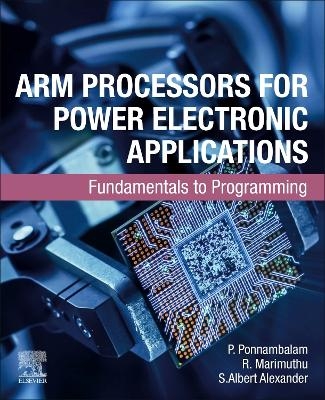
ARM Processors for Power Electronic Applications
Elsevier - Health Sciences Division (Verlag)
978-0-443-33094-0 (ISBN)
- Noch nicht erschienen (ca. August 2026)
- Versandkostenfrei
- Auch auf Rechnung
- Artikel merken
P. Ponnambalam is a Professor & Head of Department for Energy and Power Electronics Department, School of Electrical Engineering, at VIT Vellore, India. He obtained his B.E in Electrical and Electronics Engineering from Madurai Kama Raj University, his M.E in Power Electronics and Drives from Anna University Chennai, and his Ph.D. from the Anna University Chennai. His area of interest is embedded controllers for Power Converters, Hybrid PV-TEG systems, Fuzzy Controllers for power electronic applications. He has handled the subject Advanced Processors for Power converters multiple times for MTech Power Electronics and Drives students and hence he has a sound knowledge in programming embedded controllers. He has guided the students for the doctoral degree in the area of power electronics. He has conducted workshops and lectures in the field of embedded systems and programming with ARM processor. R. Marimuthu, Associate Professor (Sr.,), School of Electrical Engineering, Vellore Institute of Technology, Vellore. He received bachelor’s degree in Electronics and Instrumentation from Bharathiyar University, Coimbatore and the master’s degree from Anna University, Chennai, and Ph.D. degree from VIT, Vellore. His research title is “Design of Low Power and High-Speed Compressors for Multipliers. He has published more than 50 research publications in various reputed journals & conferences. His area of interest are Embedded systems, Approximate Computing, and Renewable Energy Sources. He has given many invited talks & good knowledge in embedded programming. Dr. S. Albert Alexander is at the Department of Electrical and Electronics Engineering, Kongu Engineering College, Perundurai. He is a post doctoral Research Fellow from Northeastern University, Boston, Massachusetts. He is a recipient of Raman Research Fellowship from the University Grants Commission. His current research focuses on fault diagnostic systems for solar energy conversion systems and smart grids. He has 14 years of academic and research experience. He has published 25 technical papers in international and national journals and presented 23 papers at national and international conferences.
SECTION 1. ARM Fundamentals
1. Introduction
2. Number Systems
3. Hexadecimal Representation
4. Reduced Instruction Set Computer (RISC)
5. ARM Architecture
6. Registers
7. Program Status Register (PSR)
8. Processor Modes
9. Pipeline
10. Vector Tables
11. Sample design exercises
SECTION 2. Instruction Sets
12. Introduction
13. Instruction set format
14. Addressing Modes
15. Data Processing Instructions
16. Branch Instructions
17. Load Store Instructions
18. Program Status Register Instructions
19. Co-Processor Instructions
20. Sample design exercises
SECTION 3. General Purpose Input Output (GPIO)
21. Introduction
22. Features of GPIO
23. Registers of GPIO
24. Programming with GPIO
25. LED Blinking
26. Changing the time delay of LED blinking based on input port
27. Fast GPIO
28. Programming with Fast GPIO
29. Design exercises
SECTION 4. Digital to Analog Converter
30. Introduction
31. Features of DAC
32. Registers of DAC
33. Programming with DAC
34. Saw-tooth waveform
35. Triangular Waveform
36. Sinewave
37. Sample design exercises
SECTION 5. Analog to Digital Converter
38. Introduction
39. Features of ADC
40. Registers of ADC
41. Programming with ADC
42. Software Controlled Mode
43. Burst Mode
44. Start conversion from external source
45. Design examples
SECTION 6. Timers
46. Introduction
47. Features of Timers
48. Registers of Timers
49. Programming with Timers
50. Generating triggering pulse for step down chopper
51. Generating triggering pulse for single phase half-controlled converter
52. Generating triggering pulse for single phase AC voltage controller
53. Generating triggering pulse for single phase full bridge inverter
54. Generating triggering pulse for three phase inverters
55. Generating triggering pulse for cycloconverter
56. Generating square waves using Timer Match
57. Measuring the time taken for a square wave using Timer capture
58. Design examples
SECTION 7. PWM
59. Introduction
60. Features of PWM
61. Registers of PWM
62. Programming with PWM
63. Single edge mode
64. Double edge mode
65. Generating PWM based triggering pulse for single phase full bridge inverter
66. Examples
SECTION 8. Exceptions in ARM processor
67. Introduction
68. Exceptions
69. Vectored Interrupt Controller (VIC)
70. External Interrupt
71. Programming with External Interrupt
72. Generating triggering pulse for step down chopper and varying the duty ratio using external interrupt
73. Generating triggering pulse for single phase full bridge inverter and varying the frequency using external interrupt
74. Timer Interrupt
75. Programming with Timer Interrupt
76. Generating triggering pulse for single phase full bridge inverter using timer interrupt
77. Generating triggering pulse for single phase full bridge inverter using timer interrupt and varying the frequency using external interrupt
78. PWM Interrupt
79. Programming with PWM Interrupt
80. Single edge PWM with PWM Interrupt
81. Double edge PWM with PWM Interrupt
82. ADC Interrupt
83. Programming with ADC Interrupt
84. Using ADC interrupt to control the speed of chopper-controlled DC motor based on the input analog signal fed to ADC
85. Examples
SECTION 9. Universal Asynchronous Receiver Transmitter (UART)
86. Introduction
87. Features of UART
88. Registers of UART
89. Programming with UART
90. Programming ARM processor to remotely control the chopper-controlled DC motor
91. Examples
SECTION 10. Watch Dog Timer (WDT)
92. Introduction
93. Features of WDT
94. Registers of WDT
95. Programming with Watch Dog Timer (WDT)
96. Programming ARM processor to reset the processor when the watch dog timer overflows
97. Programming WDT interrupt
98. Matrix converter
SECTION 11. Inter Integrated Circuits (I2C) Communication
99. Introduction
100. Features of I2C
101. Registers of I2C
102. Programming with I2C
103. Programming the I2C to interface multiple sensors
104. Examples
SECTION 12. Serial Peripheral Interface (SPI)
105. Introduction
106. Features of SPI
107. Registers of SPI
108. Programming with SPI
109. Programming the SPI to interface multiple microcontrollers
110. Examples
SECTION 13. Real Time Clock (RTC)
111. Introduction
112. Features of RTC
113. Registers of RTC
114. Programming with RTC
115. Examples
| Erscheint lt. Verlag | 1.8.2026 |
|---|---|
| Verlagsort | Philadelphia |
| Sprache | englisch |
| Maße | 191 x 235 mm |
| Themenwelt | Mathematik / Informatik ► Informatik ► Theorie / Studium |
| Informatik ► Weitere Themen ► Hardware | |
| Technik ► Elektrotechnik / Energietechnik | |
| ISBN-10 | 0-443-33094-8 / 0443330948 |
| ISBN-13 | 978-0-443-33094-0 / 9780443330940 |
| Zustand | Neuware |
| Informationen gemäß Produktsicherheitsverordnung (GPSR) | |
| Haben Sie eine Frage zum Produkt? |
aus dem Bereich