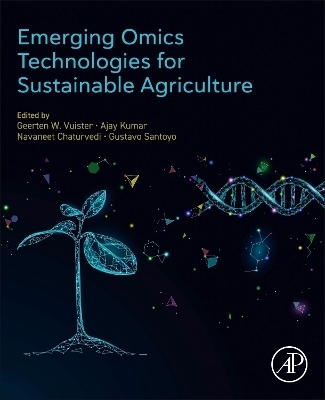
Emerging Omics Technologies for Sustainable Agriculture
Academic Press Inc (Verlag)
978-0-443-40316-3 (ISBN)
- Noch nicht erschienen (ca. Februar 2026)
- Versandkostenfrei
- Auch auf Rechnung
- Artikel merken
The integration of genomics, transcriptomics, proteomics, and metabolomics has advanced the understanding of plant and microbial systems and the application of this knowledge has enabled precision farming, optimizing crop yield and minimizing environmental impact. There are unprecedented opportunities to enhance crop yields, improve pest and disease management, to optimize resource utilization and to mitigate environmental impacts. Through the use of advanced data analytics, machine learning, and predictive modeling, researchers can decipher complex biological processes and develop innovative solutions for agricultural challenges.
Emerging Omics Technologies for Sustainable Agriculture explores the advancements in AI-driven omics technologies, such as genome editing, transcriptomics, and phenomics, and their applications in crop improvement, soil health monitoring, and precision agriculture.
Geerten W. Vuister holds a chair position in Structural Biology at the Institute for Structural and Chemical Biology of the University of Leicester and is an honorary professor at the University of Birmingham, associated with the UK National NMR facility. Professor Vuister also chairs the Collaborative Computational Project for NMR (CCPN), a long-standing, international, UKRI-funded project to support biomolecular NMR with software tools, training and establishing best-practices. His research focuses on biomolecular data analysis, including artificial intelligence and machine learning approaches, data remediation, and harvesting for omics type repositories and data exchange. As member of the world-wide PDB (wwPDB) validation task force and member of the working group on integrative structures, and as chair of the NMR-exchange working group, he is directly involved in efforts to leverage the information that can be obtained from integrated omics approaches. Professor Vuister has published over 130 peer-reviewed articles, including in Nature Struct. Mol. Bio., Nature Methods, Structure, J. Am. Chem. Soc., PNAS, Scientific Reports, Mol. Cell and Front. Mol. Biosci. Dr. Ajay Kumar is currently working as an assistant professor at Amity Institute of Biotechnology, Amity University, Noida, India. Dr. Kumar recently completed his tenure as a visiting scientist from Agriculture Research Organization, Volcani Center, Israel. He has published more than 175 research, review articles, and book chapters in international and national journals. He serves as an associate editor for Frontiers in Microbiology and as guest editor for various journals such as Plants, Microorganisms, and Sustainability. Dr. Kumar has also edited more than 32 books with the leading publishers such as Elsevier, Springer, and Wiley. Dr. Kumar has wide area of research experience, especially in the field of plant-microbe Interactions, microbial biocontrol, Postharvest management of fruits, microbial endophytes related to medicinal plants and cyanobacteria-pesticides interactions. Navaneet Chaturvedi is an assistant professor at the Amity Institute of Biotechnology, Amity University, Noida, India. He has established a robust foundation, acquiring essential skills that position him well for success in a research-intensive role within the institute. With 7.5 years of experience, Dr. Chaturvedi is enthusiastic about making substantial contributions to the esteemed research community. His research spans across various institutions globally, including Tel Aviv University (Israel), IIT(BHU) India, University of Information Science & Tech North Macedonia, University of Leicester (UK), and PharmCADD in South Korea. These diverse experiences have allowed him to collaborate with multidisciplinary teams, fostering a culture of innovation and excellence. His expertise encompasses molecular dynamics (MD) simulation, molecular docking, free energy calculation, machine learning, protein folding, and computer-aided drug design. Dr. Chaturvedi has authored approximately 25 scientific contributions, and this number continues to grow. These contributions take the form of research and review articles as well as book chapters, published with leading international journals and publishers. Gustavo Santoyo is a Professor of Agrogenomics at the Institute of Chemical and Biological Research, Universidad Michoacana de San Nicolás de Hidalgo, Mexico. He holds two BSc degrees, one in Biology and the other in Psychology. He earned his PhD in Biomedical Sciences from the National Autonomous University of Mexico (UNAM). Dr. Santoyo conducted postdoctoral studies at the Center for Cancer Research, The National Institutes of Health, USA, and was a visiting professor at Wilfrid Laurier University, Canada. His current research focuses on elucidating plant–soil–microbe interactions and on investigations in agrogenomics. He is a prolific book author/editor and journal reviewer. He serves as a Special Content Editor for Microbiological Research (Elsevier) and as an Associate Editor for Frontiers in Plant Sciences (Frontiers), Journal of Advanced Research (Elsevier), and Antonie van Leeuwenhoek (Springer). He is a member of the Mexican Academy of Sciences and holds the Nivel III distinction in the Sistema Nacional de Investigadores of Mexico. In 2024, he received the State Award for Science, Technology, and Innovation, granted by the Government of the State of Michoacán.
1. Introduction to emerging omics technologies and sustainable agricultural practices
2. Diagnosis of plant diseases using artificial intelligence tools
3. Comparative genomics: insights into enhancing disease resistance in crops
4. Insights into bioinformatics tools for crop improvement
5. Genomic approaches for disease resistance in crops: a comparative study
6. Microbiome dynamics in agricultural systems: from root-microbe interactions to sustainable practices
7. Microbial threats in agricultural crops and their management through artificial intelligence approaches
8. Agriculture meets artificial intelligence: revolutionizing farming practices through technology
9. Predicting crop yields with machine learning
10. Metagenomics and the soil microbiome: shaping the future of sustainable agriculture
11. Introduction to technological advancement in smart farming practices
12. Climate-resilient agriculture: harnessing cutting-edge technologies for innovation
13. Introduction, challenges and applications of artificial intelligence and the Internet of Things for sustainable agriculture
14. Role of cryopreservation procedure for viruses’ eradication in horticulture
15. Emerging omics technologies to combat herbicide-resistant weeds
| Erscheint lt. Verlag | 1.2.2026 |
|---|---|
| Verlagsort | San Diego |
| Sprache | englisch |
| Maße | 191 x 235 mm |
| Gewicht | 450 g |
| Themenwelt | Technik ► Umwelttechnik / Biotechnologie |
| ISBN-10 | 0-443-40316-3 / 0443403163 |
| ISBN-13 | 978-0-443-40316-3 / 9780443403163 |
| Zustand | Neuware |
| Informationen gemäß Produktsicherheitsverordnung (GPSR) | |
| Haben Sie eine Frage zum Produkt? |
aus dem Bereich