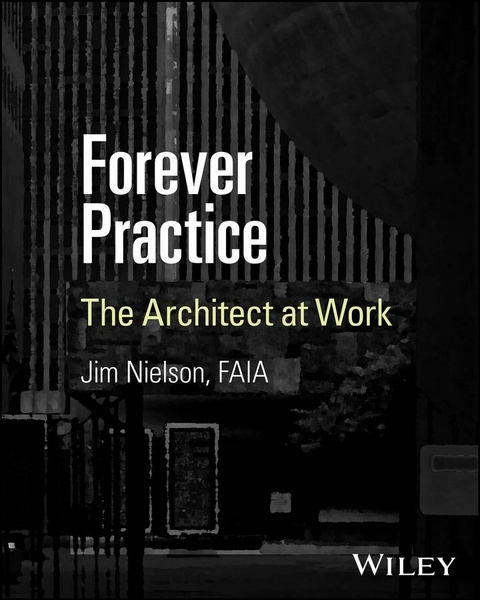
Forever Practice (eBook)
427 Seiten
Wiley (Verlag)
978-1-394-32438-5 (ISBN)
A Practical Guide to the Career and Practice of Architecture
Where will architecture take you? Find answers in Forever Practice: The Architect at Work, a thoughtful and accessible book by author Jim Nielson, FAIA. Drawn from decades of experience and study, this engaging new book immerses the reader in best practices and proven tools for success.
In 28 brisk chapters, this book lends readers a glimpse of the architect in practice. It instills confidence and purpose. The author demystifies the profession, crafting his narrative-about licensure, project management, sustainability, and so much more-from the fodder of experience, case studies, and savvy. Empowering readers to embrace their role (or their future) as a practitioner, Forever Practice: The Architect at Work:
- Offers concrete steps for leading a collaborative team from project conception through completion
- Includes a wealth of insights and lessons learned to prepare readers for challenges in the field
- Features practice management tools and discussion topics for classroom and independent learning
- Addresses key professional standards, including codes of conduct, ethics, and the standard of care
Forever Practice: The Architect at Work is perfect for architecture students enrolled in professional practice courses. It is also ideal for early-career professionals and seasoned practitioners seeking to deepen their understanding of practice management and design team leadership.
'In this book, Forever Practice: The Architect at Work, Jim Nielson, FAIA undertakes the task of introducing the reader to those business skills an emerging architectural professional, as well as a more seasoned professional, needs to succeed over a long career. It's all there, plus additional resources to explore these topics more deeply. After reading this book, you'll want to keep it near your computer as a valued reference.'
-RK Stewart, FAIA, Hon FRAIC, Hon JIA, Hon AIA, 2007 AIA National President
'I wish I had had Jim's book when I was in practice.'
- John S. Reynolds, FAIA, Emeritus, Professor Emeritus, University of Oregon, Co-author, Mechanical and Electrical Equipment for Buildings
'For years Jim has played an active role in the regulatory process governing the profession of architecture at the local and national level. This book helps readers - from aspiring architects to seasoned practitioners - come to understand the general requirements of licensure and professional practice.'
- Harry M. Falconer, Jr., FAIA, NCARB, HonD BAC, Hon FCARM, Former Senior Architect | Vice President, Policy + International Relations, NCARB
Jim Nielson, FAIA, is a mentor to students and fellow architects. He designed the professional practice course he has been teaching at Utah Valley University. This book is a product of wide-ranging project and practice management experience. Jim applies that same experience in joining professionals, elected officials, and others across the US and Canada to support NCARB, NAAB, AIA, and non-profit groups seeking to serve the profession and its values. Jim serves on the Board of Governors of Envision Utah, an influential visioning powerhouse active in many markets locally and around the country. He has been a state legislator, real estate developer, architect licensing board member, and expert consultant on construction defects cases. He has published dozens of newspaper columns, and his public policy work has been cited in Business Week.
A Practical Guide to the Career and Practice of Architecture Where will architecture take you? Find answers in Forever Practice: The Architect at Work, a thoughtful and accessible book by author Jim Nielson, FAIA. Drawn from decades of experience and study, this engaging new book immerses the reader in best practices and proven tools for success. In 28 brisk chapters, this book lends readers a glimpse of the architect in practice. It instills confidence and purpose. The author demystifies the profession, crafting his narrative about licensure, project management, sustainability, and so much more from the fodder of experience, case studies, and savvy. Empowering readers to embrace their role (or their future) as a practitioner, Forever Practice: The Architect at Work: Offers concrete steps for leading a collaborative team from project conception through completionIncludes a wealth of insights and lessons learned to prepare readers for challenges in the fieldFeatures practice management tools and discussion topics for classroom and independent learningAddresses key professional standards, including codes of conduct, ethics, and the standard of care Forever Practice: The Architect at Work is perfect for architecture students enrolled in professional practice courses. It is also ideal for early-career professionals and seasoned practitioners seeking to deepen their understanding of practice management and design team leadership. In this book, Forever Practice: The Architect at Work, Jim Nielson, FAIA undertakes the task of introducing the reader to those business skills an emerging architectural professional, as well as a more seasoned professional, needs to succeed over a long career. It s all there, plus additional resources to explore these topics more deeply. After reading this book, you ll want to keep it near your computer as a valued reference. RK Stewart, FAIA, Hon FRAIC, Hon JIA, Hon AIA, 2007 AIA National President I wish I had had Jim s book when I was in practice. John S. Reynolds, FAIA, Emeritus, Professor Emeritus, University of Oregon, Co-author, Mechanical and Electrical Equipment for Buildings For years Jim has played an active role in the regulatory process governing the profession of architecture at the local and national level. This book helps readers from aspiring architects to seasoned practitioners come to understand the general requirements of licensure and professional practice. Harry M. Falconer, Jr., FAIA, NCARB, HonD BAC, Hon FCARM, Former Senior Architect | Vice President, Policy + International Relations, NCARB
Chapter 1
Caring About the World We Live In
On a job-hunting trip shortly before completing his architecture degree, a future architect scored an interview with the lead in-house architect for a large organization. His group wasn’t hiring, but the gentleman graciously continued with a few thoughts about his city and its leading architecture firms.
At one point, the senior architect said to the job seeker rather abruptly, “Architecture is a jealous master. It can take over your life.” He wondered whether the prospective architect was up to the task of balancing his life as an architect with family, community, avocations, and other passions. The field was all-consuming, he told him. If allowed to do so, architecture could easily overshadow everything else this aspiring professional cared about.
Architecture is both demanding and rewarding. Often, those that pursue it can’t help but fall under its spell. Sometimes they just don’t know when to quit.
He’d Keep Designing
“What would an architect do if he suddenly received a million dollars?” I think I was in architecture school when I first heard this quip.
“He’d keep designing until he had spent it all.”
Ask yourself
What is it that makes architecture students pull all-nighters on studio projects? What makes architects polish a Monday design presentation all weekend long?
If they think about it, practitioners may say the reason the profession of architecture often takes over an architect’s life is that almost every task an architect undertakes is so complex that in all her professional pursuits, the architect may never quite reach a point where she’s got it down—where there’s nothing left to figure out. Architects will generally agree that every task an architect completes, whether design, documentation, marketing, or mentoring, could still be improved, extended, or embellished. There is always more that could be done.
Architects tend to be possessed of a perpetual consciousness that they could improve their work further if they just kept at it a little longer. Few are those that recognize when it’s time to quit.
Perhaps Architects Care Too Much
Architects may have important skills that others do not:
- An architect is often skilled at seeing solutions to problems that are not obvious
- In practice, architects learn to be unusually good at leading a team of experts
- Architects generally have training and experience they can apply in designing elegant solutions
- Experienced architects may also possess the uncanny ability to understand the big picture very quickly—to recognize instantly the many factors members of their team must work through to craft a successful project
Even if some architects don’t possess special skills such as these, most architects tend to have the self-confidence to convince themselves that their own personal skillsets are a cut above those of contractors, city officials, developers, facilities managers, bankers, and pretty much everyone. So, with sincere confidence in their own unique gifts, experienced architects may forge ahead as if their skills did stand a world apart.
Skills or no skills, because architects usually care deeply about the built environment, they often do feel a burden to put the skills they have to use in the interest of society. In a way, many architects see it as a duty to protect those around them from the dreadful impact of living, working, and playing in badly designed spaces.
For instance, consider the following case studies, based on the experiences of architects dealing with real-world challenges. As is the case throughout this book, identifying information has been removed from these accounts to ensure anonymity.
Example #1
Tom was part of the design team working on a large project near the center of a good-sized city. Tom’s architecture group had teamed with an out-of-town firm for this project; Tom headed up on-site construction administration work, including shop-drawing review. The work was at the corner of two busy streets, where the city would also be doing sidewalk and utility improvements under separate contracts.
So as not to affect traffic more than necessary, the city scheduled its sidewalk and utility work at that corner concurrently with construction on the building. They engaged the contractor Tom was working with to do this separate, off-site construction, as well.
Tom and his firm weren’t involved in designing utility work at the corner, but he was well aware of it. Even though his design team had no contractual responsibility to take the city’s separate efforts into account in their work, he felt that coordinating with the city made sense.
The city’s construction work included upgrades to the roadway, curb and gutter, walks, lights, traffic signals, and signage. When Tom saw a coordination drawing outlining the city’s offsite work pinned up in the contractor’s trailer one afternoon, he was dismayed. At the edge of the sidewalk, the design called for a signpost, a light pole, and a traffic signal pole: three separate elements. All of this visual clutter would interrupt the view of the pedestrian crossing the street, partially blocking visibility of the main entry to the new building Tom and his partner firm were working on.
Tom couldn’t let go of his concerns. Without getting a go-ahead from his principal in charge, from the city, or from anyone else, he started working on a solution. He gathered dimensional information and made related comments in his notebook while in the contractor’s trailer. Back at the office, he sketched options, picked the best solution, drew it up, and offered it to the city’s civil/utilities project manager as a suggestion. His solution gathered all three verticals—traffic signal pole, light pole, and signpost—into a single element. And he showed how they could move the whole obstacle just a couple of feet to avoid blocking the line of sight to the entry from any point in the crosswalk.
Things were ultimately built just as Tom had sketched them.
Excellent work, right?
Ask yourself
What are the possible impacts of Tom’s decision to become involved in the design of this off-site work by the city? Consider both positives and negatives.
Example #2
American Institute of Architects (AIA) Contract Documents typically contain a requirement that architects rarely allow to play out. AIA Document A201-2017, General Conditions, for example, includes the following provision:
When the Contractor considers that the Work, or a portion thereof which the Owner agrees to accept separately, is substantially complete, the Contractor shall prepare and submit to the Architect a comprehensive list of items to be completed or corrected prior to final payment. (§ 9.8.2)
The document then goes on to describe responsibilities of the architect and owner to review, perhaps accept, and possibly add to the list—often called a punch list—before executing a Certificate of Substantial Completion.
This is how the AIA General Conditions of the contract divide up initial punch list responsibilities, even though some owner-contractor agreements may set things up differently.
But even with AIA conditions of the contract in place, things are rarely done that way. It turns out that tradition and the architect’s own insistence almost always lead to the architect preparing the punch list—first draft and every draft.
Ask yourself
Considering example #2, how would you respond to the following questions?
- How can the architect know for sure whose responsibility it is to prepare the punch list?
- What reasons might an architect have for taking over this responsibility of a contractor?
- What are the effects of this common tactic on the part of architects?
- How does this approach affect individual project team members and the team as a whole?
- If a contractor asks an architect, “When would you like to walk the site and prepare the punch list?” Knowing it’s the contractor’s responsibility to prepare the list, what might an appropriate and effective response look like?
Additional Resources
The Architect’s Handbook of Professional Practice1
| Chapter 9 | Design Project Delivery (P. 552, ¶ 1 & 2 “Scope Creep”) |
| 10.10 | Project Completion and Post-Construction |
| 16.4 | Dispute Management and Resolution (Pp. 1031, ¶ 6 “Scope Creep,” 1032, blue box text: “Playing Outside the Contract”) |
| ProPEL, ACSA Professional Practice Education Library (Videos for Classroom Use) |
| Failure Unit | Lesson 3 Architecture Dos and Don’ts (Time stamp 3:28 through 4:43 and 8:30 through the end of the video—“Don’t Give Away…Services.”) |
Author’s Note
A project he’d always dreamed of
Once, when my business partner showed me a Request for Proposals (RFP) that had been sent to him, he and I did a quick no-go/go check (see...
| Erscheint lt. Verlag | 26.6.2025 |
|---|---|
| Sprache | englisch |
| Themenwelt | Technik ► Architektur |
| Schlagworte | Canada chef training • Canadian culinary education • cooking techniques • cooking theories • culinary school textbook • culinary skills • culinary techniques textbook • food preparation textbook • professional cooking textbook • professional kitchen methods |
| ISBN-10 | 1-394-32438-3 / 1394324383 |
| ISBN-13 | 978-1-394-32438-5 / 9781394324385 |
| Informationen gemäß Produktsicherheitsverordnung (GPSR) | |
| Haben Sie eine Frage zum Produkt? |
 EPUB (Adobe DRM)
Kopierschutz: Adobe-DRM
Adobe-DRM ist ein Kopierschutz, der das eBook vor Mißbrauch schützen soll. Dabei wird das eBook bereits beim Download auf Ihre persönliche Adobe-ID autorisiert. Lesen können Sie das eBook dann nur auf den Geräten, welche ebenfalls auf Ihre Adobe-ID registriert sind.
Details zum Adobe-DRM
Dateiformat: EPUB (Electronic Publication)
EPUB ist ein offener Standard für eBooks und eignet sich besonders zur Darstellung von Belletristik und Sachbüchern. Der Fließtext wird dynamisch an die Display- und Schriftgröße angepasst. Auch für mobile Lesegeräte ist EPUB daher gut geeignet.
Systemvoraussetzungen:
PC/Mac: Mit einem PC oder Mac können Sie dieses eBook lesen. Sie benötigen eine
eReader: Dieses eBook kann mit (fast) allen eBook-Readern gelesen werden. Mit dem amazon-Kindle ist es aber nicht kompatibel.
Smartphone/Tablet: Egal ob Apple oder Android, dieses eBook können Sie lesen. Sie benötigen eine
Geräteliste und zusätzliche Hinweise
Buying eBooks from abroad
For tax law reasons we can sell eBooks just within Germany and Switzerland. Regrettably we cannot fulfill eBook-orders from other countries.
aus dem Bereich