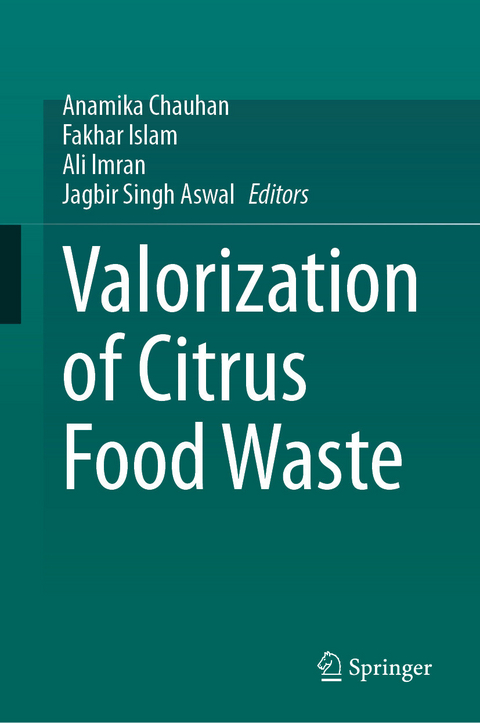
Valorization of Citrus Food Waste (eBook)
452 Seiten
Springer (Verlag)
978-3-031-77999-2 (ISBN)
The establishment of fruit juice companies in the 20th century marked the beginning of the widespread use of citrus fruits. Around 18% of the total citrus fruit production in the world is used industrially, primarily for the manufacture of juice. Citrus fruit consumption and interest are growing, and trash generation is also increasing, adding to the environmental load. Because of their unwanted and unsanitary character, discarding fruit segments without due care is hazardous to the environment. Producing citrus juice results in the creation of waste, which accounts for over 50% of the mass of fresh fruit. Peels, seeds pomace, and wastewater are all included in this waste. Fruit
peels, seeds, and pulp from ruined fruit are covered with citrus wastewater. About 10 million MT of trash are produced annually by the processing of citrus fruit worldwide, which poses a severe ecological problem. Citrus by-products are troublesome wastes because of their abundance and perishablenature. Citrus peels that are around 80%
water decay fast, attracting bugs, bacteria and mold. Citrus peel utilization is therefore essential for waste management and not only a means of boosting revenue. Citrus trash must be disposed of properly since improper disposal pollutes the land and water, further harming the aquatic habitat.
An efficient strategy for sustainable waste management is to use citrus wastes to create useful bioproducts. Numerous methods have been developed to boost the pectin recovery from citrus trash due to the continuously growing demand. Valorization of Citrus Food Waste presents the high-value compound in the citrus wastes and their extraction methods for obtaining the value-added products as well as their corresponding applications and will be useful to food scientists and industry members exploring the use of valorization process for waste fruits as new components and sources in nutraceuticals. Thisbook is a full of source for the valorization of citrus waste, the use of bioactive components and waste management.
| Erscheint lt. Verlag | 23.6.2025 |
|---|---|
| Zusatzinfo | IX, 452 p. 41 illus., 36 illus. in color. |
| Sprache | englisch |
| Themenwelt | Naturwissenschaften ► Chemie |
| Technik | |
| Schlagworte | Bioactive Compounds • Citrus food • Citrus waste • Peel waste management • valorization • value-added products |
| ISBN-10 | 3-031-77999-1 / 3031779991 |
| ISBN-13 | 978-3-031-77999-2 / 9783031779992 |
| Informationen gemäß Produktsicherheitsverordnung (GPSR) | |
| Haben Sie eine Frage zum Produkt? |
 PDF (Wasserzeichen)
DRM: Digitales Wasserzeichen
Dieses eBook enthält ein digitales Wasserzeichen und ist damit für Sie personalisiert. Bei einer missbräuchlichen Weitergabe des eBooks an Dritte ist eine Rückverfolgung an die Quelle möglich.
Dateiformat: PDF (Portable Document Format)
Mit einem festen Seitenlayout eignet sich die PDF besonders für Fachbücher mit Spalten, Tabellen und Abbildungen. Eine PDF kann auf fast allen Geräten angezeigt werden, ist aber für kleine Displays (Smartphone, eReader) nur eingeschränkt geeignet.
Systemvoraussetzungen:
PC/Mac: Mit einem PC oder Mac können Sie dieses eBook lesen. Sie benötigen dafür einen PDF-Viewer - z.B. den Adobe Reader oder Adobe Digital Editions.
eReader: Dieses eBook kann mit (fast) allen eBook-Readern gelesen werden. Mit dem amazon-Kindle ist es aber nicht kompatibel.
Smartphone/Tablet: Egal ob Apple oder Android, dieses eBook können Sie lesen. Sie benötigen dafür einen PDF-Viewer - z.B. die kostenlose Adobe Digital Editions-App.
Buying eBooks from abroad
For tax law reasons we can sell eBooks just within Germany and Switzerland. Regrettably we cannot fulfill eBook-orders from other countries.
aus dem Bereich