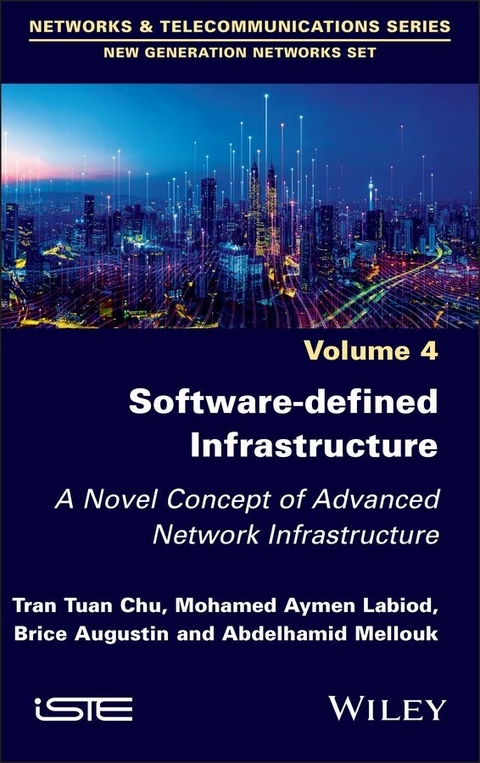
Software-defined Infrastructure (eBook)
224 Seiten
Wiley-Iste (Verlag)
978-1-394-38859-2 (ISBN)
Software-defined Infrastructure focuses on the cutting-edge shift in hardware deployment and communication management methods, which enable unified, scalable and adaptive network management to support Healthcare IoT (H-IoT) communication, where real-time data transmission is essential to system success. The book presents a novel network concept and solutions for tackling the challenges in key areas such as 5G, and beyond, in network management, multipath transport protocols and edge computing.
This book aims to simplify network management, improve remote patient monitoring communication and enhance patient outcomes. Through case studies and theoretical models, the book offers insights into the transformation of advanced networks in the H-IoT context and lays the foundation for innovative ideas in this research domain.
Tran Tuan Chu obtained his PhD from Paris-Est Créteil University (UPEC), France, in 2023. His research focuses on Software-Defined Infrastructure, and IoT-Digital Twins.
Mohamed Aymen Labiod is Associate Professor at UPEC, France. His research focuses on 5G and 6G architectures, network slicing, mobile and multiaccess networks and multi-connectivity, among other topics.
Brice Augustin is Associate Professor at UPEC, France. His research focuses on Quality of Experience (QoE) in 5G and cloud-based multimedia services, exploring adaptive network mechanisms and edge computing.
Abdelhamid Mellouk is Full-time University Professor, Director of the IT4H High School Engineering Department and Head of the TincNET Research Team, UPEC, France. He is also the founder of Network Control Research and Curricula activities at UPEC, President of the Policies and Programs commission at the National Council for Scientific Research and Technologies, a HCERES Expert, a CNU member and Co-President of the DS-AI Systematic Deep Tech Hub.
In the era of the Internet of Things (IoT) and Digital Twins (DT), network infrastructures are rapidly evolving to meet industrial demands. Thus, we were motivated to explore the changing landscape of network deployment, management and utilization, driven by the rise of connected devices and emerging challenges. Software-defined Infrastructure focuses on the cutting-edge shift in hardware deployment and communication management methods, which enable unified, scalable and adaptive network management to support Healthcare IoT (H-IoT) communication, where real-time data transmission is essential to system success. The book presents a novel network concept and solutions for tackling the challenges in key areas such as 5G, and beyond, in network management, multipath transport protocols and edge computing. This book aims to simplify network management, improve remote patient monitoring communication and enhance patient outcomes. Through case studies and theoretical models, the book offers insights into the transformation of advanced networks in the H-IoT context and lays the foundation for innovative ideas in this research domain.
Introduction
Digital change has been
particularly challenging
in healthcare...
da Fonseca et al. (2021)
I.1. H-IoT context
The Internet of Things (IoT) is the technology that enables the link between the world’s objects and their identities in the digital space. After two decades of development, 15 billion things will be connected to the Internet by 2025, according to CISCO. This indicates the IoT’s development capability and exposes various potential issues and opportunities with such dramatic growth. The upward trend in the IoT’s number of devices is predicted to continue increasing even further because of the technology’s broad adoption in various industries: manufacturing, logistics, smart driving, smart homes, smart cities, etc.
Among numerous domains influenced by the IoT paradigm, there is a crucial domain that consistently improves the quality of human life and also receives significant research attention from the community, which is eHealth. The eHealth paradigm describes the healthcare services supported by digital processes, technology and communication. Throughout its history, the eHealth transition has significantly improved healthcare services – automating redundant tasks, unifying digital health records, increasing patient satisfaction, lowering costs, etc. – by digitizing healthcare procedures. However, various trivial tasks that need to be included require the next level of innovation, such as large-scale health monitoring, telemedicine and telehealth. The emergence of the IoT paradigm in the eHealth domain thus leads to a branch formulation in the literature: healthcare Internet of Things (H-IoT). The emergence of this domain promises the deployment of ubiquitous multilayer connected smart devices that enable potential solutions and open new opportunities for future use cases.
To investigate existing research challenges in the field, especially toward the eHealth use case, we conduct a thesis and present our work in this book.
I.2. Scope identification
In the H-IoT branch, the critical factor that fuels the success of the ecosystem is delivering vital healthcare data in real time, especially in urgent circumstances. The main reason is that the prehospital stage is vital to maintaining the patients’ conditions before treating them at the healthcare facilities. During this phase, time and communication continuity are essential to allow on-the-scene healthcare providers to deliver proper first aid to patients. Therefore, we oriented our solutions first to cope with such critical circumstances to satisfy its strict communication requirements and preserve the holism of our proposed solutions. However, their applicable prospects are feasible and unlimited in the general IoT context or even in less competitive scenarios and other domains.
Generally, the system architecture in the H-IoT domain comprises three layers: Things, Communication and Processing. Despite many existing studies, most have focused on the healthcare-related computing tasks at the Things and Processing layers. Some might investigate the Communication layer to improve the network performance. Such improvement might happen at the gateway endpoint but rarely influences the network ecosystem. The main reason for such limitation comes from a factor that could easily be ignored by researchers. Most of the research has always been conducted with a common presumption: the communication infrastructure is static throughout the communication process and could not be influenced by a third-party actor.
However, this assumption might no longer fully reflect the typical network conditions. The principal factors leading to this situation are the complex Internet operations, the software-defined network’s advancements, the rise in mobile users and the global deployment of the 5G network. To be more explicit, the complex Internet operations and the rise in mobile users cause variations in the network infrastructure while the transmission is happening. On the other hand, the global 5G deployment and SDN developments enable advanced features such as network function virtualization and network slicing. These features allow third-party actors to create a separate network from the Internet infrastructure. They could also join, operate, manage and share their assigned infrastructure with other participants. In short, the prospect of the Internet and the features it brought with it have evolved through time and invalidated the presumed legacy of a static H-IoT communication process. Acknowledging the situation, we are motivated to update the H-IoT’s Communication layer with the latest network advancements (multiple network interfaces and cutting-edge transport protocol – QUIC). The following points specify our objectives in this work:
- We confirm the statements above by studying the H-IoT state of the art (SOTA).
- We present to the community our studied perspective, point out the existing limitations in the literature and later navigate our research directions.
- We also present our proposed solutions to deal with the existing drawbacks and fill the pointed-out research gap in the domain’s most challenging conditions.
I.3. Main contributions
As mentioned in the previous discussion, our objective is to renovate the Communication layer in the H-IoT domain. Therefore, this book studies the latest opportunities offered by cutting-edge network technology. Briefly introducing our novel solutions, the following top-down view summarizes our contributions in this book:
– Software-defined infrastructure (SDI): a novel paradigm attempts to deal with network hardware heterogeneity by unifying the network infrastructure into one coherent logical view. The paradigm can provide dedicated solutions for critical network use cases, especially emergency H-IoT, by its central management capability and universal accessibility to the network devices. We formulated a unified functional model that allows the proposed paradigm to optimize the overall network performance or prioritize critical traffic in urgent situations. We also present four experimental approaches to evaluate the proposed paradigm’s efficiency. Our obtained simulation results also confirmed the paradigm’s network orchestrating capabilities and its effectiveness in improving network performances for vital data transmission.
– SMART connection migrations (SCM): an approach that takes advantage of the unified logical network overview empowered by the SDI paradigm to maintain a seamless network experience for emergency vehicles to transmit vital healthcare data. The proposed method not only enables the ability to ensure vital transmission continuity and optimize overall latency for onboard devices to edge computing servers, but also succeeds in reducing the required duration to execute the mobile device’s connection handover in a simulation environment by 50%.
– Generic adaptive deep-learning-based multipath scheduler selector (GADaM): an intelligent approach that manages multiple network interfaces to provide the best network performance for the network terminal in highly dynamic network conditions without the SDI controller’s assistance. In the simulation and practical environments, the “scheduler selector” deep-learning model achieved a high performance in selecting the most suitable scheduler based on multiple interfaces’ network characteristics. In particular, the practical results also proved the model’s capability to outperform the SOTA in some specific scenarios without prior knowledge.
I.4. Content organization
Having discussed the contributions of the book, we now present its organization. First of all, Chapter 1 covers the H-IoT SOTA. This chapter analyzes and classifies the surveyed papers to present the lessons learned and the opportunities neglected in the literature. Afterward, considering the given context and assisting the reader’s navigation, we structure our contributions into three dedicated chapters regarding a general system’s top-down view.
After the first chapter’s overview, Chapter 2 introduces the first contribution of SDI, which influences the whole healthcare network infrastructure with its top-down overview. Initially, we present the literature’s limited vision of the software-defined paradigm. Then, we investigate the research gap in Chapter 1. Later, we construct a new paradigm to fill the missing gap and enable future research. We also present a unified functional model with specified converged conditions and a simulation framework to concretize our proposed paradigm for prospective performance evaluations. Four distinguished experimental scenarios dedicated to supporting healthcare transport are presented to evaluate the novel paradigm’s performance. The results confirm SDI’s effectiveness by significantly improving the selected network metrics (bandwidth, delay and packet loss) versus the SOTA in healthcare vital data transmission scenarios.
Taking advantage of SDI’s accessibility and knowledge about the healthcare network ecosystem, Chapter 3 presents an intelligent approach toward seamless and transparent network experiences for a healthcare endpoint: SCM. The approach aims to bridge the gap in the SOTA Internet connection concept that primarily focuses on static infrastructure but not highly dynamic and flexible network infrastructure, whose criteria are mobile healthcare transport scenarios. By employing...
| Erscheint lt. Verlag | 18.6.2025 |
|---|---|
| Reihe/Serie | ISTE Invoiced |
| Sprache | englisch |
| Themenwelt | Technik ► Elektrotechnik / Energietechnik |
| Schlagworte | Communication Management • digital twins (DT) • edge computing • hardware deployment • Healthcare IoT (H-IoT) • Infrastructure • Internet of Things (IoT) • multipath transport protocols • network deployment • Network Management • remote patient monitoring communication • Software |
| ISBN-10 | 1-394-38859-4 / 1394388594 |
| ISBN-13 | 978-1-394-38859-2 / 9781394388592 |
| Informationen gemäß Produktsicherheitsverordnung (GPSR) | |
| Haben Sie eine Frage zum Produkt? |
 EPUB (Adobe DRM)
Kopierschutz: Adobe-DRM
Adobe-DRM ist ein Kopierschutz, der das eBook vor Mißbrauch schützen soll. Dabei wird das eBook bereits beim Download auf Ihre persönliche Adobe-ID autorisiert. Lesen können Sie das eBook dann nur auf den Geräten, welche ebenfalls auf Ihre Adobe-ID registriert sind.
Details zum Adobe-DRM
Dateiformat: EPUB (Electronic Publication)
EPUB ist ein offener Standard für eBooks und eignet sich besonders zur Darstellung von Belletristik und Sachbüchern. Der Fließtext wird dynamisch an die Display- und Schriftgröße angepasst. Auch für mobile Lesegeräte ist EPUB daher gut geeignet.
Systemvoraussetzungen:
PC/Mac: Mit einem PC oder Mac können Sie dieses eBook lesen. Sie benötigen eine
eReader: Dieses eBook kann mit (fast) allen eBook-Readern gelesen werden. Mit dem amazon-Kindle ist es aber nicht kompatibel.
Smartphone/Tablet: Egal ob Apple oder Android, dieses eBook können Sie lesen. Sie benötigen eine
Geräteliste und zusätzliche Hinweise
Buying eBooks from abroad
For tax law reasons we can sell eBooks just within Germany and Switzerland. Regrettably we cannot fulfill eBook-orders from other countries.
aus dem Bereich