


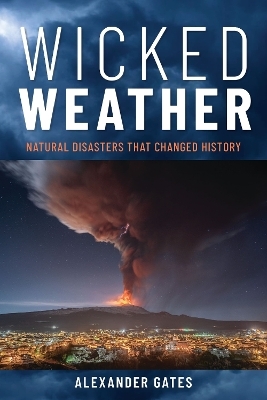
Wicked Weather
Natural Disasters that Changed History
Seiten
2026
Rowman & Littlefield (Verlag)
978-1-5381-9893-3 (ISBN)
Rowman & Littlefield (Verlag)
978-1-5381-9893-3 (ISBN)
- Noch nicht erschienen (ca. April 2026)
- Versandkostenfrei
- Auch auf Rechnung
- Artikel merken
Looks at the most significant natural disasters in Earth’s history and considers whether we can prevent them from happening again.
Natural disasters occur on a regular basis throughout the world with severe events occurring every few years or less. However, some natural disasters are so severe that they change human history—or at least contribute to changing it—by striking key locations and/or at key times to cause such drastic changes. Each disaster type impacts human settlements in different ways and can be local, affecting small countries or areas, or global, affecting the world. These disasters destabilized populations, the governments of provinces and countries, and drastically impact populations and the priorities of a nation in response to a natural disaster. In other words, they changed history.
In Wicked Weather, Alexander Gates explores these notable environmental disasters and their impacts, raising the question: What can we do to prevent this from happening again? After an introduction on why certain disasters occur most often in specific areas, Gates covers history’s most impactful volcanic eruptions, earthquakes, hurricanes/cyclones/typhoons, tornadoes, droughts, floods, and tsunamis. Each chapter investigates significant cases of each environmental disaster that shifted power in a region, caused wars, toppled governments, or changed policies and the way people approached life in these parts of the world.
Gates also examines the field of disaster management and the agencies that handle it—what can be done during, immediately after and well after a natural disaster and how society can respond and recover. The progression naturally depends on the type, location, and severity of the disaster. These progressions can lead to complete rebuilding of communities with safeguards to reduce the impact of the next disaster to complete abandonment of the location and every scenario between. Wicked Weather is a fascinating study of our worst disasters, a call to action as we face a dangerously changing climate, and a guide to limiting our susceptibility to the forces of nature.
Natural disasters occur on a regular basis throughout the world with severe events occurring every few years or less. However, some natural disasters are so severe that they change human history—or at least contribute to changing it—by striking key locations and/or at key times to cause such drastic changes. Each disaster type impacts human settlements in different ways and can be local, affecting small countries or areas, or global, affecting the world. These disasters destabilized populations, the governments of provinces and countries, and drastically impact populations and the priorities of a nation in response to a natural disaster. In other words, they changed history.
In Wicked Weather, Alexander Gates explores these notable environmental disasters and their impacts, raising the question: What can we do to prevent this from happening again? After an introduction on why certain disasters occur most often in specific areas, Gates covers history’s most impactful volcanic eruptions, earthquakes, hurricanes/cyclones/typhoons, tornadoes, droughts, floods, and tsunamis. Each chapter investigates significant cases of each environmental disaster that shifted power in a region, caused wars, toppled governments, or changed policies and the way people approached life in these parts of the world.
Gates also examines the field of disaster management and the agencies that handle it—what can be done during, immediately after and well after a natural disaster and how society can respond and recover. The progression naturally depends on the type, location, and severity of the disaster. These progressions can lead to complete rebuilding of communities with safeguards to reduce the impact of the next disaster to complete abandonment of the location and every scenario between. Wicked Weather is a fascinating study of our worst disasters, a call to action as we face a dangerously changing climate, and a guide to limiting our susceptibility to the forces of nature.
Alexander Gates is a distinguished service professor of Earth and environmental sciences at Rutgers University. He has published twelve books, including Reclaiming Our Planet. His work in geology, education and broadening participation in STEM has been recognized with 29 professional awards. Gates is a resident of New Jersey.
Chapter 1: What Are Natural Disasters?
Chapter 2: What Makes Natural Disasters Occur in Certain Areas?
Chapter 3: Volcanic Eruptions
Chapter 4: Earthquakes
Chapter 5: Hurricanes
Chapter 6: Tornadoes
Chapter 7: Tsunamis
Chapter 8: Droughts and Famines
Chapter 9: Floods
Chapter 10: Can It Happen Again?
Notes
Index
About the Author
| Erscheint lt. Verlag | 2.4.2026 |
|---|---|
| Sprache | englisch |
| Maße | 152 x 229 mm |
| Themenwelt | Naturwissenschaften ► Biologie ► Ökologie / Naturschutz |
| Technik ► Umwelttechnik / Biotechnologie | |
| ISBN-10 | 1-5381-9893-2 / 1538198932 |
| ISBN-13 | 978-1-5381-9893-3 / 9781538198933 |
| Zustand | Neuware |
| Informationen gemäß Produktsicherheitsverordnung (GPSR) | |
| Haben Sie eine Frage zum Produkt? |
Mehr entdecken
aus dem Bereich


aus dem Bereich
Methoden – Lösungen – Anwendungen
Buch | Hardcover (2025)
Hanser (Verlag)
CHF 69,95


